
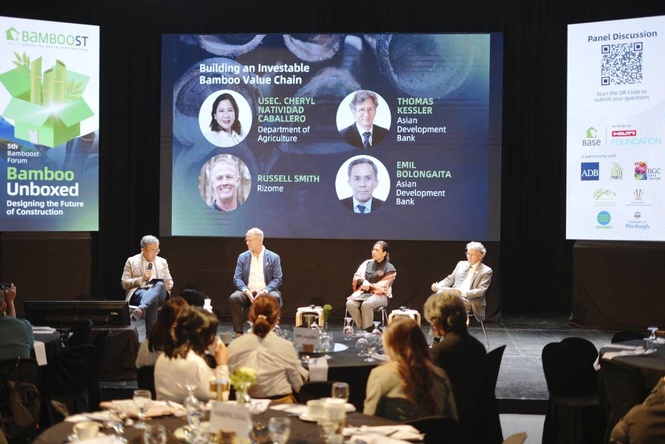
WHAT will it take to build and sustain a supply chain that will bring bamboo from the farmlands to the markets while attracting a continuous line of investment from the public and private sectors alike? That question was asked during the conference Bamboost V: “Bamboo Unboxed: Designing the Future of Construction,” which took place on Sept. 30. Hosted by the Base Bahay Foundation (BASE), a global leader in bamboo-based research and low-carbon building technology, the summit gathered engineers, architects and policy innovators to showcase how engineered bamboo systems are resisting climate disasters and revolutionizing sustainable urban architecture.
The question happened at an apt time. Only a day before, on Sept. 29, the House Committee on Agriculture and Food approved a substitute bill that intends to strengthen Republic Act 7900, or the High-Value Crops Development Act of 1995. The substitute bill recognizes bamboo as a high-value industrial crop that can be leveraged to establish a national framework that will directly link farmers to processors, businesses, companies and customers. Bamboo proponents welcomed this development, pointing to the potential of the plant to boost an industry, create a sustainable line of products, generate jobs, and bring in much revenue to the economy.
During one discussion, three panelists gave the elements essential for the creation of that supply chain: Continuous demand with support from both the public and the private sectors. The planting and nurturing of the right kind of seeds that can grow into healthy plants that can then be converted into quality materials. Finally, the involvement of the other stakeholders, including small businesses and processors who, according to one panelist, are often forgotten in planning. While acknowledging that bamboo is a “promising value chain that creates a development impact,” Thomas Kessler from the Asian Development Bank pointed out that an “investable value chain will require predictable returns and manageable risks. That is only possible when the players of the whole value chain are working together. Plantation without processors or processors without buyers” will not translate into any kind of sustainable business.
The economic sense
He stressed the business angle, saying that bamboo production must be “connected to a commercially viable value chain.” A deeper dive into the economics would mean answering the following questions: “What are the markets and the products that they want? Can those products compete on price, quality, and performance? What processing and manufacturing capacity is required to produce them? And then, given the species, quality, quantity and price of bamboo [that is being demanded], what does that require from our farmers?” Rizome Bamboo CEO Russell Smith agreed that bamboo growth has to “make economic sense” to the farmers if it is to scale. A “reliable supply of bamboo, the right species, quality, volume, and price” has to be present and guaranteed, especially if investors’ usual fear of uncertainty is to be addressed. Rizome is an industry pioneer, among the first in the country to produce a wide array of bamboo-building products like bamboo slats, veneers, and laminated strand lumber. Department of Agriculture Undersecretary Cheryl Natividad Caballero addressed the question of supply, saying that the government has been working with NGOs and the private sector to ensure that new seeds are being planted and grown. Through Project Sustainable Agroforestry Farm Enterprise (SAFE), community-based bamboo nurseries are being established to allow the local people themselves to produce the right species depending on the market requirements. One model consists of a 5-hectare farm with well-managed irrigation systems. Another partnership with the National Power Corp. has led to the opening up of thousands of hectares of watershed areas to a multi-cropping system, highlighting bamboo as the permanent crop. Undersecretary Caballero said that bamboo’s importance comes into play, especially with rising climate change impact. “It can become an alternative to steel for construction,” she said. Smith forecasted the future creation of bamboo buildings that can “lock” carbon in their frames. After more than 30 years since he co-founded his company, Smith remains optimistic about the evolution of bamboo as a crop and an industry. He mentioned the strides that had been taken from coming up with the first-ever singular “engineered bamboo beam that was production-ready at scale” to their current projects of building 23-meter spans of said beams. To date, their innovation involves working with other natural materials like tropical soft wood and coconut fiber to bring out bamboo’s best qualities, especially for architecture and construction. Smith said that he believed it is about time that “bamboo mania” captured the imagination of the public for the industry to scale. Coming full circle, Kessler said that while public intervention cannot replace capital, it can “create the conditions for private capital to come in.” He added, “Investors need confidence in the demand, operational standards, regulations, technology, execution, and cash. This is where public intervention matters. “