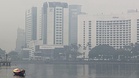
Kota Kinabalu: Luyang Assemblyman Samuel Wong has urged the Federal Government to establish a comprehensive, long-term bilateral framework with Indonesia to address recurring transboundary haze.
He said the issue should be treated primarily as a public health concern rather than a political matter, and that a more structured mechanism was needed to address forest and land fires that repeatedly affect the region.
“First and foremost, this is about the health and well-being of our people. Haze does not recognise borders, and when air quality deteriorates, ordinary Malaysians, especially children, the elderly and those with respiratory conditions, are directly affected.
“We should work closely with Indonesia in the spirit of cooperation and mutual respect. At the same time, we need a framework that allows both countries to respond faster and prevent the situation from recurring year after year,” he said in a statement.
Wong said the severity of the current fire season warranted greater urgency, noting that Indonesia had reported about 202,000 hectares of land burnt between January and July this year, with almost half of the area recorded in July alone.
He said authorities had also identified a significant number of hotspots across Kalimantan and Sumatra, while September remained a high-risk period due to continued dry conditions.
In Sabah, all six air quality monitoring stations recorded unhealthy Air Pollutant Index (API) readings on Sept 2, with Kota Kinabalu recording 172.
Sabah authorities had also said the haze was believed to have originated from forest and peatland fires in Kalimantan.
Wong said Malaysia should therefore work with Indonesia to establish a standing bilateral haze cooperation framework rather than relying mainly on ad hoc measures.
Among the measures he proposed was a permanent Malaysia-Indonesia mechanism involving relevant Federal and State agencies to coordinate prevention, monitoring and emergency response.
He also called for greater intelligence and information sharing, including hotspot and satellite data, fire locations, high-risk areas and concessions, while respecting the laws and jurisdictions of both countries.
He said stronger preventive measures were also needed to identify the causes of recurring fires, including suspected deliberate burning, illegal land clearing and fires occurring within commercial concession areas.
Closer enforcement cooperation should also be explored, he said, particularly to enable more efficient sharing of information and evidence relevant to cross-border impacts under the respective countries’ laws.
Wong also proposed exploring a rapid-response mechanism for major fires, including possible coordination of aerial firefighting resources such as water-bombing aircraft when fires reached a scale that could threaten neighbouring areas.
“Water-bombing aircraft cooperation is something that can be studied further. I am not suggesting that we immediately establish a new arrangement without examining the technical, legal and operational requirements.
“But when a major fire is burning close to our region and has the potential to affect millions of people, we should be open to every practical option that can improve the speed and effectiveness of our response,” he said.
However, Wong stressed that prevention must remain central to any long-term solution.
“If fires continue to occur almost every year, we need to look beyond putting out the fire after it has started. We need to strengthen prevention, early detection, land and peatland management, enforcement and accountability.
“A comprehensive mechanism should also provide a clear channel for both countries to raise concerns, exchange information and coordinate action before the situation becomes a regional health crisis,” he said.
Wong said the latest haze episode should be used to strengthen cooperation between Malaysia and Indonesia on an issue affecting both countries.
“But political will is important. We have dealt with transboundary haze for many years. If we continue responding only when the haze arrives, we will keep facing the same cycle.
“Now is the time to put in place a comprehensive, practical and lasting framework. For the health of our people in Sabah, Sarawak and Peninsular Malaysia, we cannot afford to wait before acting,” he said.