You're earning Malaysia's minimum wage of RM1,700 a month and you need a car to get to work. So you buy the cheapest new car you can find. Problem solved, right?
Not quite.
Once EPF, SOCSO and EIS deductions enter the picture, a Malaysian employee below 60 earning RM1,700 basic salary takes home roughly RM1,501 a month. And that's where the maths starts getting uncomfortable.
Because owning a car isn't just about squeezing a RM250 or RM300 monthly instalment into your budget. There's petrol, insurance, road tax, servicing, tyres, batteries and eventually repairs.
So instead of asking what car a bank might let someone earning RM1,700 finance, we're asking something more useful:
What car can you actually afford to own?
TL;DR RM1,700 gross salary leaves roughly RM1,501 take-home pay under our scenario. A new Axia E could consume around 36% of that after estimated running costs. A new automatic Axia G pushes our estimate to around 45%. A used car costs less to buy, but needs a bigger repair and maintenance buffer. If you genuinely need a car, consider "testing" the commitment first by saving RM500-RM600 monthly for six to 12 months to build a down payment and emergency buffer. First, How Much Of That RM1,700 Do You Actually Take Home?For this comparison, we're using a Malaysian employee below 60 earning exactly RM1,700 in basic salary, without overtime or additional allowances.
Monthly PayAmountGross salaryRM1,700.00EPF-RM187.00SOCSO-RM8.25EIS-RM3.30Estimated take-homeRM1,501.45That RM1,501.45 is the figure we'll use when looking at affordability. Everybody's finances are different, of course. Someone living with their parents will have a very different budget from someone paying rent or supporting a family.
So think of this as a baseline, not a declaration that everyone earning RM1,700 has exactly the same spending power.
This is probably the biggest trap when shopping for a car. A listing advertising "RM250/month" sounds manageable. But your car doesn't stop asking for money after the bank gets paid.
The Carz Real Cost Test Instalment + Fuel + Insurance & Road Tax + Maintenance + Wear & Repair ReserveWe're assuming around 1,000 km of driving per month, with fuel calculated using RON95 at RM1.99 per litre under BUDI95 for an eligible Malaysian.
Tolls and parking are excluded because those vary enormously depending on where you live and work.
All figures below are therefore budgeting estimates, not quotations or guaranteed ownership costs.
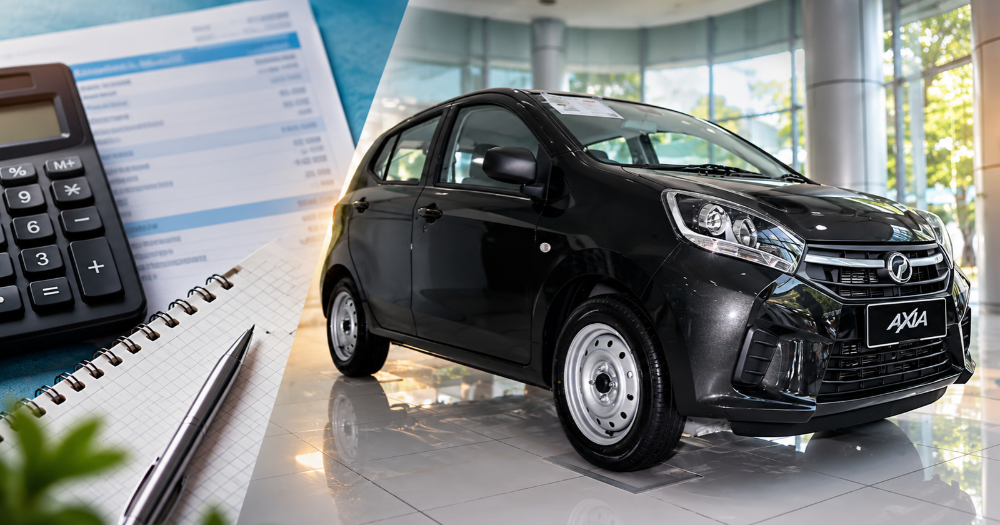
Option 1: Malaysia's Cheapest New Car, The Axia ELet's start at the bottom of the new-car market. The Perodua Axia E costs RM22,000, excluding insurance. Carz covered its launch back in 2023, when it arrived specifically as a more affordable entry point for Malaysian buyers.
There's a reason it's so cheap. This isn't the same Axia as the current D-CVT variants. The Axia E is based on the previous-generation model and comes exclusively with a five-speed manual gearbox.
For our calculation, we'll assume:
RM22,000 vehicle priceRM2,200 or 10% down paymentRM19,800 financed9-year loan3.5% illustrative flat interest rateThat works out to roughly RM241 per month.
Sounds pretty reasonable. But that's only the loan.
Estimated Monthly CostAxia EInstalment~RM241Fuel~RM100Insurance + road tax reserve~RM80Maintenance reserve~RM70Tyres/battery/wear reserve~RM50Estimated total~RM541/month Axia E Estimated Car Budget ~RM541/Month That's around 36% of RM1,501 take-home pay.And remember, we're still missing parking and tolls. You also need to eat, pay bills, possibly pay rent, build emergency savings and, well, live.
What If You Need An Automatic?Here's where things get considerably harder. Following Perodua's August 2026 price revision, the current Axia 1.0 G D-CVT costs RM33,900, excluding insurance. Carz recently compared the newly priced Axia directly against the Proton Saga.
Using the same 10% down payment, nine-year tenure and illustrative 3.5% flat interest rate gives us roughly RM360 per month.
Again, that's only the loan.
Estimated Monthly CostAxia GInstalment~RM360Fuel~RM100Insurance + road tax reserve~RM100Maintenance reserve~RM70Tyres/battery/wear reserve~RM50Estimated total~RM680/month Almost half your take-home pay: Our estimated RM680 monthly car budget represents roughly 45% of RM1,501 take-home pay, before parking and tolls.Would a lender necessarily use our calculation when deciding whether to approve you? No.
But being eligible for a loan and being comfortable owning the car are two very different things.
If you're deciding between Malaysia's mainstream budget models generally, Carz has also compared the Saga, Bezza and Axia as sub-RM50,000 budget cars, including the ownership costs beyond their sticker prices.
New Axia E Vs Axia G: The Numbers At A GlanceOur ScenarioAxia EAxia GPriceRM22,000RM33,900Transmission5MTD-CVTEstimated instalment~RM241~RM360Estimated total monthly car budget~RM541~RM680Share of take-home pay~36%~45%So... Just Buy Used?That's the obvious alternative. And yes, the used market can dramatically reduce what you need to spend on the car itself.
At the time of writing, CariCarz used-car listings show automatic Proton Sagas around the low-to-mid RM10,000 range, while older automatic Axias can also be found around the mid-teens depending on year, mileage and condition.
For example, during our research we found a 2018 Proton Saga 1.3 Executive automatic advertised at RM13,800. Its CariCarz financing calculator illustrated approximately RM246 per month over five years, based on 90% financing at 3.8%.
That's considerably cheaper than financing a new Axia G. But there's another catch...
Cheap Used Cars Still Need MoneyAn older car deserves a bigger maintenance and repair buffer. Using that roughly RM14,000 Saga as an example:
Estimated Monthly CostUsed SagaInstalment~RM250Fuel~RM120Insurance + road tax reserve~RM70Routine maintenance~RM80Repair/wear reserve~RM100Estimated total~RM620/monthThat's still roughly 41% of RM1,501 take-home pay.
A RM10,000 car that immediately needs tyres, suspension work and an air-conditioning repair can quickly become more painful than its purchase price suggests.
A Used Axia May Be The Better CompromiseIf owning a car is genuinely unavoidable, we'd be more interested in a well-maintained used Axia than simply hunting for the cheapest car available.
During our research, CariCarz had older automatic Axias advertised around the mid-RM10,000 range, including a 2016 Axia G automatic at RM14,700.
The appeal is straightforward: automatic transmission, small 1.0-litre engine, low road tax and a common Malaysian model, without taking on the RM33,900 purchase price of a new Axia G.
Buying Used On A Tight Budget? Don't Skip These ✓ Check the car's condition ✓ Check its service history ✓ Get the car inspected where possible ✓ Keep money aside for repairs ✓ Don't judge affordability from the advertised instalment aloneThe examples in this article are snapshots of asking prices available during our research. They're not endorsements of individual vehicles, and financing availability or rates can differ from the illustrative figures shown.
What About Buying An Old Car With Cash?This could actually be the cheapest route over the long term because removing the loan makes a big difference to monthly cash flow.
But there's an obvious problem: someone taking home RM1,501 a month may not have RM10,000 sitting around.
And if you do have RM10,000 saved, spending almost all of it on an old car could leave you with nothing when the car needs repairs or life throws something else at you.
Our rule of thumb here: A cash car only makes financial sense if buying it doesn't wipe out the savings you may need for emergencies and repairs.Cheap transportation isn't very cheap when one breakdown sends you into debt.
But What If You Really Need A Car?Sometimes, not buying a car isn't realistic.
You might work somewhere with poor public transport, travel odd hours, or simply need your own transport to keep earning an income.
If that's your situation, we'd suggest preparing for the cost before committing to the loan.
Try This Before Buying Save RM500-RM600 Every Month First That's roughly what our examples suggest car ownership could consume each month. If you can consistently put that amount aside while still covering your essentials, you'll get a much better idea of whether your budget can handle a car.There's another benefit: you're building up cash at the same time.
Save RM500 a month for six months and you'll have RM3,000. Keep it going for a year and that's RM6,000.
At RM600 a month, you're looking at RM3,600 after six months or RM7,200 after a year.
That money can put you in a much healthier position when it's finally time to buy.
Save Each MonthAfter 6 MonthsAfter 12 MonthsRM500RM3,000RM6,000RM600RM3,600RM7,200Don't Put All Of It Into The Down PaymentThis part is important.
If you've managed to save RM6,000, we'd be cautious about throwing the entire RM6,000 at the car just to reduce the loan.
You still need a financial buffer for things the monthly instalment doesn't cover.
For a used car especially, that could mean servicing immediately after purchase, replacing worn tyres or a battery, fixing something the previous owner neglected, or simply having money available if the car unexpectedly needs repairs.
Think In Two Pots Pot 1: Down payment and initial car expenses Pot 2: Emergency and repair bufferThe exact split depends on the car and your circumstances, but the principle is simple: don't become a car owner with RM0 left in the bank.
And if you try saving RM500-RM600 every month but repeatedly need to dip into that money just to cover food, rent, bills or other essentials, that's useful information too.
It may be telling you that taking on a RM500-RM600 monthly car burden right now would leave your budget too exposed.
On the other hand, if you can sustain the saving habit for six to 12 months, you'll enter car ownership with a down payment, some emergency protection and proof that your monthly budget can actually absorb something close to the cost of owning one.
So What Car Should You Buy On RM1,700?After doing the maths, our answer isn't particularly glamorous:
Carz Verdict On RM1,700, we'd prioritise preparation over rushing into a new-car loan. If you genuinely need a car, a carefully chosen used model may make more sense once you've built a down payment and emergency buffer.The RM22,000 Axia E comes closest, particularly if you can drive manual, already have the down payment, don't travel far and have relatively few other financial commitments.
Even then, our illustrative budget puts total car expenses at roughly 36% of take-home pay. Need an automatic? A new Axia G pushes our estimate to around 45%.
If a car is absolutely necessary for earning your living, a modest, well-maintained used car with manageable financing is probably the least painful route. A used Axia is where we'd start looking, but condition and maintenance history matter more than simply finding the lowest price.
If you don't absolutely need a car yet, keeping that RM500 or RM600 in your pocket each month and building your savings may be the better deal.
Because when you're earning RM1,700, the question isn't really whether you can make the monthly instalment. It's whether you can still afford everything else after you do.
FAQCan I buy a car with a RM1,700 salary?Possibly, depending on your loan eligibility, down payment and other financial commitments. But our calculations show that being able to finance a car doesn't necessarily make it comfortable to own on RM1,700.
What is the cheapest new car in Malaysia?The Perodua Axia E is priced at RM22,000 without insurance. It uses the previous-generation Axia platform and comes with a five-speed manual transmission.
Is a used car better on a RM1,700 salary?It can lower the purchase price and monthly instalment, but older cars require a larger maintenance and repair buffer. Condition and service history are especially important when your monthly budget is tight.
Should I buy an old car with cash instead?It can reduce your monthly commitments, but only if the purchase doesn't wipe out the savings you'll need for emergencies and unexpected repairs.
How we calculated this: Figures are illustrative estimates based on the assumptions stated in the article and information available at the time of writing. Actual financing rates, insurance premiums, fuel consumption, maintenance costs and vehicle condition will vary. Used-car listings and asking prices may also change or be removed after publication.