
The National Women’s Survey 2025/2026, published by Suluh Centre, found that 62.7% of respondents considered women underrepresented in the country’s legislatures, while only 17.1% believed current representation was adequate.
KUALA LUMPUR: Nearly two-thirds of women surveyed nationwide believe women remain underrepresented in Parliament and state assemblies, with family commitments and caregiving responsibilities identified as the biggest barrier to greater political participation.
The National Women’s Survey 2025/2026, published by Suluh Centre, found that 62.7% of respondents considered women underrepresented in the country’s legislatures, while only 17.1% believed current representation was adequate.
The survey gathered responses from 1,030 women across Malaysia between December 2025 and June 2026, supplemented by focus group discussions and community sessions involving another 270 women.
On women’s political leadership, 55.2% of respondents said women needed more opportunities to demonstrate their capabilities, while 31.2% said women were as competent as male leaders.
Family commitments and the double burden of caregiving were cited by 45.8% of respondents as the main obstacle to women’s political participation.
This was followed by what respondents described as a harsh and masculine political culture, at 33.3%, and limited access to information and early support, at 19.1%.
Suluh Centre executive director and report lead author Nadia Nazri said the findings showed that women were more concerned about practical barriers than proving their capabilities.
“The women in this survey are not asking to be told they are capable. They are telling us what stands in the way, and it is time,” she said.
Nazri said care responsibilities that affected women’s participation in the workforce could also prevent them from taking part in community leadership and politics.
“That makes childcare and eldercare part of the country’s economic infrastructure, not a family matter,” she said.
The survey also identified the rising cost of living as the issue having the greatest personal impact on respondents, with 54.2% citing it.
This was more than twice the proportion who identified job opportunities and salaries, at 25.1%, and almost three times the proportion who cited household debt and financial commitments, at 18.8%.
The report also found a gap between awareness of government assistance programmes and the ability to access them.
Some 58.9% of respondents said they had heard of government programmes for women but did not know how to apply, while 22.5% said the information was inaccessible or too difficult to understand.
Only 18.5% said they knew how to apply for assistance and had successfully done so.
Suluh Centre stressed that the figures did not indicate that respondents had been denied assistance or that their applications had failed, but reflected the proportion who had information they considered clear enough to act on.
Social media was the main source of news for 79.9% of respondents, compared with 12.9% who mainly relied on television, radio and newspapers.
TikTok was the most commonly selected platform, at 52.2%, while 95.1% identified WhatsApp as their main messaging application.
The report recommended several measures aimed at improving women’s participation and access to support.
These include legislating a proposed minimum 30% requirement for women candidates, with a clear implementation timetable, as recommended by the Parliamentary Special Select Committee in June.
The report also called for a mandatory protection review before every seven-day Emergency Protection Order expires, to ensure survivors of domestic violence are not left without protection while an Interim Protection Order is being prepared.
Other recommendations include piloting six days of paid childcare leave for each parent through government-linked companies before considering amendments to the Employment Act, and establishing a community caregiver formalisation programme to train and certify informal caregivers.
The programme, according to the report, could help expand affordable childcare in underserved communities while improving care standards and safety.
“Malaysia is not short of laws and programmes for women. What the survey shows is the distance between what exists on paper and what a woman can actually use,” Nazri said.
“Our recommendations are mostly about making existing rights work.”
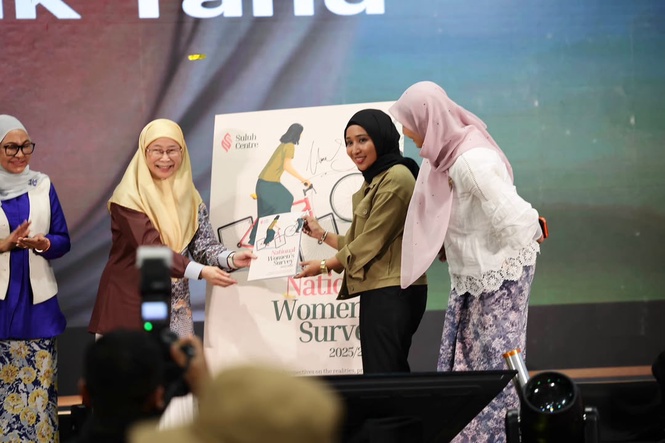
The report was launched at Kompleks Sukan Bandar Tun Razak by former deputy prime minister and Bandar Tun Razak MP Datuk Seri Dr Wan Azizah Wan Ismail, following the graduation of more than 300 women who completed Suluh Centre’s year-long Wanita Mendunia leadership programme.
The graduates are expected to return to their hometowns and communities to contribute to local initiatives and change.
The survey was designed and conducted by POLITY under the leadership of its chairperson Nurul Izzah Anwar. POLITY subsequently became Suluh Centre during the preparation of the report, under whose name the findings were published.