
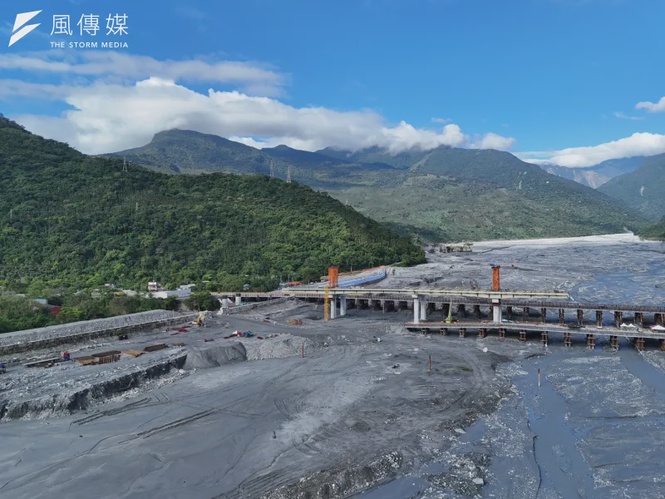
A year after a barrier lake on Matai'an Creek gave way and pushed black silt through Guangfu Township, the mud is out of Hualien's houses, classrooms and rice fields. It is not out of the township.
The spoil now sits in long mounds near Dajin Road along Provincial Highway 9, at Atomo on the creek's southern bank and around Fenglin to the north. One mound beside the highway runs close to a kilometer, stands four to five stories high and measures about 50 meters across. Seen from a distance, the blue tarpaulins stretched over it look like two enormous blue serpents laid out along the floor of the East Rift Valley.
Where the tarpaulins do not reach, the sun bakes the fine silt into dust. It drifts into houses and classrooms, so teachers keep windows shut on warm days. A car washed on a Monday wears a gray film by Wednesday. When light rain falls, it lands as something closer to mud than water.
Roads have reopened and schools are back in session, which is the version of Guangfu that appears in official progress reports. The version residents live in is still provisional, and it has been held together mostly by money that no government appropriated.
Donations Fed Students While Budgets Waited
The pattern is consistent enough to be embarrassing. Small farmers who lost machinery and whose fields disappeared under heavy sediment got back to planting because companies, religious groups and civic organizations cleared the land and supplied equipment.
The baseball field at Guangfu Junior High School was swallowed by the mudflow. Donors, charities and people from Taiwan's baseball community graded the ground, laid new infield clay, strung netting and replaced the gear. The team was training again in a little over a month.
At Guangfu Commercial and Industrial Vocational High School, outside support restored the auto-repair workshops and other practical training spaces so students could keep taking hands-on classes. Even meals came from outside the budget. In the first weeks after the flood, people from other parts of Taiwan drove in boxed lunches for two weeks. After that the school drew on public donations to cover lunch for every student and breakfast and dinner for boarders, spending more than NT$2 million by the end of June this year. Housing, uniforms and daily necessities for the poorest students were paid for the same way.
Private relief moved quickly because it answered the need in front of it. Children had no food, so food arrived. A field was destroyed, so it was made playable. Machinery was gone, so machinery was found. Public works, by contrast, must pass through planning, design, public notice, tendering, construction and inspection. Every one of those stages exists for a defensible reason. Stacked end to end, they produce a year of waiting.
Procurement Rules Left Schools Bidding Alone
Public money should be scrutinized, and large budgets should be tendered openly. None of that explains what happened in Guangfu.
The government knew from the first week that a disaster of this size would generate an enormous volume of construction work in a small area, and that contractors, skilled labor and heavy machinery would be scarce. That was the moment to authorize special disaster-zone procurement, to bundle tenders across sites and to move crews in from other regions. Instead, each school and each agency was left to bid on its own timetable and to absorb its own failed tenders. The cost of an inflexible system was passed to the people least able to carry it.
Distrust Between Taipei And Hualien Raises Every Cost
Reconstruction in Guangfu also runs across a political fault line. The central government and the Hualien County government belong to opposing parties, and the working relationship between them has been short on trust for years.
The division of labor makes that expensive. River management on Matai'an Creek is a central responsibility. Drainage, ditches and local facilities inside the township fall to the county government and the township office. Some campus reconstruction money comes from the Ministry of Education and the Ministry of Sports, and some of it can only be spent through Hualien County. Moving the spoil involves public works agencies, environmental regulators and river authorities at once. No single body can finish the job, and any one of them can stall it.
There is not yet enough evidence to pin a specific delay on partisan conflict. There does not need to be. Distrust raises the cost of every conversation, every decision and every handoff. The central government says the funding is approved. The county says the work must follow the law. The county asks Taipei for help. Taipei asks for a complete plan. Each agency can document what it did, and no one is accountable for the result.
Rivers do not recognize jurisdictional boundaries, and floodwater does not sort itself by party color. A government that cannot cross a partisan line has no standing to ask disaster victims for indefinite resilience.
The Executive Yuan and the Hualien County government should establish a joint reconstruction platform with real decision-making authority, seating the central government, the county, the township office and the affected communities at the same table. Every outstanding item should carry a named responsible agency, a deadline and a stated reason for any delay. Interagency disputes should be settled within a fixed period rather than circulated as paperwork. Both sides should publish progress against one shared set of indicators, so neither can choose the flattering numbers.
Guangfu's Dust Is Now A Public Health Problem
Governments like to describe recovery in approved budgets, contracts awarded and completion rates. Residents are asking different questions. How many families are still in temporary housing? How much farmland cannot be planted? When does the central kitchen reopen? When does the spoil actually go somewhere? Will the drainage system hold through the next heavy rain? And what is a year of airborne silt doing to the people breathing it?
A construction completion rate is not a recovery rate. What Guangfu needs is a single published timetable covering housing, farmland, spoil disposal, campus works, air quality, health monitoring and the return of local industry, each line with a deadline and an agency attached to it.
The dust in particular has crossed from nuisance into public health. Long-term air quality monitoring should be installed, with particulate readings and dust composition made public, and health tracking offered to residents, students and the cleanup crews who worked in it longest. Exposed spoil should be covered, watered and planted to hold it down. If respiratory illness surfaces in Guangfu a decade from now and the government only then begins studying the risk, an entire generation will pay for the delay.
Goodwill Cannot Be Counted As Government Performance
Taiwan's most admired quality is the willingness of ordinary people to catch one another. Guangfu proved it again, from the volunteers known here as the shovel superheroes to the corporate donors, the university alumni who rebuilt a baseball field and the strangers who showed up with lunch.
But a government cannot enter a volunteer miracle on its own ledger. Principals raising money, companies adopting schools and residents rescuing themselves cannot become the standing model for disaster governance. Private generosity is built for emergencies. Long-term reconstruction is what institutions are for.
The people of Guangfu have already shown they can stand up. What is being tested now is whether the state can finish the work no volunteer can do, after the donations dry up, the volunteers go home and the cameras move to the next story.
Taiwanese goodwill bought the government a year. It should not be asked to underwrite a second one. A state that leans on that goodwill to patch the holes in its own machinery will find that even the most moving story eventually reads as an indictment.