
FEW bilateral relationships carry as much shared history and as much unresolved friction, as the one between Malaysia and Singapore.
Separated in 1965 after a brief and difficult merger, the two countries have spent six decades learning to be close neighbours rather than one nation. That history still surfaces in old disputes over water pricing, airspace and land reclamation.
But it is increasingly being overshadowed by a more practical question: How much closer can two deeply intertwined economies become and what should that closeness look like?
The clearest answer so far is the Johor-Singapore Special Economic Zone (JS-SEZ), signed by Prime Ministers Datuk Seri Anwar Ibrahim and Lawrence Wong in January 2025.
Spanning more than 3,500 sq km of southern Johor, an area comparable to Shenzhen and Hong Kong combined, the zone offers reduced corporate tax rates, concessionary income tax for skilled workers and streamlined cross-border approvals through a joint facilitation centre.
It is a rare example of two sovereign states agreeing to blur an economic border for mutual benefit rather than compete across it.
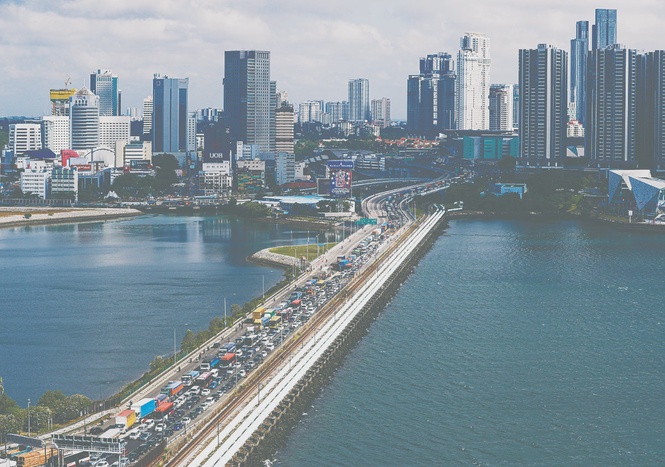
Alongside it, the Rapid Transit System Link connecting Johor Bahru and Woodlands is expected to begin operations by the end of 2026, cutting a commute that can take over an hour in causeway traffic down to about six minutes by rail.
These projects matter because they force both governments to solve the unglamorous problems that have lingered for years: customs friction, work-pass mismatches, land use disputes and the sheer congestion of the world’s busiest land border crossing.
During Singapore President Tharman Shanmugaratnam’s state visit to Malaysia this July, both sides described progress in resolving several long-standing bilateral issues through what officials called constructive negotiation guided by mutual respect.
That language matters less than the outcome but it signals a relationship trying to manage its irritants quietly rather than let them dominate the headlines, as they periodically have in the past.
The economic logic behind this convergence is straightforward. Singapore is running out of land to expand its manufacturing and logistics base while Johor has space, a lower cost structure and a young, increasingly skilled workforce.
Malaysia gains investment, jobs and technology transfer; Singapore gains room to grow without abandoning its home market. Neither side needs to pretend this is charity. It is mutual self-interest, which tends to be a far sturdier foundation for cooperation than sentiment alone.
Yet, the way forward is not without risk. Johor officials have acknowledged concerns about checkpoint congestion and the availability of skilled labour, while the JS-SEZ’s detailed master plan has taken longer to emerge than originally promised. The government now expects it to be formally launched in December 2026.
There is also a structural imbalance to manage carefully: if Johor becomes simply a low-cost extension of Singapore’s economy without corresponding gains in wages, skills and local ownership, the partnership will breed resentment rather than shared prosperity.
Malaysia needs to negotiate not just for investment volume but also for the quality and permanence of what that investment leaves behind.
There is also a generational opportunity being underused. Younger Malaysians and Singaporeans increasingly move for work, study and family across a border their grandparents once crossed without a passport.
Deeper cooperation on education, healthcare access and talent mobility, beyond the flagship economic zone, would do more to entrench durable goodwill between the two societies than any single infrastructure project.
Malaysia and Singapore do not need to resolve every historical grievance to move forward together. What they need is what both governments now appear to be building: a habit of treating disagreements as manageable and cooperation as the default.
If the JS-SEZ and the RTS Link are delivered with the same discipline with which they were negotiated, they could mark the point where the relationship stopped being defined by its separation in 1965 and started being defined by what two ambitious, complementary economies chose to build together.
Nevhan Phrassantha Naidu Puspakarsn is a graduate of the National Defence University of Malaysia, holding a Bachelor’s degree in International Relations (Diplomacy and International Security). Comments: letters@thesundaily.com.my