
When a single mother stood in front of a wet market window in Ampang, her eyes couldn't be separated from the price tag: "Chicken RM 8.90/kg". He took a deep breath. In his mind was the broadcast of the presentation of the state budget, when the Prime Minister said that the float of chicken prices would "save RM1 billion" and keep chicken prices under control. But what does it mean for him who must split his salary to buy side dishes every week?
Behind the jargon of "floating" and "price control" lies the great promise as well as the hidden risks. In this article, we will explore how the policy came about, the extent of its effect on the market and the pockets of the people, and whether the "RM1 billion austerity" has really turned into a tangible benefit or just a new rhetoric in Malaysia's economic drama.
"Price liberalization for chicken" is a term that is suddenly often used in the presentation of the 2026 Budget. Through this flotation, the government switches from direct price intervention or subsidies that set a certain price, to a freer market mechanism but still accompanied by "control" or limited intervention so that prices do not soar wildly.
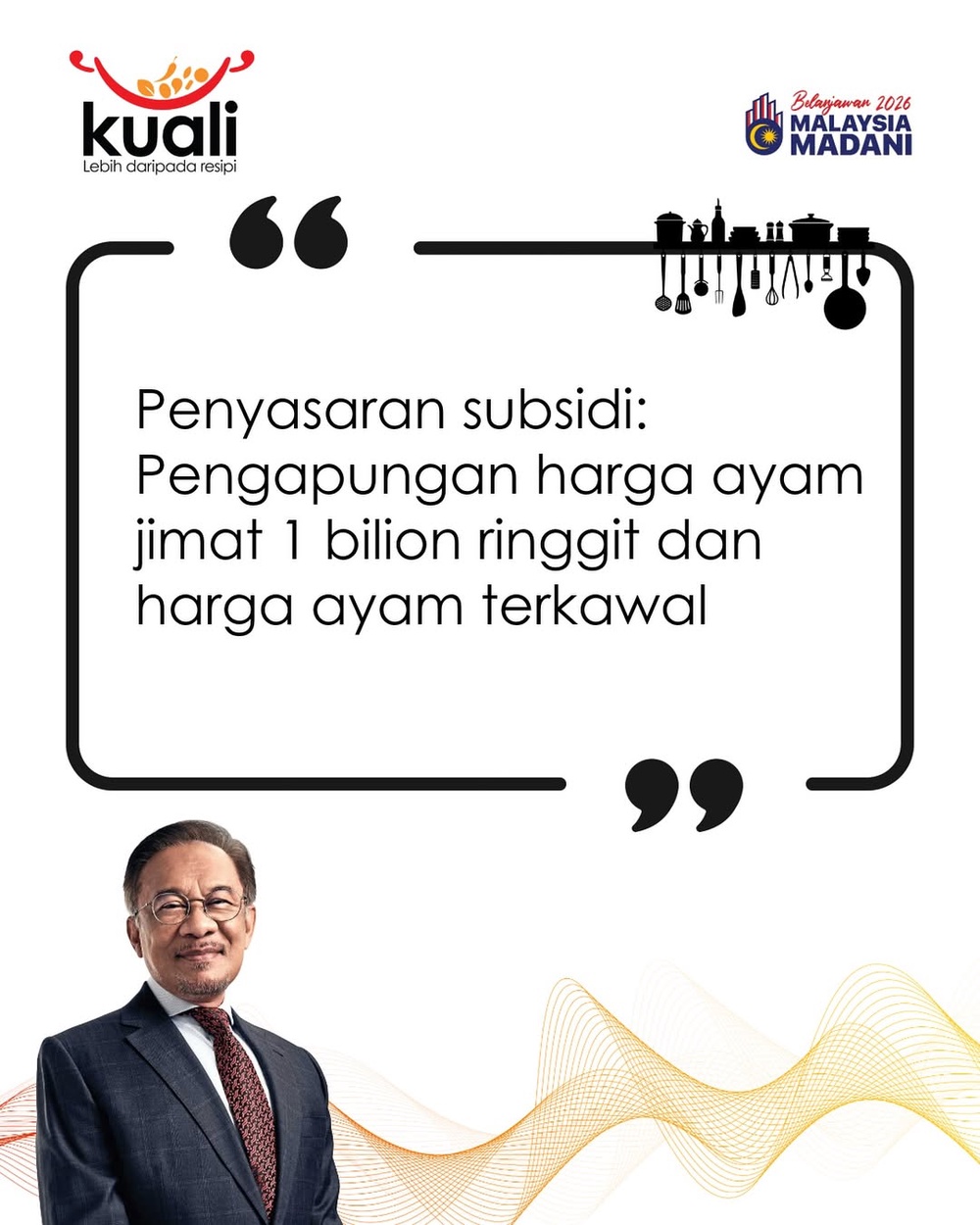
In the context of Budget 2026, Prime Minister Datuk Seri Anwar Ibrahim said that through the floating of chicken and egg prices, the government has managed to save RM1 billion for each of these commodities. This means that the float of chicken prices is claimed to be one of the measures to save massive subsidies. the Battle of the Bulge Chicken price float saving RM1 billion and chicken prices under control") (SuaraTV)
"Controlled" chicken prices are a password that, even if prices are allowed to move more freely, the government will put limits, supervision, and intervention so that prices do not rise too extreme or unfairly. The main task of supervisory boards such as MyCC (Malaysian Competition Commission) is crucial here. (Astro Awani)
This step did not appear suddenly. Malaysia has been facing a large burden of subsidies and fiscal challenges. In Budget 2026, the government claimed that the targeted subsidy program is expected to save a total of RM15.5 billion a year where floating chicken and egg prices each contributed RM1 billion in savings. (MalaysiaGazette) With the reduction in direct intervention, the government hopes that the remaining funds can be diverted to social programs, infrastructure, or the productive sector.
But on the one hand, the government realizes that the chicken market is very sensitive to feeding prices, logistics, poultry diseases, and global fluctuations can shake price stability. Therefore, flotation does not mean releasing everything to the market alone but maintaining a balance between fiscal relief and people's capabilities.
According to media reports, MyCC stated that the supply of chicken in the market was not disrupted immediately after the removal of the chicken subsidy and flotation, and the price of chicken in the retail sector for the first two days was in the range of RM6.49 to RM11.00 per kilogramme. (Astro Awani) MyCC also announced that it has not received any significant complaints regarding scarcity or noticeable price spikes.
This statement of market watchers is an important point: if the market is able to survive the initial phase of liberalization, then the flotation move can be shown as "safe". However, the price range is still very wide at RM6.49 to RM11.00, indicating that the price variation in the local market is highly dependent on location, business scale, and distribution margin.
Local governments and local entities often claim that chicken prices are still under control. For example, the Putrajaya Corporation stated that "chicken prices are still stable, supply is sufficient and under control." (ppj.gov.my) In a social media campaign, authorities also highlighted that the float in chicken prices has helped to reduce the burden of subsidies and the flow of people's pockets. (Instagram)
But what needs to be looked at: does that stability apply across the country from big cities to remote villages? Can small traders in faraway areas still sell at a decent margin without raising prices to consumers?
Some small traders and breeders said that the rising cost of feed, DOC (Day-Old Chick) chicken, transportation, and labor wages remain a big pressure. If the margin gets thinner, they may raise the price little by little to keep the business afloat. In rural areas, logistics costs can add a higher burden than urban markets, so "controlled prices" can feel far removed from the local reality.
In addition, the patronage of the distribution chain and the power of wholesalers could affect how these policies translate to prices in local storefronts. When one large distributor controls the market in a particular region, there is room for a covert margin game that is difficult to oversee.
For ordinary consumers, especially low-income groups, the floating of chicken prices and targeted subsidies give hope that prices do not rise dramatically, and that "more targeted" subsidies can help burden them proportionately. But when the price of chicken in the market rises beyond their purchasing power segment, the immediate effect is felt as the cost of side dishes increases, consumption patterns are corrected, and household inflation pressures increase.
Meanwhile, small farmers could feel another effect: they may lose the certainty of the minimum price that was once guaranteed by subsidies or interventions. If the market fluctuates, farmers must bear the risk of prices falling or production costs increasing. Without an adequate safety net, they could be pushed out of business or sell less or even stop their business.
In big cities, modern markets and supermarkets can adjust supply chains more quickly, so prices may be more stable. But in remote villages or remote areas, traders and consumers may have to face higher prices due to transportation costs and high distribution margins. In other words, "controlled prices" can feel like "high local prices".
For the government, asserting that chicken flotation "saves RM1 billion" is a narrative that reinforces that subsidy policies must not be forever out of control. But criticism could potentially arise: is this genuine austerity for the people, or cuts to subsidies and protections for the more vulnerable groups?
Some opposition parties or economic observers may view this move as a hidden tax on the people, wrapped up as an efficiency reform policy. If the price of chicken is controlled only in the city market, while in the outer areas it soars, then the claim of stability becomes fragile in the eyes of many citizens.
For the flotation to be successful without harming the people, supervisory agencies such as MyCC and the Ministry of Domestic Trade & Kos Sara Hidup (KPDN) must play a crucial role. MyCC has stated that it will continue to monitor the existence of anti-competition actors (cartels) or price manipulation after the liberalization of chickens. (Astro Awani)
The function of inspections, distribution chain audits, and consumer complaint mechanisms are the backbone of control so that prices do not shoot out of control.
The government must design a targeted subsidy scheme that is transparent, targeted, and flexible. If the price of chicken rises in certain areas, there is a mechanism for distributing complementary assistance or subsidies so as not to burden consumers. Coupon or direct cash subsidy models can be used to accommodate local vulnerabilities.
One of the prevalent weaknesses in the food sector is the lack of open supply chain data (inputs, distribution costs, merchant margins). To keep flotation from becoming a door for exploitation, the government and stakeholders must open data on production prices, distribution costs per region, and traders' reasonable margins. With open data, the public and the media can check whether "controlled prices" are really maintained.
The flotation step should be accompanied by periodic evaluations, for example every quarter to see if prices are relatively stable, subsidies are on target, and farmers can still survive. If there are local distortions, the government must quickly take corrective measures: for example, channeling additional local subsidies, making temporary interventions, or permitting limited price fixing in certain zones.
AM World (tameer.work88@gmail.com) is a content creator under the Newswav Creator programme, where you get to express yourself, be a citizen journalist, and at the same time monetize your content & reach millions of users on Newswav. Log in to creator.newswav.com and become a Newswav Creator now!
The User Content (as defined on Newswav Terms of Use) above including the views expressed and media (pictures, videos, citations etc) were submitted & posted by the author. Newswav is solely an aggregation platform that hosts the User Content. If you have any questions about the content, copyright or other issues of the work, please contact creator@newswav.com.