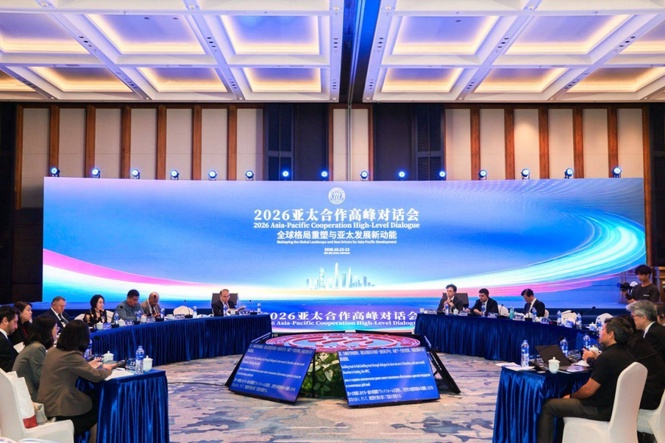
SHENZHEN — As China prepares to host the Asia-Pacific Economic Cooperation (APEC) meetings, a high-level dialogue was held here to focus on the priority areas for cooperation between China and APEC member countries.
The dialogue, organized by the Shenzhen Research Institute of Renmin University of China (RUC), featured discussions on China's modernization, integration among Asia-Pacific economies, and artificial intelligence.
The APEC summit is set to be held here on November 18-19, 2026.
The dialogue also aimed to contribute to building a stable, open, interconnected, inclusive and cooperative Asia–Pacific region.
In his speech, Zhang Donggang, secretary of the Communist Party of China committee at RUC, said Asia-Pacific is an "important growth pole of the world economy."
He said that higher education, which is at the intersection of education, science and technology and talent development, "should enable independent talent cultivation, independent knowledge and innovation, and independent scientific and technological development, so as to provide lasting support for Asia-Pacific development."
"We should share opportunities through opening up, pursue development through innovation, and build a future through cooperation, so as to contribute more wisdom and strength to building a community with a shared future for the Asia-Pacific and for mankind," Zhang said.
Vice Minister of the Publicity Department of the Shenzhen Municipal Party Committee, Zeng Xianglai, said that openness and innovation was among the main drivers that pushed high-quality development in the city.
"We will transform Shenzhen’s dynamic pilot initiatives into living examples that can serve as references for the Asia–Pacific region, join the APEC summit, discuss major strategies for Asia–Pacific cooperation, and jointly write a new chapter of mutual benefit and collaborative development across the region," Zeng said.
The event was held in Bao'an district, one of the nine districts of the city and its most important hub as it houses the Shenzhen Special Economic Zone and the Shenzhen Bao'an International Airport, the city's main gateway to the world.
Chen Weiwen, a member of the Shenzhen Bao'an District Party Committee, said that the partnership between the district and RUC aims to position it as a key gateway connecting high-end academic and industrial resources in China and abroad.
During the event, a report by RUC that highlighted the challenges of the region, the transformation of APEC, and the position of China, authored by Wang Wen, Director of the Global Leadership Institute at Renmin University of China, was launched.
Wang said that while cooperation in the region has deepened after the Asia-Pacific Community was proposed in 2008, structural challenges remain, including geographical space, economic systems, institutional rules, and socio–cultural factors.
"China should play an active role in areas such as ideological guidance, humanistic exchange, interconnectivity, and shared public sentiment, thereby helping to deepen and strengthen the development of the Asia–Pacific community," Wang said.
The first roundtable focused on new pathways for Asia-Pacific economic integration. Participants from Chile, Mexico, Papua New Guinea and Russia shared experiences and insights on interconnectivity and how APEC should focus on developing regional areas.
The second rountable addressed issues on governance and cooperation, where participants from Japan, South Korea, Russia, and Vietnam explained how the region should define their roles while also strengthening mechanisms such as voluntary participation, consensus and non-binding cooperation and gradually expand into an important platform for regional coordinated governance.
Artificial intelligence was the central point in the third roundtable, where participants from Malaysia. Taiwan and Thailand highlighted how AI should be harnessed while addressing possible regulations to prevent its misuse.