
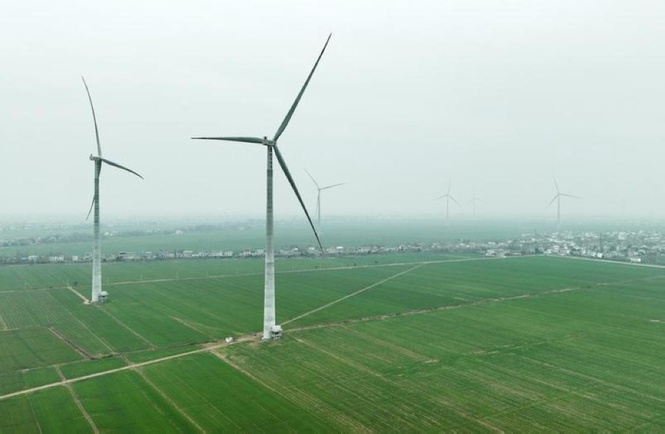
NANCHANG — A quiet transition is sweeping across factories in China, the “workshop of the world,” as industrial sites embrace green technologies and sustainable practices.
At the China Resources (CR) Jiangzhong Pharmaceutical Valley in Nanchang, capital of east China’s Jiangxi province, the scene could easily be mistaken for a nature reserve rather than a pharmaceutical manufacturing hub.
Forests and lakes occupy three-quarters of the 133-hectare site. Downstream of a seven-tiered rolling dam, treated wastewater runs crystal clear, while Chinese mergansers, a species under second-class national protection, paddle leisurely across the water.
“After treatment, wastewater can be directly used for irrigation or firefighting,” said Zhong Zhijian, general manager of the CR Jiangzhong Wanli Manufacturing Base.
The site epitomizes the broader shift in China’s industrial landscape from energy-intensive, heavily polluting operations toward green, low-carbon and circular development.
Once emblematic of industrial pollution, sectors like steel and cement are at the forefront of China’s green shift.
Fangda Special Steel in Nanchang has transformed its 220-hectare plant into a site with green coverage amounting to 39 percent and 30,000 square meters of landscaped water. It is the first steel company in Jiangxi province to get a national 4A-level tourist attraction rating, according to Zhang Yulong, chief engineer of Fangda Special Steel’s environmental management department.
Yet 17 years ago, this site was a typical old industrial zone, dust-laden with aging equipment. The turning point came in 2009, when a series of energy conservation and emission reduction projects were launched following corporate restructuring. In 2018, the company reinvested heavily in ecological restoration.
Nationwide, China’s manufacturing industry is shedding the stereotype that “industry means pollution,” thanks to technological innovation and environmental investment.
In Zhanjiang, south China’s Guangdong province, for example, Baosteel completed China’s first million-ton near-zero-carbon steel production line in December 2025.
Conch Cement in Wuhu, Anhui province, in eastern China, meanwhile, has built a pioneering smart factory, combining ultralow emission renovation, energy-efficient upgrades and photovoltaic power generation.
According to Li Tianwei, director of the Department of Atmospheric Environment at the Ministry of Ecology and Environment, 95 percent of China’s coal-fired power generation capacity and 90 percent of its steel production capacity now meet ultralow emission standards.
In the coking and cement industries, 360 million tons of coking capacity and 470 million tons of cement clinker capacity have undergone similar retrofits.
Environmental investments are increasingly seen not as financial burdens, but as sources of competitive advantage.
At Fangda Special Steel, technical renovations and eco-friendly upgrades have boosted industrial efficiency, resulting in a profit per ton of steel placing it among the top-tier steel companies in the country.
The green shift is taking root and flourishing at a growing number of industrial sites across China.
China now boasts more than 8,000 national-level green factories. In 2025, the national-level green factories contributed 22 percent of the total output value of the country’s manufacturing, up from just 9 percent in 2021. xinhua