
BEIJING: Inside a training centre in southern China, more than 100 humanoid robots stand in neat rows. A dozen human trainers wearing headsets guide some of them through simple tasks – sorting crates, packaging noodles, making coffee.
The humanoids are slow and awkward. A novice trainer might get them to produce one usable movement in 300 attempts; an experienced trainer, one in 50.
Robot maker UBTech won an US$18 million (RM72 million) tender from the Guangxi regional government last October to supply the training facility with humanoids and related hardware. The mission: to produce training data for so-called embodied AI – robots able to perceive, decide and act in the physical world. The trainers use headsets to see from the robots’ perspective and handheld controllers fitted with sensors to translate their own movements into the robots’ actions.
Teaching humanoids to handle labour-intensive work could one day meet an acute need. China’s population is aging and shrinking, eroding a critical demographic advantage for its industrial base: a vast pool of workers. And China’s military researchers have explored the potential uses of robotics and artificial intelligence (AI)in future weapons systems.
The Liuzhou centre, which Reuters visited in April, aims to sell robot-training data to factories. But three staffers acknowledged the subsidy-dependent project currently has no clear path to profitability, citing high operating costs and low prices for its data in the nascent market.
UBTech and the Guangxi and Liuzhou governments didn’t comment for this story.
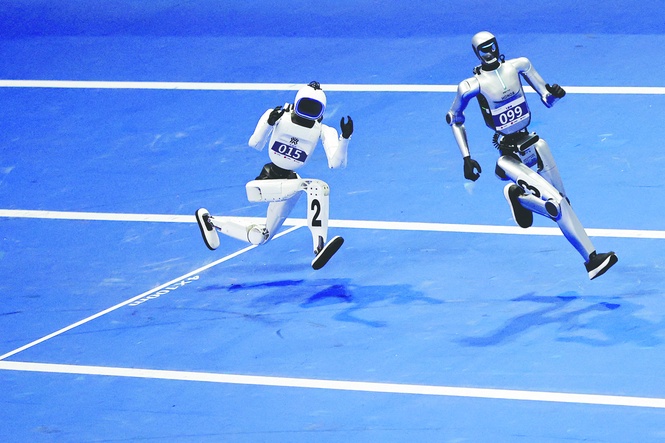
The facility captures a central tension in China’s humanoid push: Government funding and manufacturing investment are racing ahead of the robots’ ability to operate outside of choreographed demonstrations – like the kung fu routines, dances and boxing matches that have made the machines internet sensations.
Though China’s robot makers produce world-beating hardware, the humanoids lack the intelligence needed for general-purpose work, limiting their practical uses, a half-dozen industry executives and researchers told Reuters. Critically, they struggle with situations requiring intuition or deviation from programmed routines.
“The robots’ IQ is too low,” said Tang Wenbin, co-founder and CEO of AI robotics venture Yuanli Lingji, at a March industry panel. “A lot of what we see is dancing disguised as working.”
This Reuters examination of China’s humanoid boom is based on hundreds of corporate filings and government procurement records; visits to factories, robot-training centres and humanoid showrooms; and interviews with 40 people including executives, investors and researchers. It reveals a widening gap between government ambitions and robot capabilities – resulting in a market where manufacturing capacity outpaces commercial demand, key players rely on subsidies and prices are falling.
The humanoid-robot industry shipped about 20,000 units globally last year, with Chinese manufacturers accounting for 95%, according to BofA Global Research. Gan Xiaobin, an official at China’s Ministry of Industry and Information Technology, said in July the country expects to build more than 100,000 humanoids this year. BofA forecasts 1.2 million annual shipments globally by 2030.
Beijing’s effort to build intelligent robots follows the industrial-policy blueprint it deployed for electric vehicles and solar panels: Subsidize a strategic sector, build capacity early, and stoke fierce competition to drive down costs. Such investment serves China’s ambition to win control of critical industrial technology and displace Western competitors.
But cars and solar were mature industries when China accelerated production. Humanoids, by contrast, remain an early-stage technology with limited domestic or foreign demand and unresolved problems in dexterity, reliability, intelligence and cost, analysts and industry executives say. Government entities are at once major financiers and customers of the same robots – artificially boosting demand.
That all makes China’s gamble on humanoids a riskier prospect.
Some analysts question whether a general-purpose machine built in humans’ image makes economic sense when robotic arms – purpose-built for specific manufacturing tasks – are cheaper, more reliable and already in wide use.
Kevin Xu, of US investment firm Interconnected Capital, said some founders have characterized China’s humanoid sector as a “bubble.”
“There will 100% be a consolidation sooner or later,” Xu said. “It’s just a matter of who and how ugly.”
China has more than 150 humanoid-robot companies, according to the National Development and Reform Commission, the top economic planner. That exceeds the number of Chinese electric vehicle brands. The agency, which didn’t respond to questions, said in November that companies were crowding into humanoids before the technology and business models had matured.
The country’s national, provincial and local governments spent at least US$230 million buying humanoids and related items in the first half – up from US$62 million a year earlier and US$6 million in the corresponding 2024 period, public procurement data show. Reuters reviewed nearly 1,000 fulfilled tenders covering state-entity purchases of robots, training systems, equipment and demonstration projects.
China’s industry ministry and its state-assets regulator announced in June that they would require 10 provinces to each identify at least 20 sites for real-world training of humanoids and AI systems.
Shenzhen aims to build a US$15 billion industry cluster comprising more than 1,200 embodied-intelligence robotics companies by next year. The city didn’t respond to a request for comment.
China’s strategy of flooding the market with subsidies, competitors and production capacity is designed to “kick start the Hunger Games,” an artificially hypercompetitive market that accelerates learning and innovation, said Lizzi Lee, who studies China’s economy at the Asia Society Policy Institute in New York.
For now, China’s UBTech and Unitree look like potential survivors, many analysts say. Unitree – the world’s largest seller of robot dogs and the second-largest humanoid producer – has become a bellwether for capital flowing into the sector. Shares of Unitree soared more than five-fold in their Shanghai trading debut on Aug 19, valuing the company at around US$50 billion, before pulling back. Chinese embodied-AI firms eyeing their own IPOs are closely watching Unitree’s progress as investors try to distinguish between robot companies with tangible businesses from those selling visions.
Unitree didn’t respond to a request for comment about the IPO.
So far, demand for humanoids has been created by government purchases and subsidies rather than market forces. China’s industry ministry and state-assets regulator have pledged preferential policy support for regions and companies with strong robot-training programs.
As with the early EV race, local governments are now vying to create robotics champions. Beijing’s E-Town tech zone, also known as Yizhuang, offers robotics firms sales subsidies, free workspace, computing support and vouchers to purchase data, city documents show.
In May, components supplier Lingyi iTech began production at a “super factory” in the district, providing hardware, assembly and testing for robot brands. The facility’s first phase set a target of 10,000 embodied-intelligence robots annually, scaling to 500,000 by 2030.
Deep Robotics, a Hangzhou-based manufacturer of industrial quadruped and wheeled robots, has disclosed that subsidies accounted for about 42% of its US$4.2 million net profit last year. The firm, which sold only four humanoids across 2024 and 2025, didn’t respond to questions about the impact of subsidies and the commercial outlook for humanoids.
In the fourth quarter of last year, UBTech won new contracts worth at least US$123 million to supply state-owned enterprises with humanoid hardware and related technology, public filings and announcements show. Those deals exceeded the firm’s total 2025 humanoid revenue of US$122 million. The company, which didn’t comment to Reuters, shipped 1,079 full-size humanoids last year.
Competition is driving down prices. Morgan Stanley expects the average price of a humanoid to decline 15% in 2026, before recovering modestly thereafter. The average price of Kuavo, a full-size humanoid made by Leju Robotics, fell 26% year-on-year in 2025 to about US$46,000.
Kevin Li, chief marketing officer at Chinese robot-rental platform Sharebot, said dancing robots – which companies lease for promotional events – now rent for US$440 to US$600 a day, down from roughly US$1,500 last year.
China’s humanoid race has been built partly on spectacle, with robots boogeying and boxing on television to symbolize President Xi Jinping’s “new quality productive forces” – growth built on technological innovation and advanced manufacturing.
The performances mask a fundamental question: whether the machines can generate enough value in the workplace to justify their cost.
Factory managers measure robot performance by uptime and reliability. Conventional robotic arms usually beat humanoids, said Rachel Tan, secretary-general of the Shenzhen Robotics Association, an industry group.
Early commercial cases for humanoids are emerging. Humanoid maker Galbot is deploying robots in pharmacies across more than two dozen Chinese cities to address staffing constraints and meet medicine-delivery demand.
At a Beijing pharmacy, Galbot’s robot picks products from shelves after receiving digital orders. The robot has a head, arms and torso but glides on a wheeled base. The system uses cameras, including one on the robot’s wrist, together with a gripper and suction cup to identify and retrieve items.
Zhao Yuli, Galbot’s chief strategy officer, said a humanoid can pick and prepare a product in about one minute. A typical pharmacy stocks 5,000 to 6,000 products in a 30-to-50 sqm area, Zhao said, creating a repetitive selection task that can be automated. The robots’ success rate exceeds 95%, Galbot says, with most failures involving difficulty grasping an item rather than selecting the wrong product.
The company said it hadn’t timed the robots against human workers, but believed the machines’ ability to work continuously could make them equally or more efficient overall – even if humans are faster at individual tasks.
China’s humanoid campaign relies on a simple equation: More robots in training equals more data.
Many robotics founders and investors predict consolidation could begin in late 2026 or 2027, as they expect Chinese officials to rein in subsidies and focus support on the most credible players.
Already, Chinese component prices are falling so quickly that competitors abroad struggle to keep pace, according to BofA Global Research’s Ming Lee.
Tesla illustrates the gap. Its Optimus humanoid isn’t yet sold publicly. CEO Elon Musk’s stated target price of roughly US$20,000 is a long-term goal at large-scale production. Morgan Stanley, however, last year estimated the low-volume hardware bill of materials for an Optimus Gen 2 model at US$50,000 to US$60,000.
China’s robotics industry will likely maintain its overall global advantage through a potentially painful consolidation, some analysts say. Even if bankruptcies sweep through humanoid manufacturers, China’s supply chains will persist, potentially locking foreign competitors into dependence on Chinese hardware. – Reuters