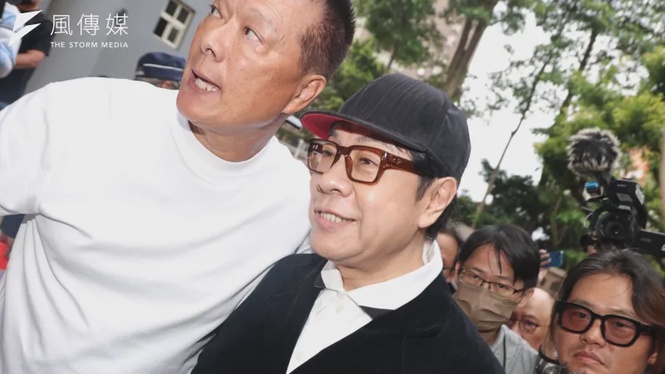
China's Taiwan Affairs Office (TAO) has told Taiwanese entertainers that they should be "proud to be upright Chinese people," weighing in on the case of Kevin Tsai, the celebrity talk show host who angered Beijing by appearing at a campaign event for a ruling party candidate in the Taipei mayoral race.
Asked on October 28 whether Tsai could return to the Chinese market after he posted on Weibo that he had "never supported Taiwan independence," TAO spokesperson Chen Binhua did not answer directly. Instead, he said there was "no room for ambiguity" on questions of national sovereignty.
The episode has become one of the stranger subplots of the 2026 Taiwan local elections, drawing in Beijing, Taiwan's government and one of the best known Taiwanese faces in Chinese entertainment.
How A Campaign Appearance Turned Into A Cross Strait Row
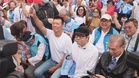
Tsai, who has hosted television talk shows since 1998 and has a large following in mainland China, attended the opening of the campaign headquarters of Puma Shen, the Democratic Progressive Party (DPP) candidate for Taipei mayor. Shen is a vocal critic of Beijing and has been placed on a wanted list by Chinese authorities.
The appearance quickly became a trending topic on Weibo, China's main microblogging platform, under the label that Tsai had shown up at "a Taiwan independence separatist's campaign event." Chinese brands that had hired him as a spokesperson moved to distance themselves.
At its regular press briefing on October 14, the TAO issued its first response, warning that no one "can profit from the mainland's development while colluding with Taiwan independence separatist forces," and accusing such people of being "two faced."
What Tsai Said In His Weibo Post
With the controversy still building, Tsai posted on Weibo on October 26. "I have always hoped for friendly exchanges between the two sides of the Taiwan Strait. I have never supported Taiwan independence," he wrote.
He added that he had interviewed nearly 10,000 guests over almost three decades, people holding every kind of view, and had never become a follower of any of them. Interviewing someone, he said, does not mean agreeing with them.
Taiwan's Government Says Independence Was Never On The Table
The post prompted a response from Taipei. On October 27, Shen Yu-chung, deputy minister of the Mainland Affairs Council (MAC), Taiwan's top agency for China policy, said that "Taiwan has never had a Taiwan independence option."
Shen Yu-chung explained that the existence of the Republic of China, Taiwan's official name, is an objective fact, and that it and the People's Republic of China are not subordinate to each other. He added that the government respects the speech and political positions of individual citizens. His framing reflects the long standing position of President Lai Ching-te's government that Taiwan has no need to declare independence because it is already a sovereign state.
Beijing Sets Its Terms For Taiwanese Stars
At the TAO briefing a day later, Chen said safeguarding China's sovereignty and territorial integrity is "the common duty of all Chinese people, including compatriots in Taiwan." Beijing respects and protects the "legitimate" freedom of expression of Taiwanese people, he said, but there is "no room for ambiguity" on major issues of sovereignty, security and development interests.
"We hope people in Taiwan's entertainment industry will be proud to be upright Chinese people and do more to strengthen the bonds between compatriots on both sides and promote cross strait exchanges and cooperation," Chen said.
He also repeated that Beijing welcomes Taiwanese visitors and supports entertainers from both sides working together to "share the cross strait cultural market and pass on Chinese culture," leaving open the door for Tsai, but on Beijing's terms.
Why It Matters For The Taipei Mayoral Race
The row has unfolded as the race for Taipei mayor tightens ahead of the November 28 vote. Shen faces incumbent Chiang Wan-an of the opposition Kuomintang. A poll released on October 20 by the Xinmin Cross-Strait Research Association put Shen at 50.3% and Chiang at 33.3%, although other surveys have shown a closer contest.
For Taiwanese celebrities who earn much of their income in mainland China, the Tsai case is a reminder that being seen with a candidate Beijing has labeled a separatist can carry a commercial cost, and that an apology on Weibo may not be enough to repair it. Taiwan's government has warned Beijing against using such pressure to interfere in the 2026 Taiwan local elections.