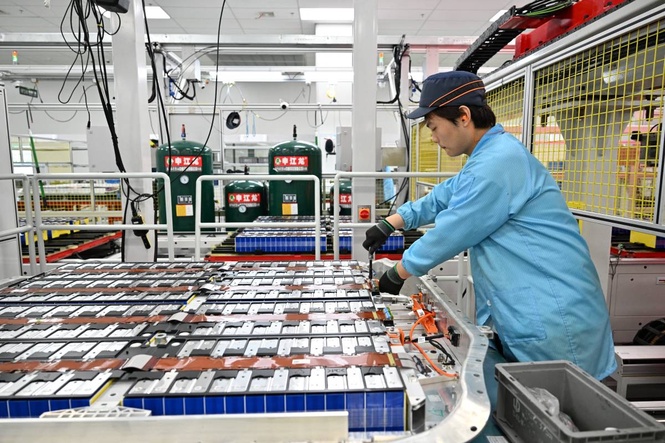
CHINA unveiled a new five-year plan for its battery industry on Monday, aiming for the initial large-scale application of all-solid-state batteries by 2030 as the country accelerates the transition of next-generation battery technology from research to commercialization.
The Ministry of Industry and Information Technology, together with six other government agencies, jointly issued the new development plan for the battery industry, outlining the sector’s development priorities over the 15th Five-Year plan (2026–2030) period.
The plan comes as China continues to expand its role in the global battery supply chain and seeks to strengthen its leadership in the global energy transition, according to Chinese experts. The country already has strong battery manufacturing capacity, but industry experts said that it still needs to improve basic research and core technologies to maintain long-term competitiveness.
To promote the high-quality development of the industry, efforts will be made to accelerate technological innovation, industrial transformation and upgrading, improve the industrial system, enhance the capacity of industrial science and technology services, and raise the quality and level of trade and investment cooperation, according to the document.
China will seek steady growth in its new battery industry over the next five years, while making major breakthroughs in advanced electrode materials, new electrolytes and high-end auxiliary materials. It also called for significant progress in new battery systems, with all-solid-state batteries moving toward initial large-scale deployment by 2030.
New batteries refer to energy storage and conversion devices built on new mechanisms, materials, structures and manufacturing processes. They include lithium batteries, sodium batteries and flow batteries, which analysts said are becoming key parts of China’s push to develop new industrial sectors, build a new energy system and strengthen its capabilities.
China’s battery industry has strong manufacturing capabilities but still needs to strengthen fundamental research, Sun Xiaohong, former secretary-general of the automotive branch of the China Chamber of Commerce for Import and Export of Machinery and Electronic Products, told the Global Times on Monday.
All-solid-state batteries are one of the plan’s key technological priorities. Compared with conventional lithium-ion batteries, which typically use flammable liquid electrolytes, solid-state batteries use solid electrolytes and are considered safer and potentially capable of offering higher energy density, according to Sun.
The plan calls for faster breakthroughs in commercialization technologies, with a focus on improving ionic conductivity, cycle stability and cost efficiency. It also stresses the need to advance key materials and processes, including interface contact technology, high ionic conductivity, long life cycles and engineering pressure system design.
China’s solid-state battery market is projected to grow from $42.5 million in 2025 to $384.8 million by 2030, a compound annual growth rate of 44.4 percent, significantly outpacing the global average of 37.5 percent.
Meanwhile, substantial research and development investments by domestic manufacturers such as CATL and BYD are accelerating solid-state battery commercialization and deployment, according to media reports.
Sun said that solid-state battery technology worldwide is still in the research and testing stage, and has not yet entered large-scale commercial use. He noted that the main challenges remain manufacturing consistency and cost reduction.
“Small-scale commercialization is already possible, but large-scale adoption still depends on lowering costs further and improving production processes,” Sun said.