China has called on Germany to support free trade and create a fair business climate, following high-level talks and against a backdrop of growing trade tensions, the Chinese Ministry of Commerce said on Thursday.
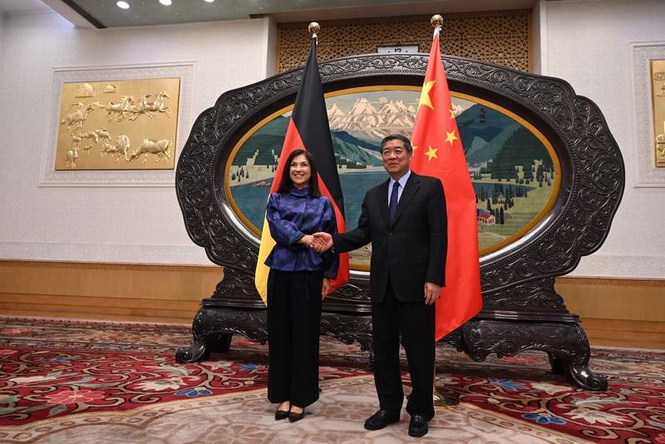
The meeting was between German Economy Minister Katherina Reiche and Chinese Commerce Minister Wang Wentao.
Ministry of Commerce spokesman He Yadong said in Beijing that, in light of rising protectionism, Germany and China should support free trade, expand mutual market access and create a fair, open and non-discriminatory business climate for cooperation between companies.
Wang met Reiche on Sunday in Brussels, followed by a meeting with EU Trade Commissioner Maroš Šefčovič on Monday. The talks focused on China's export limits on rare earths and magnets made from them, as well as the continuation of trade policy discussions.
Reiche pushes for joint committee
At the meeting with Reiche, Wang said China hoped Germany would play an active role in the European Union to push Brussels towards a "rational stance" in trade policy with China, according to the Ministry of Commerce.
Following Reiche's inaugural visit to Beijing at the end of May, Germany and China agreed to revive a joint economic committee as soon as possible.
Šefčovič said Wang had assured him that existing export limits would not affect EU supply chains. He did not elaborate on what exactly that covered when asked. Both sides also launched new trade and investment consultations aimed at defusing trade conflicts.
Expert: EU members at 'tipping point'
The EU has an enormous trade deficit with China due to high Chinese exports to Europe. Šefčovič said the market share of European companies in China was shrinking at the same time.
The EU has recently been considering new additional tariffs on imports from China if no progress is made in resolving trade disputes.
Given the threat to European industry, the sense of urgency among European leaders seems to have reached a tipping point, according to China analyst Gabriel Wildau of consultancy Teneo. It has become clear, he said, that Beijing has no intention of unilaterally addressing what Brussels sees as rampant industrial overcapacity.
The EU talks also coincided with an intense heatwave across Europe that was boosting demand for air-conditioning units and again highlighting dependencies on China.
Chinese companies such as household appliance manufacturer Midea are strongly represented in the sector.
Sales of split-unit air conditioners had doubled this year compared with the same period last year, with more than 200,000 units sold, Midea's European head for air conditioning, Xiong Xueqin, told Chinese media.