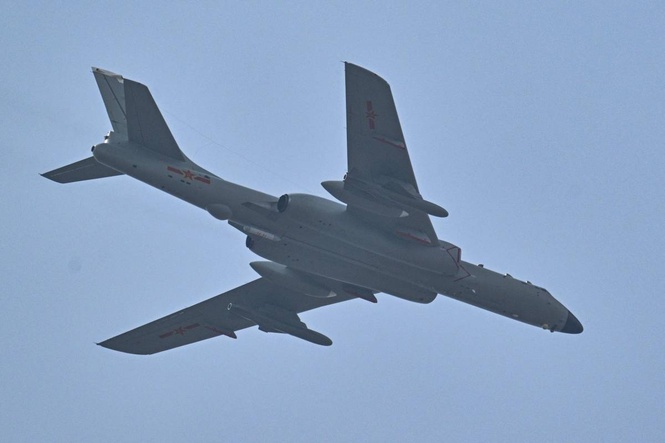
A CHINESE long-range bomber flew within 45 nautical miles of the Philippine coast and about 170 nautical miles from Metro Manila earlier this week, in what the Armed Forces of the Philippines (AFP) described as a show of force reflecting Beijing’s growing ability to project military power toward Luzon.
The People’s Liberation Army (PLA) Air Force H-6 bomber was monitored operating over the West Philippine Sea between Bajo de Masinloc, or Scarborough Shoal, and Luzon, the AFP confirmed on Wednesday, dismissing speculation that the flight was a rehearsal for a missile strike on the capital.
Retired RAdm. Roy Vincent Trinidad, AFP spokesman for the West Philippine Sea, said the aircraft’s approach was the closest Chinese bomber flight of its kind observed near the Philippines.
The military detected and tracked the bomber before it reached the country’s exclusive economic zone (EEZ), he said, demonstrating improvements in the Philippines’ surveillance capabilities.
“There is no indicator that there was such a rehearsal for a missile strike on the capital. We have to be very careful. We have to fact-check everything and get the information from reliable sources,” Trinidad said.
He said the flight reflected China’s increasingly assertive military posture, with its aircraft and other military assets operating farther from the mainland.
“It only shows that the People’s Liberation Army — the Air Force, Army, Navy, the entire PLA — is now flexing its muscles. Previously, their patrols were closer to the mainland of China. Today, they are reaching farther toward us,” Trinidad said.
The bomber’s appearance on the public flight-tracking platform ADS-B Exchange on Nov. 21 drew attention from defense observers after it briefly showed a flight path between Scarborough Shoal and Luzon.
A report by defense publication Defense Blog said the aircraft appeared to approach the Philippine coast before making a tight turn and heading back along its route.
The maneuver fueled speculation among military observers that the aircraft may have simulated a missile-launch profile, particularly because its reported turning point was estimated to be about 170 kilometers from Manila.
However, the AFP has not confirmed that the bomber simulated a weapons release, and publicly available flight-tracking data did not establish its specific variant or weapons load.
The H-6 is China’s long-range bomber platform, derived from the Soviet-era Tupolev Tu-16, but extensively modernized with improved engines, avionics and weapons systems.
Newer variants can carry long-range cruise missiles for land-attack and maritime-strike missions, allowing Chinese aircraft to target military installations, ships and other assets without having to fly directly over them.
The bomber’s appearance near Luzon underscores the importance of the Philippines’ ability to detect, identify and track aircraft operating near its territory as China expands its military presence and activities in the South China Sea.
Trinidad said the AFP’s ability to detect the bomber before it reached the country’s EEZ reflected gains under the military’s modernization program.
“It only shows that the modernization program has accelerated by leaps and bounds. Even beyond our EEZ, we already know what is happening. So, we now have a perspective of the region,” he said.
He added that Chinese military aircraft had conducted similar patrols around Scarborough Shoal in the past.
In March 2025, China deployed two H-6 bombers around the shoal, according to satellite imagery cited in previous defense reporting, reinforcing Beijing’s use of military aviation in support of its claims in the disputed waters.
The AFP’s surveillance efforts are expected to receive additional support from Japan, although the Philippine military will have to wait up to three years before deploying new coastal surveillance radars and unmanned aerial vehicles (UAVs) worth P1.72 billion.
The 4.3-billion-yen grant under Japan’s Official Security Assistance (OSA) program will provide military-grade coastal surveillance radar equipment to the Philippine Navy and UAVs to the Philippine Air Force.
A Japanese Embassy official estimated that delivery could take two to three years.
Navy spokesman Capt. Marissa Martinez said the radar systems would provide 360-degree maritime domain awareness in support of the AFP’s Comprehensive Archipelagic Defense Concept (CADC) and the Navy’s Active Archipelagic Defense Strategy.
The systems are classified as military-grade because they meet the Navy’s requirements for performance, accuracy, reliability, range and integration with existing equipment, Martinez said.
The radars are expected to improve the Navy’s ability to detect and identify vessels operating within and beyond the country’s EEZ, while the UAVs would supplement the Air Force’s intelligence, surveillance and reconnaissance capabilities.
Air Force spokesman Col. Alvin Jay Capinguian said the Japanese-supplied UAVs would complement the service’s existing surveillance capabilities.
The assistance comes as the AFP shifts from a predominantly internal security posture toward defending the country’s archipelagic territory and maritime interests under the CADC, requiring improved surveillance and monitoring of strategically important waters.
The grant agreement was signed earlier this month and is Japan’s largest OSA grant to the Philippines and the first transfer of completed defense equipment under the program.
The Philippines previously received five coastal surveillance radar systems under a 600-million-yen Japanese grant signed in November 2023. The equipment was turned over to the Philippine Navy in February 2026.
The new package expands surveillance support to both the Navy and Air Force, although the number of UAVs and the technical specifications of the radar systems have not been publicly disclosed.
AFP welcomes defense deal
Also on Wednesday, the AFP welcomed the $2.4-billion defense deal promised by President Donald Trump during his two-day visit to Manila, saying it will bolster the military’s objective to continuously build the country’s credible deterrence.
“This will align with our modernization program,” Trinidad told reporters at the Kapihan sa Manila Prince Hotel.
He, however, clarified that the promise of multibillion funding was given only last week, and a lot remains to be done at the level of the Department of National Defense (DND) and other agencies that could benefit from such military grants and financing.
“It’s a good opportunity to take advantage of grants like this to develop our capability. Our capability, sovereign capability is number one, defensive in nature,” Trinidad said.
Such deals, Trinidad said, will likewise allow the armed forces and the DND to be able to perform their mandates “in a more professional and international law aligned approach.”
Lastly, it will hasten the implementation of the CADC but will not be limited to kinetic capabilities that are meant to threaten any adversary who wishes to do harm to the Philippines.
Defense Secretary Gilberto Teodoro Jr. on Tuesday said that under the $2.4-billion deal, the US will be selling sensitive military weapons exclusively to the Philippines.
These weapons, he said, are “very hard to get.”