
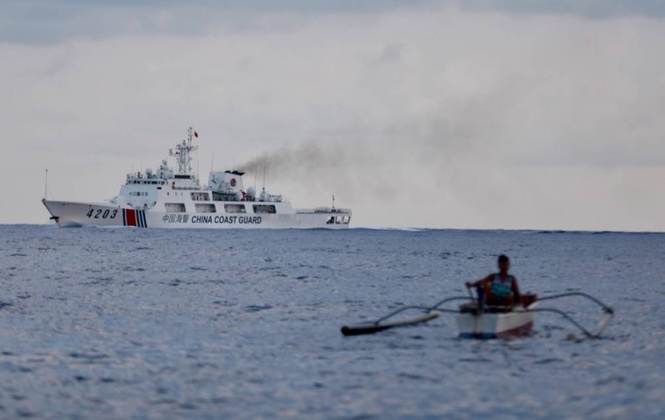
CHINA Coast Guard (CCG) presence around Bajo de Masinloc (Scarborough Shoal) has surged to unprecedented levels this year, with Chinese vessels nearly matching their record annual patrol activity in just the first six months of 2026, an analysis by the Asia Maritime Transparency Initiative (AMTI) showed.
AMTI said CCG vessels logged 933 ship-days around Bajo de Masinloc from January to June, compared with 1,099 ship-days for the whole of 2025. The 2025 figure was more than double 2024’s 516 ship-days.
CCG patrol activity rose from an average of 90 ship-days per month in the first half of 2025 to 156 per month this year, peaking at 216 in May.
AMTI said multiple CCG vessels frequently maintained a perimeter covering approaches to the shoal within roughly 30 nautical miles, while six to eight Chinese maritime militia vessels maintained a persistent presence closer to the shoal.
Some vessels also patrolled along and sometimes across China’s claimed nine-dash line, positioning themselves to intercept Philippine vessels heading toward Bajo de Masinloc.
Philippine law enforcement patrols also increased, with Philippine Coast Guard and Bureau of Fisheries and Aquatic Resources vessels averaging 43 ship-days per month in the first half of 2026, up 43 percent from the same period last year.
AMTI recorded 112 days during the first half of 2026 when interactions between CCG and Philippine vessels were observed. One such encounter occurred on May 27 involving CCG vessel 21563 and the Philippines’ BRP Datu Pagbuaya.
The increased patrols came alongside China’s deployment of floating structures at the shoal.
On May 25, the Philippines reported finding a 6-by-6-meter floating structure inside the lagoon and filed a diplomatic protest. China later described it as a temporary research facility.
The structure was removed on June 17, but two buoys installed in October 2025 and other floating objects identified by the Philippine Coast Guard remained.
The developments prompted national security expert Jose Antonio Goitia to warn that China cannot establish sovereignty through what he described as illegal acts.
Goitia cited Panganiban (Mischief) Reef, where China began building structures in 1995 that were initially described as shelters for fishermen but later developed into a major Chinese military outpost.
He pointed to the 2016 South China Sea Arbitral Award, which found Panganiban Reef to be a low-tide elevation within the Philippines’ exclusive economic zone and continental shelf and incapable of appropriation.
The tribunal also found that China’s construction there violated Philippine sovereign rights under the United Nations Convention on the Law of the Sea. China has rejected the ruling.
Goitia said China’s use of coast guard and maritime militia vessels to confront Philippine vessels and fishermen constituted a form of gray-zone coercion intended to pressure Manila and gradually change the status quo without triggering open conflict.
“The Philippines cannot allow that to become normal,” he said.
He said Filipino fishermen should not lose their rights because Chinese vessels were larger or better armed.
“Force does not create sovereignty,” Goitia said.
His comments come as AMTI warned that China’s activities at Bajo de Masinloc were entering new territory.
The group said Beijing was combining unprecedented CCG patrols with new forms of nominally civilian activity to strengthen its physical presence and establish new patterns of activity around the disputed shoal.
AMTI said the increased activity had occurred without China crossing the traditional red lines of constructing a permanent structure or conducting land reclamation at Bajo de Masinloc.
