
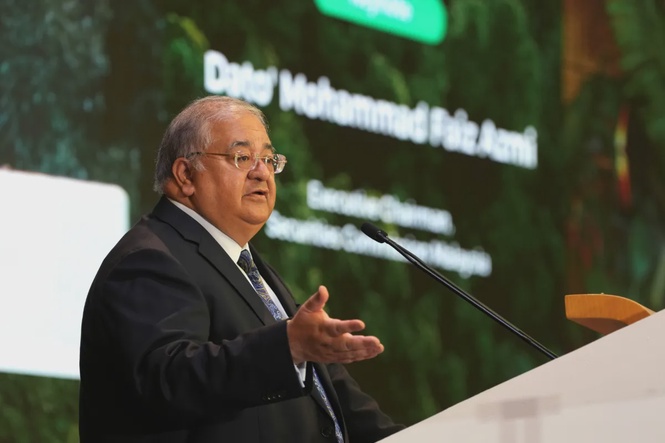
KUALA LUMPUR: Climate risk is no longer just an environmental concern but a national and economic imperative, requiring a coordinated response from the government, regulators and market participants to safeguard economic and financial stability.
Securities Commission Malaysia (SC) chairman Datuk Mohammad Faiz Azmi said climate change is a ‘whole-of-society’problem, and all stakeholders – from government and its ministries to its agencies and government-linked companies, to regulators such as Bank Negara Malaysia (BNM) and the SC, as well as corporates, the private sector, NGOs and the public – have a part to play.
“Over the past seven years, the Joint Committee on Climate Change (JC3), launched by BNM in 2019, has driven several key initiatives in building Malaysia’s climate finance ecosystem.
“Its achievements span from mobilising capital for projects to establishing relevant frameworks for sustainable finance.
“A key initiative worth noting is the Climate Finance Innovation Lab (CFIL). Launched in June 2025, the CFIL is JC3’s flagship initiative to connect climate and nature-related projects with funding.
“It has onboarded 30 projects with total funding needs exceeding RM4 billion as of January 2026,“ Mohammad Faiz told delegates at the JC3 Journey to Zero (J20) Conference titled “Building Climate and Nature Resilience for People and Business” today.
A second cohort of 22 projects seeking RM1.73 billion is undergoing a structured accelerator programme with the UN Global Compact Network Malaysia.
Mohammad Faiz said the JC3 supported the National Sustainability Reporting Framework by issuing guidance documents for banks, insurers, and takaful operators to make sustainability disclosures more robust and comparable.
The guidance documents complement the Illustrated Sustainability Reports issued by the Advisory Committee on Sustainability Reporting for the plantation and construction sectors.
“The biggest achievement to me, however, was the effort to focus on the availability of data. The JC3 Climate Data Catalogue expanded the data available to 186 unique data items with the overall data availability rising to 82% in 2025,” the SC chairman said.
“This increasing availability of data helps with the adoption and disclosure of sustainability reporting in Malaysia.
“There are other initiatives that JC3 are focusing on as well, such as capacity building, the creation of guidance documents and the adoption of the Asean Taxonomy through the Malaysian Taxonomy.
“We also note BNM’s continued focus on the role of financed emissions in our economy and the monitoring of the resilience of banks and their customers to be able to deal with what is ahead in the future.”
Moving on, Mohammad Faiz said the SC has an important role to play in helping to evolve the capital market players to be more resilient and to continue to grow the economy despite the challenges ahead.
Under the SC’s Capital Market Masterplan 2026-2030 launched in March this year, sustainability is one of the four strategic pillars. The others are market vibrancy, inclusivity and regional opportunities.
“The aim of the sustainability pillar is to mobilise between RM90 billion and RM100 billion in total financing over the next five years in support of climate and other sustainability-related goals.
“The SC is utilising a two-prong approach towards embedding sustainable practices and looking at funding needs,“ Mohammad Faiz said.
The first priority is to increase the resilience of the corporate sector.
“This will allow us to keep growing our economy, keep businesses funded and ultimately pay for climate adaptation and mitigation needs. The key initiative we are using is the adoption of international standards, the ISSB S1 and S2 standards, to better explain what we do in a globally recognised way.
“We are launching our NSRF Kembara programme to visit all states outside the Klang Valley, starting with Sarawak and Sabah. This is to ensure we hear from all companies across Malaysia to understand their challenges and see how we, as regulators, can support them in their sustainability journey,“ Mohammad Faiz said.
The SC is also looking at how to better demonstrate Malaysia’s resilience and the need to show foreign investors that the nation can cope as more climate events occur.
“In the competition for FDI, a country’s climate resilience will become a bigger factor. We need to identify data that asset owners want to see to reassure them that investing in Malaysia is safe.
“The good news is that in international rankings, we are generally perceived as being quite resilient, ranking second after Singapore in Asean 5. However, we need more data to prove it,“ Mohammad Faiz said.
The SC’s second sustainability imperative is to mobilise capital for climate adaptation and resilience efforts.
“Estimates put Malaysia’s climate adaptation needs by 2050 at between US$852 billion and US$1.1 trillion (RM3.47 trillion and RM4.48 trillion). To put it in context, the entire Malaysian capital market size is just over US$1 trillion.
:However, adaptation projects often have limited commercial viability and marginal bankability. This makes getting private investment to support public works challenging,“ Mohammad Faiz said.
He pointed out some efforts BNM is making on this front, such as the CFIL initiative.
Mohammad Faiz said the SC is considering one proposal – the Sukuk Prisma framework.
The idea is to have a new purpose-driven framework that will be aligned with Maqasid Al-Shariah or the objectives of syariah, as well as the Asean Taxonomy and international green bond principles.
Such sukuk may be in non-ringgit currencies and follow other fatwas not used in Malaysia.
“The aim is to connect foreign capital with our national priorities on areas relating to adaptation and resilience,“ Mohammad Faiz said.
Another interesting potential funding instrument for climate, is tokenisation, the SC chairman said, adding that its primary advantage lies not only in its cost-effectiveness but also in its ability to improve processes, increase efficiencies, and widen access to capital from new investors.
Mohammad Faiz said the capital market has facilitated a few important digital innovations in this area this year.
In April, Khazanah Nasional Bhd, in collaboration with the SC, launched Malaysia’s first tokenised sukuk.
Subsequently, CIMB Group Bhd piloted the settlement of its tokenised sukuk using tokens based on cash deposits.
“These are the types of responsible innovation that we are encouraging,“ Mohammad Faiz said.