
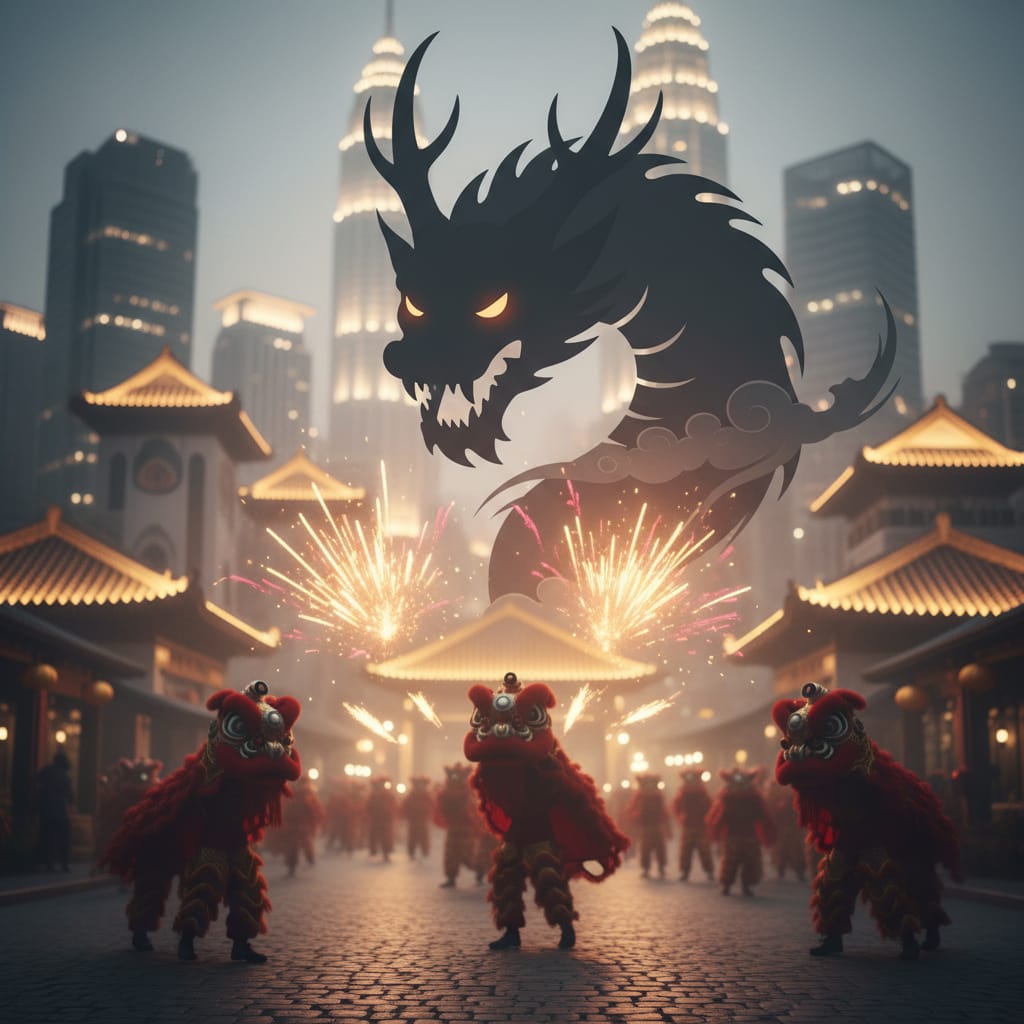
On the eve of Chinese New Year 2026, Kuala Lumpur’s central streets thrummed with fireworks, lion dances and crimson banners. Yet behind this spectacle lies an origin story rooted in fear a fear so deep that it shaped one of the world’s most joyous festivals. According to ancient folklore, the traditions we now celebrate began as a collective strategy to ward off a terrifying creature called Nian that once terrorised villagers at year’s end. (loreward.org)
At first glance, red lanterns and booming firecrackers seem festive. But their origins are darker. The word Guo Nian literally means “to pass the Nian,” reflecting a time when people braced for a yearly attack from this beast. (Encyclopedia Britannica)
The Beast That Started It All
In the earliest tellings, the Nian was no whimsical monster. It was a ferocious creature with a lion’s head, horns and a body as powerful as an ox, emerging from the mountains or sea at the end of each lunar year to hunt villagers and livestock. (Alibaba Party)
Historians note that while written sources of this legend are surprisingly recent, the narrative persists because it resonates with collective memories of hardship and survival during winter months. The terror was real for ancient villagers. Crops were scarce in winter. Risks from wild animals, famine and disease were common. In that context, the Nian story symbolises all the anxieties that came with the turn of the seasons. (South China Morning Post)
One telling has villagers fleeing to hills each year. An old beggar, however, stayed behind and discovered Nian’s weakness: loud noise, firelight and the colour red. (Alibaba Party)
His idea was simple but transformative: hang red paper on doors, light bamboo that cracked like thunder and make as much racket as possible. By morning, the village stood safe and intact Nian was gone. (Encyclopedia Britannica)
From that moment, noise and colour became ritual. Firecrackers, lanterns, red couplets and lion dances were born not from celebration alone, but from a collective act of defiance and survival. (destinationchina.com.cn)
Fear Turned Tradition
In China and beyond, these practices evolved into joyous customs. Red became synonymous with good luck because it once repelled danger. Firecrackers became celebration staples because they once kept villagers alive. Modern scholars recognise that the Nian story has likely changed over time. Some point out that there is no ancient text describing the beast, suggesting the legend may have been shaped, embellished and reinterpreted through generations. (The World of Chinese)
Yet the legend remains central because it explains, in human terms, why certain traditions emerged. The absence of early written evidence does not diminish the narrative’s cultural power. Folklore often reflects shared experiences of fear, resilience, and community, not literal history. (The World of Chinese)
How Fear Forged Customs Across Asia
Chinese New Year traditions inspired by Nian spread far beyond China. In Malaysia, Singapore and Indonesia, similar rituals loud celebrations and red decorations are observed by ethnic Chinese communities. (Times Union)
In Penang and Kuala Lumpur, festive markets, lion dance parades and firecracker displays have become economic drivers as well as cultural signifiers, drawing tourists and locals alike. (Times Union)
Despite safety regulations in many cities, the spirit remains the same. Where firecrackers are restricted, drumbeats and dance fill the void. Where lanterns light the night, families gather to feast and renew bonds. The energy is about community as much as celebration. (Times Union)
Red as Symbol, Noise as Ritual
In some regions, red packets (angpao) evolved from protective charms to gifts symbolising blessings and prosperity. Lion dance performers, once improvisers of noise to scare off evil, now compete for skill and artistry. (Tatler Asia)
Even social media reflects the transformation. Videos of dazzling firework shows and lion dance competitions now outnumber tales of mythical beasts. Yet beneath the glitter lies a shared cultural memory of vulnerability turned into joy.
Fear, Joy and Cultural Resilience
The deep human truth in the Nian narrative is clear: communities faced danger by coming together. Rituals that began as defensive measures became celebrations of unity and renewal. That transformation mirrors how humans across cultures turn fear into meaning. (South China Morning Post)
In Malaysia, Chinese New Year is both an ethnic celebration and a national event. Government tourism bodies report millions in revenue from festivals and related commerce each year. Ethnic Chinese communities contribute significantly to multicultural vibrancy. Yet the old fear behind the rituals rarely gets airtime. (Times Union)
Questions Beyond Folklore
Some modern scholars ask whether the legend’s humanitarian core has been lost in commercialization. Is Chinese New Year now more about spectacle than meaning? Some suggest the risk is trivialising deep cultural symbols. Others argue that evolution is natural for any living tradition.
What do you think? I’d love to hear your opinion in the comments section.
Legends like Nian endure because they serve human needs: they explain, they teach and they bind people across time. Whether literal or symbolic, the monster story offers insights into how societies shape ritual from fear.
At its core, Chinese New Year is about starting anew. Families reunite, debts are settled, homes are cleaned, and old grievances are forgotten. That process of cleansing and renewal echoes the villagers’ first act of defeating their fear.
In 2026, as dusk fell on Chinese New Year Eve, families across Malaysia lit lanterns, banged drums and exchanged blessings. The spectacle carried centuries of memory fear transformed into joy.
The Nian may never have existed in flesh and blood, but its legacy lives on every time someone hangs a red couplet or laughs at a firecracker’s crack.
.png)
Got a fun CNY story? Share it, and you might take home Ang Pow and prizes worth up to RM2,980! Find out how to join here. T&Cs apply.
AM World (tameer.work88@gmail.com) is a content creator under the Newswav Creator programme, where you get to express yourself, be a citizen journalist, and at the same time monetize your content & reach millions of users on Newswav. Log in to creator.newswav.com and become a Newswav Creator now!
The User Content (as defined on Newswav Terms of Use) above including the views expressed and media (pictures, videos, citations etc) were submitted & posted by the author. Newswav is solely an aggregation platform that hosts the User Content. If you have any questions about the content, copyright or other issues of the work, please contact creator@newswav.com.