THE Commission on Elections (Comelec) will file charges over the tampering of 16,453 ballots in Maluso, Basilan, with Chairman George Erwin Garcia describing the incident as electoral sabotage, a crime that carries severe penalties, including life imprisonment and perpetual disqualification from public office.
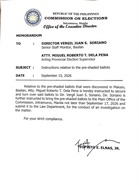
Garcia said the Comelec was preserving as evidence all 36 boxes containing the tampered ballots involved in the incident.
“A total of 16,453 ballots in all. That is electoral sabotage, strictly speaking,” Garcia said during a media interview Tuesday at Camp General Gonzalo H. Siongco in Datu Odin Sinsuat, Maguindanao del Norte.
He said the Comelec would issue the necessary orders and directives once the commission returned to Manila to begin the process of holding those responsible accountable.
The discovery of the tampered ballots in Maluso prompted the Comelec to order the printing and distribution of replacement ballots.
Garcia said the original tampered ballots would not simply be discarded but would instead be preserved as evidence for possible proceedings.
The proclamation of winning candidates was put on hold after voting in key municipalities was extended past scheduled deadlines due to ballot compromises and severe logistical bottlenecks.
Basilan Provincial Election Supervisor Miguel Roberto Dela Peña confirmed Tuesday that local canvassing boards cannot proceed with formal declarations until 100 percent of precinct election returns have been fully processed and consolidated.
Garcia said that under electoral rules, the proclamation of winning candidates and political organizations can only occur in an open session before the official Board of Canvassers once all legal prerequisites were satisfied.
Voting in the municipality of Maluso was extended until Tuesday after election inspectors discovered compromised, pre-shaded ballots in 36 precincts.
‘A gold standard’
Despite reports of poll-related violence and irregularities, Garcia described the first Bangsamoro elections as a potential “gold standard” for elections, citing the high voter turnout and rapid transmission of results despite incidents of violence.
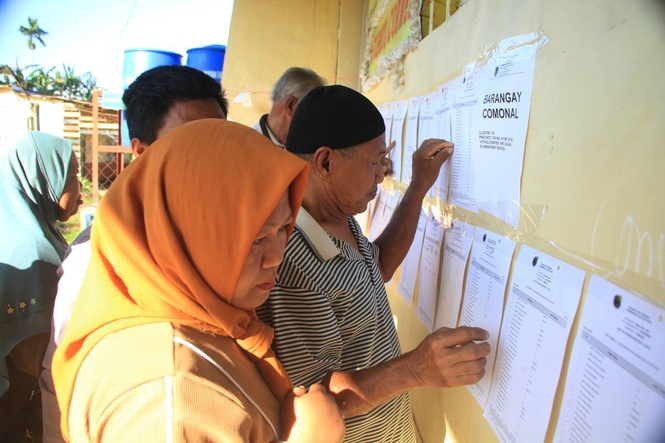
He said the election recorded an average voter turnout of around 80 to 81 percent, equivalent to roughly 1.9 million voters.
He also pointed to the speed of electronic transmission, saying results began entering Comelec servers shortly after polling places closed and that the commission had a general picture of the winners by around 8:30 to 9 p.m.
Garcia acknowledged that incidents of violence occurred during the election.
However, he said the incidents did not prevent large numbers of voters from participating.
“If you balance this and look at it somehow, this is something that we can consider a gold standard in our elections,” Garcia said in Filipino.
He said the Comelec had learned several lessons from the election, particularly in relation to automated transmission and election management.
Garcia said those lessons would be useful for the 2028 national and local elections.
He also credited the security sector and mechanisms connected with the peace process for helping contain incidents during the election.
Meanwhile, as of Tuesday morning, the Parish Pastoral Council for Responsible Voting (PPCRV) said that it had counted 97.93 percent of the votes cast in the Bangsamoro Autonomous Region in Muslim Mindanao (BARMM) parliamentary elections, with 111 precincts still awaiting transmission.
Ana Singson, PPCRV spokesman and trustee, said the remaining precincts account for 2.17 percent of the votes yet to be counted.
“As of today, we have vote count of 97. 93 percent of the votes cast in BARMM,” Singson said in a message Tuesday.
She said the PPCRV’s LED screens would continue showing updated results until noon Tuesday, Sept. 15.
The group’s website and Facebook page will also continue to provide updated results, although transmissions may become intermittent as most of the votes have already been transmitted, Singson said.
Physical election returns from across BARMM are being sent to the PPCRV-AMA Makati Command Center, where they will be scanned and compared with the electronically transmitted results.
The audit and count are scheduled from Sept. 17-22.
The comparison is intended to check the integrity of the transmission of election results, Singson said.
Action vs election violence
Also on Tuesday, Garcia said the commission will coordinate with security agencies to identify and hold accountable those responsible for violence and other criminal incidents during the conduct of the elections.
Garcia said the Comelec would work with the Office of the Presidential Adviser on Peace, Reconciliation and Unity (Opapru), the Armed Forces of the Philippines (AFP) and the Philippine National Police (PNP) to identify those who may have been involved in election-related violence.
He said the agencies would help pinpoint individuals who may have been responsible for or involved in violent incidents so they could be held accountable.
Garcia cited a shooting incident in the Mustapha area of Cotabato City that lasted for several hours but, according to him, did not result in any reported casualties.
He also referred to gunfire at Central Pilot Elementary School, where voters and members of the media were present.
Garcia said election-related disputes between political groups should not put voters at risk.
“The bullet does not choose,” Garcia said in Filipino, stressing that civilians should not be caught in clashes between rival groups.
He said the Comelec would not allow those responsible for violent incidents to escape accountability because failing to act could encourage similar incidents in future elections.
Garcia also credited the AFP and PNP for responding to incidents and helping contain security problems during the election.
He said the Comelec would begin issuing the necessary orders and directives to pursue accountability once the commission returned to Manila.
The poll chief also emphasized that even extensive security preparations cannot completely prevent determined individuals from committing election-related crimes.
Garcia said the Comelec, AFP and PNP had deployed substantial security forces during the elections, but acknowledged that some incidents still occurred.
He said the issue involved not only weapons being brought through checkpoints but also the possibility that perpetrators could obtain weapons from nearby locations or conceal explosive devices.
Garcia said security forces could confiscate weapons at checkpoints, but they could not necessarily determine whether an ordinary-looking bag contained an explosive device.
He said the objective was therefore to contain incidents within limited areas and prevent them from affecting large numbers of voters.
BFP, UBJP lead party race
The PPCRV’s unofficial count showed that the Bangsamoro Federal Party (BFP) and the United Bangsamoro Justice Party (UBJP) continued to lead the party race in the Bangsamoro parliamentary elections.
As of 3:51 p.m. Tuesday, BFP had 660,947 votes, or 35.2 percent, while UBJP had 609,245 votes, or 32.4 percent.
The BARMM Grand Coalition (BGC) ranked third with 386,224 votes, or 20.5 percent.
Other parties in the tally were the Raayat Democratic Party with 67,865 votes (3.6 percent), Pro Bangsamoro Party with 36,507 (1.9 percent), BaPa with 35,535 (1.9 percent), and BEST Party with 26,762 (1.4 percent).
Moro Ako had 16,708 votes (0.9 percent), followed by Mahardika with 14,748 (0.8 percent), Abot with 11,317 (0.6 percent), Mushawara with 8,006 (0.4 percent), Isama with 3,309 (0.2 percent), and PBB with 2,588 (0.1 percent).
The figures are unofficial and may still change as remaining election returns are transmitted and canvassed by the Commission on Elections.
The party results will determine the allocation of seats for the regional parliamentary party representatives, separate from the parliamentary district representatives.
Wary of seat projections
Garcia has cautioned against relying on unofficial computations circulating on social media to determine how many seats each political party will receive in the Bangsamoro Parliament.
He said he had seen social media posts attempting to calculate the number of parliamentary seats that various parties could obtain based on the election results.
He explained that parties should not simply add up their votes, calculate their percentage and immediately use that percentage to determine the number of seats they would receive.
According to Garcia, the first step is to determine which parties are entitled to guaranteed seats under the applicable 2.5-percent threshold.
Only after that first allocation would the remaining seats be distributed.
There are 80 parliamentary seats up for grabs in the BARMM elections.
These seats are allocated across three main categories: 40 seats for regional political party representatives (50 percent), 32 seats for parliamentary district representatives (40 percent), and eight seats for sectoral representatives. Garcia urged those making unofficial computations to ensure that they were using the correct formula before presenting projections as the likely composition of the Bangsamoro Parliament.
The final allocation of seats will be determined through the Comelec’s official process.
‘Dark shadow’
Senate Majority Leader Juan Miguel Zubiri on Tuesday expressed dismay over reports of violence and alleged electoral fraud that marred the first parliamentary BARMM elections, saying the incidents had cast a “dark shadow” over what should have been a historic celebration of democracy and self-determination.
Zubiri said the Bangsamoro people had waited a long time for the elections, which were postponed four times, and should have been given the opportunity to choose their leaders peacefully.
“I am deeply appalled and dismayed by the horrible violence and disturbing reports of fraud that have cast a dark shadow over the first BARMM parliamentary elections,” Zubiri said.
“This election should finally have been a celebration of democracy and self-determination, not a battleground or a source of further bloodshed,” he added.
Zubiri, who played a key role in the passage of the Bangsamoro Organic Law, said it was painful for him to see violence and alleged irregularities mar the long-awaited elections.
“As the father of the Bangsamoro Organic Law, it is painful for me to see this happen. This is not what I envisioned for the BARMM, because we went through such a long process and invested many years in dialogue, negotiation and peacebuilding to reach this day,” he said.
Zubiri said that the Bangsamoro people had fought for decades for the right to determine their own future and should not be deprived of that right through violence, intimidation or fraud.
The Akbayan party-list group said the first parliamentary election in the BARMM opened a path toward democratic self-government but also exposed how violence, armed groups and entrenched political interests could undermine the region’s transition from conflict to electoral politics.
The party-list said reports of killings, shootings, intimidation and alleged pre-shaded ballots showed that the shift from guns to ballots remains incomplete in parts of the autonomous region.
“We celebrate the Bangsamoro people’s democratic advance while recognizing the urgent work that remains to ensure that future elections are genuinely free, safe, and inclusive,” Akbayan said.
The Philippine Alliance of Human Rights Advocates (Pahra) also condemned the violence, threats, and reports of voter intimidation emerging from areas in the BARMM.
In a statement, Pahra had highlighted numerous issues before and during the polls.
“Elections must provide people with a genuine freedom of choice. No voter should be prevented, pressured, threatened, or made to fear consequences because of who they support or how they choose to cast their ballot. The right to vote must be enjoyed equally, regardless of political affiliation, identity, or community,” they added.
The rights group called on the Comelec, the Bangsamoro government, the PNP and the AFP to “immediately strengthen measures that will protect voters, election workers, candidates, human rights defenders, observers, and other stakeholders throughout the remaining electoral processes.”
The National Citizens’ Movement for Free Elections (Namfrel) congratulated the people of the BARMM for turning out for the first autonomous elections.
“That nearly 2.4 million registered voters turned out despite the circumstances is a testament to the Bangsamoro people’s commitment to democratic participation. Namfrel also expresses its deep appreciation to all its Bantay ng Bayan volunteers in BARMM for their dedication throughout the election period,” the poll watchdog said.
It also condemned the election-related violence, especially in Cotabato City, which is the seat of the Bangsamoro government.
“Violence has no place in a democratic process. Namfrel calls on the appropriate authorities — law enforcement and the Department of Justice — to conduct a thorough, impartial, and transparent investigation into all election-related violent incidents, to identify those responsible, and to bring them to justice without delay,” the poll arm said.
“Namfrel is deeply concerned by the discovery of pre-shaded ballots in 36 out of 68 precincts in Maluso, Basilan, before voters were able to cast their votes. This is not an isolated administrative lapse. It required access to official election materials prior to voting — access that should not have been available to any partisan actor,” it added.
“At the same time, Namfrel wishes to be clear: the election produced a popular mandate. It has not yet produced a government. No party has secured the 41 seats needed for a parliamentary majority on its own. The formation of a governing coalition and the selection of the Chief Minister by the newly-elected Parliament will take place after Oct. 30. These are the next critical steps, and they carry the same weight for the peace process as the election itself,” it added.