Cardinals in the secret conclave are set for another round of discussions on Thursday after failing to select the next pope on the first day of voting.
Black smoke has poured from the Sistine Chapel chimney, signalling the 133 cardinals taking part have voted but have not yet reached a two-thirds consensus required to elect a new leader of the Catholic Church.
The smoke is the only public sign of what is happening during the Papal Conclave, after the cardinals handed in their phones and took oaths of secrecy while the Vatican shut down mobile phone towers to protect the deliberations.
The conclave began with a mass in St Peter’s Basilica on Wednesday morning, and senior cardinal Giovanni Battista Re prayed for the cardinals to be enlightened to choose “the Pope our time needs”.
Standing before Michelangelo’s famous vision of heaven and hell, the cardinals swore to carry out the solemn duty of selecting a new Pope.
Cardinals Pietro Parolin and Cardinal Luis Antonio Tagle have been among the favourites to succeed Pope Francis, who made liberal changes to the Catholic Church during his 12-year papacy.
Read More
Key Points
- Black smoke emerges from the Sistine Chapel
- ‘Extra omnes’ is called, starting the conclave
- Cardinals taking vow of secrecy in order of seniority
- Why the Vatican is cutting the phone signal ahead of the Conclave
- Catholic priest says 'it's everybody's guess' ahead of voting on next Pope
- The way the voting ritual works
How long does the conclave take?
21:46
,
Jabed Ahmed
The longest conclave in history lasted nearly three years, but it's reasonable to assume that this conclave will be much, much shorter.
Cardinals this week said they expect a short conclave, though it will likely take at least a few rounds of voting.
A first round produced darks dark smoke that rose into Wednesday's night sky, sending a disappointed crowd to disperse in all directions.
For most of the past century, it has taken between three and eight ballots to find a pope. John Paul I — the pope who reigned for 33 days — was elected on the third ballot in 1978. His successor, St. John Paul II, needed eight. Francis was elected on the fifth in 2013.
The history of papal names
21:28
,
Jabed Ahmed
For most of the Catholic Church's first millennium, popes used their given names. The first exception was the 6th century Roman Mercurius, who had been named for a pagan god and chose the more appropriate name of John II.
The practice of adopting a new name became ingrained during the 11th century, a period of German popes who chose names of early church bishops out of “a desire to signify continuity," said the Rev. Roberto Regoli, a historian at Rome's Pontifical Gregorian University.
For many centuries, new popes tended to choose the name of the pope who had elevated them to cardinal. John was the most popular, chosen by 23 popes, followed by Benedict and Gregory, each with 16.
Only starting in the mid-20th century did new popes begin to choose names signaling the aim of their papacy, Regoli said.
“Even now, as we are waiting for the new pope, the name with which he will present himself will help us to understand the horizon towards which he wants to proceed," Regoli said.
Some names have been out of use for centuries, like Urban or Innocent.
“I don’t think anyone will pick Innocent,″ Imperatori-Lee said, given the abuse and other scandals that have rocked the church. ”I don’t think that would be the right choice."
Five reasons why previous non-European papal candidates have fallen short
20:59
,
Jabed Ahmed
Full report | Black smoke seen over Sistine Chapel after first vote for Pope undecided
20:39
,
Jabed Ahmed
Voting to resume tomorrow
20:25
,
Jabed Ahmed
The wait for a new pope goes on after black smoke rose from the Sistine Chapel.
It is expected voting will resume on Thursday, and up to four rounds of voting can take place each day, two in the morning and two in the afternoon.
Watch | Moment smoke signal shows whether new Pope has been chosen
20:11
,
Jabed Ahmed
Pictured | Black smokes pours out chapel chimney
20:10
,
Jabed Ahmed
Breaking | Black smoke emerges from the Sistine Chapel
20:04
,
Jabed Ahmed
Cardinals in the secret conclave to decide the next pope have cast their first votes but failed to reach a consensus.
Black smoke has poured from the Sistine Chapel chimney, signalling the 133 cardinals taking part have voted but have not yet reached a two-thirds consensus required to elect a new leader of the Catholic Church.
Waiting for the first smoke signal
19:59
,
Jabed Ahmed
People filled the crowd of St. Peter’s Square as cardinals were locked in the Sistine Chapel, taking what was expected to be their first vote to choose a new pope.
They were waiting for smoke to waft from a chimney over the chapel: black for votes that fail to get a winner or white when they have one.
Tom Hallett, 65, came to Rome from Florida to witness the election of a pope.
“I feel he will be Italian since it hasn’t been like that since 1978,” he told AP.
He didn’t expect to see white after the first vote but came anyway. “It will be God’s choice,” he added.
Myra Beye, 25, who hails from the Philippines but has lived in Rome for many years, was expecting the election of Filipino Cardinal Luis Antonio Tagle.
“So that’s why I’m here today, to support him, even though my prayers will be with whoever is elected,” she said.
Challenges facing the next pope | LGBTQ+ outreach
19:37
,
Jabed Ahmed
Francis famously said, “Who am I to judge?” when asked in 2013 about a purportedly gay monsignor at the Vatican.
Francis sought to assure gay people that God loves them as they are, that “being homosexual is not a crime,” and that everyone is welcome in the church.
His successor must decide whether to follow in that outreach or pull back. There's plenty of support for rolling it back.
In 2024, African bishops issued a continent-wide dissent from Francis’ decision allowing priests to bless same-sex couples, and bishops from around the world attending his synod on the church's future backed off language explicitly accepting LGBTQ+ people.
“We want a united Catholic Church, but we must stay with the fundamentals,” said Ndyanabo, the Ugandan lay leader. “The gospel should not change at all because of our own human weakness.”
The Rev. James Martin, who seeks to build bridges with LGBTQ+ Catholics, knows the degree of opposition but remains hopeful.
“The challenge for the new pope is to continue Francis’ legacy of reaching out to a group who has felt excluded from their own church,” Martin said. “Based on the synod, I would say that many cardinals feel that there needs to be welcome of LGBTQ+ people because they know their dioceses. But how far that goes is up in the air.”
How the voting ritual works
19:18
,
Jabed Ahmed
Each cardinal writes his choice on a paper inscribed with the words "Eligo in summen pontificem" — "I elect as Supreme Pontiff."
They approach the altar one by one and say: "I call as my witness, Christ the Lord who will be my judge, that my vote is given to the one who, before God, I think should be elected."
The folded ballot is placed on a round plate and tipped into an oval silver and gold urn. Once cast, the ballots are opened one by one by three different "scrutineers," cardinals selected at random who write down the names and read them aloud.
Cardinals can keep their own tally on a sheet of paper provided but must turn their notes in to be burned at the end of voting.
The scrutineers, whose work is checked by other cardinals called revisors, then add up the results of each round of balloting and write the results down on a separate sheet of paper, which is preserved in the papal archives.
As the scrutineer reads out each name, he pierces each ballot with a needle through the word "Eligo" and binds them with thread and ties a knot.
The ballots are then put aside and burned in the chapel stove along with a chemical to produce either black smoke to signal no winner, or white smoke to announce that a new pope has been elected.
Where are the 133 cardinals from?
18:59
,
Jabed Ahmed
Not all cardinals are eligible to take part in the conclave. Only those under the age of 80 when it begins can join in, reducing the number of eligible cardinals to 135.
Two of those cardinals - one from Spain, and another from Keyna - were unable to attend, so 133 cardinals will take part.
Here’s a bit of a breakdown of where they are from.
Europe: 52
Unsurprisingly, Italy has the most cardinals, with 17 in total. European cardinals are also from countries including Spain, France, the Netherlands and Hungary.
Asia and the Middle East: 23
These cardinals are from countries including Myanmar, Thailand, Singapore, India and Japan.
Africa: 17
The African cardinals come from countries including Côte d’Ivoire, Ethiopia, the Democratic Republic of Congo and South Africa.
North America: 16
Of these, 10 are from the United States, four are from Canada and two are from Mexico.
South and Central America: 21
These cardinals represent countries including Argentina, Brazil, Ecuador and Peru.
Oceania: 4
There is one cardinal each from Australia, New Zealand, Papua New Guinea and Tonga.
What is the Swiss Guard?
18:46
,
Jabed Ahmed
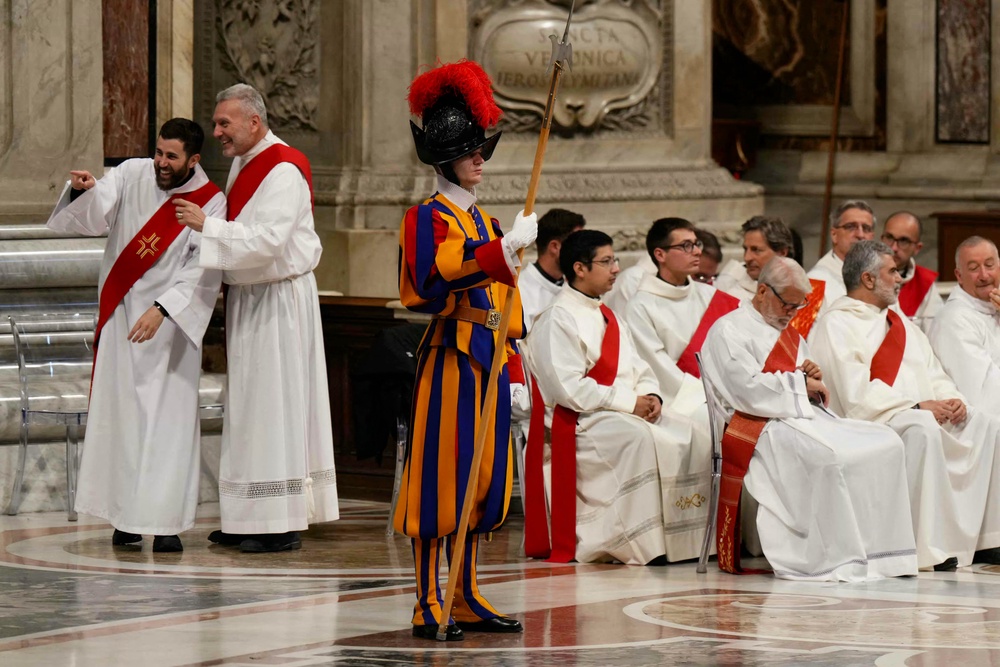
The Swiss Guard has been a feature of the Vatican for centuries, but their uniforms in bright stripes of yellow, blue and red belie their legitimate military training.
They have formed part of the Vatican’s security since 1506, and have sometimes been referred to as the smallest army in the world.
According to the Encyclopedia Britannica, members must be Swiss Roman Catholics between the ages of 19 and 30, and have undergone basic training in the Swiss military.
Despite being Swiss, they are independent of the Swiss military and are instead employed by the Catholic Church.
New pope must bring groups together, expert says
18:31
,
Jabed Ahmed
The next pope must be someone who can bring together disparate groups within the Catholic Church, an emeritus professor of Catholic theology at the University of Bristol said.
Prof Gavin D’Costa said: “Although politics and power exist within the conclave, like any large institution and as shown in the recent film Conclave, the primacy of prayer by the cardinals – and their chief concern for the common good of the Church – should be kept clear.
“This conclave is more universal in representative terms than any other in the history of the Church, even if it is also lacking in balance – having more European cardinals than any other single group, but with a dwindling Catholic population in Europe.
“The priority will be to select a Pope who embodies the common good, who can unite disparate groups within Catholics, and provide a vision of the Church that can be conducive to peace, cooperation and justice in a broken world.”
Pictured | Faithful pray at the Vatican
18:16
,
Jabed Ahmed
An imposter gatecrashed the last conclave
17:56
,
Jabed Ahmed
The most recent conclave in 2013 featured a bizarre incident before the official proceedings began - when a fake cardinal gatecrashed a pre-conclave meeting.
The impostor was caught sneaking into a gathering of cardinals dressed in fake clerical robes before he was escorted out of the Vatican by Swiss Guards.
He reportedly shook hands with priests and said his name was “Basilius”. He also reportedly told his fake peers that he was a member of the “Italian Orthodox Church” - which does not exist.
He was discovered by a guard who noticed he was wearing a pink scarf around his waist rather than the proper sashes worn by true cardinals.
All eyes on Sistine Chapel for smoke
17:36
,
Jabed Ahmed
All eyes are on Vatican City for the sign of a new pope.
Smoke indicating whether or not the 267th pope has been chosen could come from the specially erected chimney of the Sistine Chapel as early as Wednesday evening.
If black smoke rises into the air over St Peter’s Square, it will confirm no one achieved the required two-thirds majority, and voting will resume on Thursday.
Up to four votes a day can take place from then, two in the morning and two in the afternoon, with white smoke confirming a new pope has been chosen.
Watch | key moments from the funeral of Pope Francis
17:18
,
Jabed Ahmed
Just over a week ago, hundreds of thousands of people gathered in Rome and the Vatican to farewell the much-loved Pope Francis.
Here are the key moments from that historic funeral.
Watch: cardinals take oath of secrecy
16:59
,
Rachel Clun
The conclave has begun, but earlier the cardinals all swore oaths of secrecy in Latin.
Watch that ceremony here:
‘Extra omnes’ is called, starting the conclave
16:43
,
Rachel Clun
Archbishop Diego Ravelli has called out "Extra omnes," Latin for "all out."
It means anyone not eligible to vote must leave the Sistine Chapel.
The doors will be closed and ceremonially locked, allowing the work of the conclave to begin.
The word conclave comes from the Latin, con clave, which means ‘with a key’.
In pictures: Scenes at the vatican as conclave begins
16:38
,
Rachel Clun
Many people have gathered in St Peter’s Basilica to watch the ceremonies leading up to the start of the conclave.
The cardinals are continuing to swear their oaths.
Cardinals taking vow of secrecy in order of seniority
16:26
,
Rachel Clun
The cardinals are currently taking the vow of secrecy, before the conclave begins.
The Vatican News reports they are going in order of seniority.
First was Cardinal Pietro Parolin, who has been the Vatican’s secretary of state for more than a decade. He was, before Pope Francis died, the second most senior member of the Catholic Church.
In pictures: Faithful watch as conclave begins from St Peter's Square
16:14
,
Rachel Clun
Faithful, tourists and the media gathered in St Peter’s Square to watch as the cardinals go through the last ceremony before the conclave begins.
Oath of secrecy now being read
16:01
,
Rachel Clun
The oath all 133 cardinals must swear to is now being read.
The oath is in Latin, but each cardinal must swear to uphold the secrets of the election of the Pope, including how they came to the decision, unless the new pontiff decides the deliberations can be made public.
Each cardinal must now make their vow while placing their hand on the Book of the Gospels.
Cardinals bow to crucifix in Sistine Chapel
15:42
,
Rachel Clun
As the cardinals file into the Sistine Chapel, they bow in pairs at the altar.
Behind the altar is a crucifix, and behind that is Michelangelo’s Jesus the Judge mural.
Shortly, they will make their oaths before the conclave can begin.
The procession into the Sistine Chapel starts
15:34
,
Rachel Clun
The cardinals are slowly walking past the Swiss Guards in a short procession to enter the Sistine Chapel.
Led by a crucifix, the clergy are chanting the Litany of the Saints as they lead the 133 cardinal electors into the chapel.
What will happen before the conclave officially begin
15:27
,
Rachel Clun
The conclave will start shortly.
As mentioned earlier, the cardinals have gathered for the final ceremony before their secret deliberations begin.
Soon, they will have an oath-taking ceremony: taking vows of secrecy, and vowing to carry out their duty.
After that, the retired preacher of the papal household, Cardinal Raniero Cantalamessa, will deliver a meditation.
The master of papal liturgical ceremonies, Archbishop Diego Ravelli, will then calls out "Extra omnes," Latin for "all out."
Anyone not eligible to vote then leaves and the chapel doors close, allowing the work to begin.
Watch live: final ceremony before conclave is underway
15:25
,
Rachel Clun
The cardinals have gathered for the final ceremony before their secret deliberations begin.
A guide to history’s most unusual Conclaves
14:50
,
Rachel Clun
Conclaves to elect a new pope come with some 800 years of history, and not all of those papal elections have been orderly affairs.
From fist-fighting to pranks, here is a look some of the most unusual Conclaves in history:
Senior cardinal says new pontiff must be ‘the Pope that our time needs’
14:32
,
Rachel Clun
Cardinal Giovanni Battista Re said the election of the new pope “is not a simple succession of persons”, in his homily during Mass this morning.
“Let us pray, then, that the Holy Spirit, who in the last hundred years has given us a series of truly holy and great Pontiffs, will give us a new Pope according to God’s heart for the good of the Church and of humanity,” he said.
“Let us pray that God will grant the Church a Pope who knows how best to awaken the consciences of all and the moral and spiritual energies in today’s society, characterised by great technological progress but which tends to forget God.”
Re said the world today expects a lot from the Church, particularly when it comes to safeguarding spiritual values.
“May the Blessed Virgin Mary, Mother of the Church, intercede with her maternal intercession, so that the Holy Spirit will enlighten the minds of the Cardinal electors and help them agree on the Pope that our time needs.”
Senior cardinal says Church needs a new Pope who can lead ‘at this difficult and complex turning point in history’
14:14
,
Rachel Clun
Earlier, the Dean of the College of Cardinals Giovanni Battista Re led the special Mass for the election of the Pope, before the cardinal electors enter the secret conclave.
In his homily, Re said the cardinal electors were undertaking “an act of the highest human and ecclesial responsibility”, and were faced with a choice “of exceptional importance”.
“We are here to invoke the help of the Holy Spirit, to implore his light and strength so that the Pope elected may be he whom the Church and humanity need at this difficult and complex turning point in history,” Re said.
Why the Vatican is cutting the phone signal ahead of the Conclave
14:00
,
Rachel Clun
Phone signals cut, signal jammers in place and boosted security: the Vatican is taking the secrecy surrounding the conclave extremely seriously.
Soon, the 133 cardinal electors will take oaths of secrecy before the conclave to select the next Pope begins, following the oaths taken by the 100-or-so support staff who will help them for the duration of their deliberations.
But the Vatican has taken other measures to ensure no news of the deliberations inside the chapel leaks out before the white smoke signal rises over the Sistine Chapel roof.
The office of the governor of Vatican City said on Monday that the phone towers in the city state will be deactivated at 3pm Roman time (2pm UK time) on Wednesday.
Read more about the security around the conclave below:
The Roman tailors to the Popes
13:47
,
Rachel Clun
Two Roman tailors have also been wondering who will lead the Catholic Church.
Ahead of previous conclaves, the tailors had been asked to provide white cassocks in three sizes - small, medium and large - so that the newly elected Pope can get changed before their first public appearance as pontiff.
Raniero Mancinelli, who's been working on papal vestments since the early 1960s, said he's prepped three robes to donate to the Vatican anyway.
He said different Popes have had different preferences, down to the quality of the fabric used.
"Francis preferred things that were much simpler and practical," Mancinelli said inside his shop, just down the street from one of the Vatican's main entrance gates. "Ratzinger [Pope Benedict XVI] liked slightly more choice fabrics."
Lorenzo Gammarelli, the sixth-generation owner of an ecclesiastical tailor shop in downtown Rome, recalled the family lore that when John XXII was elected, the cassock was too small.
"So they had to intervene in the background, use pins to take it out so he could appear on the balcony," Gammarelli said.
Key frontrunners to be the next pope: Pietro Parolin
13:17
,
Rachel Clun
Italian Cardinal Pietro Parolin has appeared on nearly every shortlist as a contender to be the next pope.
Parolin has been the Vatican’s secretary of state for the past 12 years, the next most senior member of the Catholic Church after the Pope.
His role as the Vatican’s top diplomat has brought him into contact with cardinals around the world, both in their home countries and in Rome, meaning he is well-known to all 132 other electors going into the conclave.
The 70-year-old, originally from a small town in the northern Italian region of Veneto, is said to be a steady administrator who could bring calm after three at-times tempestuous papacies.
Italian newspaper Corriere della Sera reports he could already have the support of 50 cardinals ahead of their lock-up this afternoon.
Read more about Parolin below:
Key frontrunners to be the next pope: Pierbattista Pizzaballa
13:00
,
Rachel Clun
According to insiders, another Italian could be in the running to be the next pope: Pierbattista Pizzaballa, the Patriarch of Jerusalem.
The 60-year-old is one of the younger cardinals tipped to potentially succeed Pope Francis, but he has emerged as a favourite largely thanks to his role as leader of the Catholics in the Holy Land, at a time when events in Israel and Gaza are at the forefront of global politics.
Choosing Pizzaballa would be a significant geopolitical statement by the Church, particularly because the Church has at times been highly critical of Benjamin Netanyahu.
Pope Francis was known to highly respect him, and Pizzaballa is known for being a successful diplomat and a leading Biblical scholar.
What is the Swiss Guard?
12:42
,
Rachel Clun
The Swiss Guard has been a feature of the Vatican for centuries, but their uniforms in bright stripes of yellow, blue and red belie their legitimate military training.
They have formed part of the Vatican’s security since 1506, and have sometimes been referred to as the smallest army in the world.
According to the Encyclopedia Britannica, members must be Swiss Roman Catholics between the ages of 19 and 30, and have undergone basic training in the Swiss military.
Despite being Swiss, they are independent of the Swiss military and are instead employed by the Catholic Church.