

Not too long ago, Malaysians and wildlife enthusiasts globally celebrated a rare, heartwarming victory when a wild Malayan tapir was rescued after accidentally wandering into a suburban home in Selangor. For a brief moment, social media was flooded with messages of hope, highlighting a collective sigh of relief that one of Southeast Asia's most reclusive, prehistoric creatures had bypassed the hazards of human infrastructure. It was proof that when we see wildlife encroaching on our world, our immediate instinct can be one of protective awe.
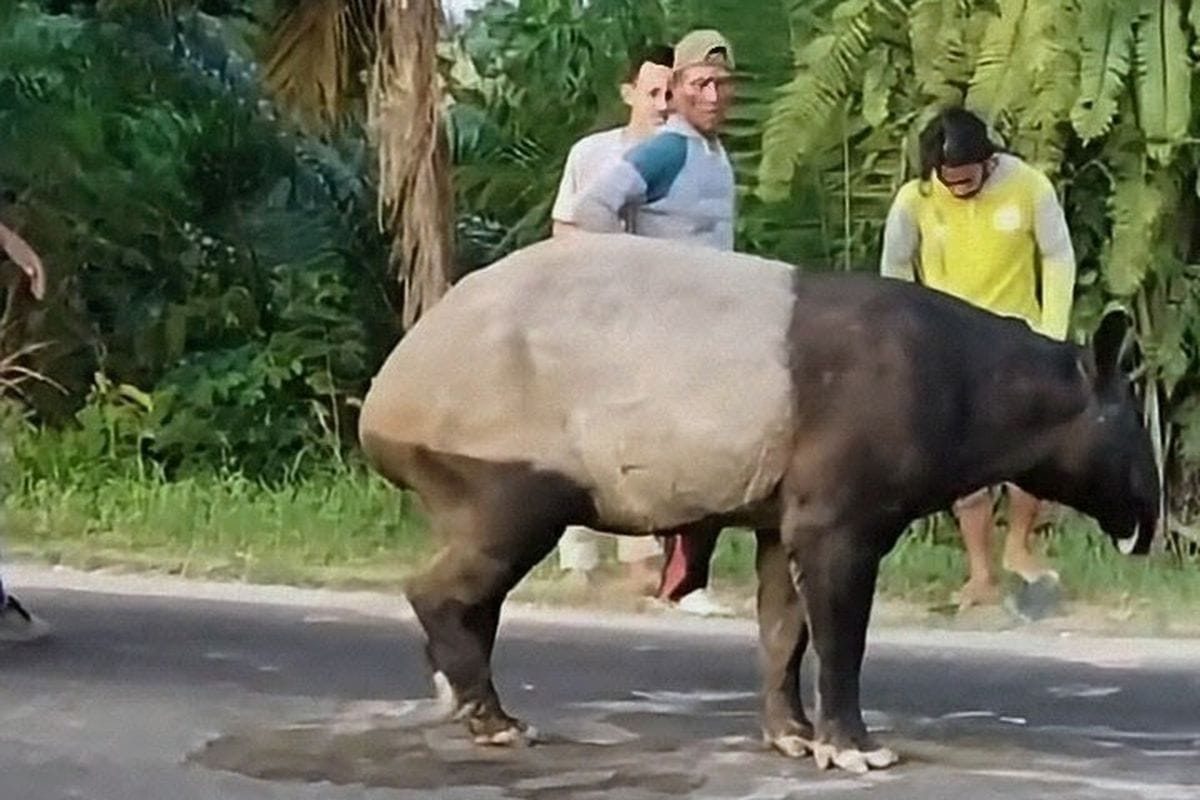
Yet, less than a year later, a horrifyingly dark mirror to that Selangor rescue played out just across the Malacca Strait. On Thursday, July 2, 2026, a magnificent, endangered Malayan tapir lost its way and stumbled onto the asphalt of the Trans-Sumatran Highway (Jalan Lintas Timur Sumatera) in the Register 45 forest area of Mesuji Regency, Lampung, Indonesia. Striking, gentle, and visually unmistakable with its monochrome coat, the tapir became an instant viral sensation. Local passersby quickly whipped out their smartphones to record the disoriented creature as it lumbered past trucks and motorbikes.
But what began as a viral curiosity took a sudden, stomach-churning turn into absolute barbarism. Rather than alerting environmental authorities or guiding the animal back to safety, a group of local villagers weaponized the tapir's confusion. Within hours of its internet debut, the gentle herbivore was hunted down, cornered, and brutally slaughtered. By Friday, Indonesian investigators from the Mesuji District Police confirmed a gruesome reality: the tapir had not only been killed, but its carcass had been chopped up, distributed among neighbors, and cooked into a local spicy dish known as rica-rica.
The law eventually caught up, with four perpetrators Ketut Suwarne (50), Wayan Supatre (30), Tri Suharyanto (45), and Made Putra Yasa (43) swiftly arrested, while two others remain at large. But the meat had already been digested, the species had lost another precious breeder, and the video of its slaughter was left circulating online. For Malaysian readers, this tragedy strikes incredibly close to home. The Malayan tapir is not just an Indonesian inhabitant; it is a shared regional treasure, deeply woven into the natural identity of Peninsular Malaysia. The incident poses an uncomfortable, urgent question: Are we fundamentally incapable of coexisting with the remnants of the ancient world, or have our socio-cultural institutions failed to teach us the value of life over appetite?
The Psychology of the Panicked Encounter
To understand how a viral phenomenon transforms into a communal dinner, one must dismantle the deep-seated cultural friction between rural communities and escalating wildlife displacement. Environmental agencies, such as the Indonesian Natural Resources Conservation Agency (BKSDA), regularly emphasize that tapirs are entirely non-aggressors. They are nocturnal, reclusive, and possess exceptionally poor eyesight, relying almost entirely on their senses of smell and hearing to navigate the dense undergrowth. When a tapir stops and sniffs the air on a busy highway, it is not challenging human authority; it is paralyzed by sensory overload, trying to map an alien, terrifying environment.
Yet, a deep sociological disconnect persists within communities bordering fragmented forests. In many rural areas across Malaysia and Indonesia, wildlife is rarely viewed through the romanticized lens of global conservation. Instead, larger animals are frequently perceived through two primary paradigms: an agricultural threat to livelihoods, or a sudden, opportunistic source of free protein. Investigators noted that the perpetrators in Mesuji acted purely on the motive of local consumption. There was no underground syndication or international smuggling network involved; it was a casual, opportunistic hunting excursion that treated a globally endangered treasure with the same indifference as an encroaching wild boar.
This casual indifference points toward a profound breakdown in educational and cultural infrastructure. When a community sees an animal listed as "Endangered" on the International Union for Conservation of Nature (IUCN) Red List, that designation carries zero weight if local socio-economic realities favor immediate consumption over long-term conservation. In many traditional mindsets, historical habits of subsistence hunting override modern statutory boundaries. The transition from filming an animal on a smartphone to hacking it apart with a cleaver reveals a dangerous cognitive dissonance: the digital world recognizes the creature's rarity, but the physical world treats it as fair game.
The Shrinking Safe Zones of Southeast Asia
The slaughter in Lampung cannot be analyzed as an isolated act of human cruelty; it is the direct byproduct of relentless, institutionalized habitat destruction. The Register 45 area where the tapir was poached is a stark example of a landscape under siege. Historically a dense migratory corridor, the region has faced massive encroachment, illegal logging, and conversion into extensive agricultural plantations. When corporate and smallholder agricultural interests systematically erase the margins of the jungle, they systematically force wildlife into direct, fatal contact with human civilization.
This pattern of structural encroachment is painfully familiar to conservationists operating within Malaysia. Academic and field studies routinely document how megafauna, including elephants, tigers, and tapirs, are squeezed into ever-shrinking pockets of protected forest. According to long-term data tracking habitat loss across Sundaland, the fragmentation of pristine forests forces animals to cross commercial highways and enter oil palm plantations merely to find food or mates. Every road cut through a jungle acts as a fracture point, splitting genetic pools and creating deadly bottlenecks where animals are highly exposed to vehicle collisions or human ambush.
The institutional failure, therefore, lies not just in poor local policing, but in a regional development model that treats wildlife corridors as secondary to economic expansion. When state planning permits high-speed highways to bisect critical ecosystems without mandating heavy investments in wildlife overpasses, underpasses, or continuous fencing, it guarantees encounters like the one in Mesuji. The tapir didn't choose to walk into the path of its killers; human infrastructure left it with absolutely no other route to take.
Justice on Paper vs. Enforcement on the Ground
In the aftermath of the Lampung slaughter, Indonesian political figures have loudly demanded blood. Members of the Indonesian House of Representatives, including DPR Komisi IV official Daniel Johan, publicly condemned the act, pushing for the absolute maximum legal penalties to create a national deterrent. Under the updated Conservation Law (Pasal 40a UU RI No. 32/2024), the perpetrators face severe multi-year prison sentences for hunting, killing, and consuming a strictly protected species.
However, historical analysis of wildlife crime across Southeast Asia reveals a stark gulf between statutory penalties and real-world deterrence. All too often, environmental laws are robust on paper but incredibly fragile in execution due to underfunded forestry departments, vast geographical terrains, and a lack of localized enforcement officers. In rural zones, by the time forestry rangers or police units receive a tip-off about a stray animal, local communities have often already processed, hidden, or consumed the evidence.
Moreover, punitive justice alone fails to address the root causes of wildlife slaughter. Locking up four villagers does not restore a breeding adult to a plummeting population, nor does it automatically reform the underlying cultural attitudes of neighboring districts. Without proactive, continuous grassroots community engagement where local populations are financially incentivized or socially proud to act as guardians of their native ecosystems enforcement agencies will always find themselves arriving too late, arriving only to document a crime scene and secure bags of residual meat.
A Shared Regional Crisis: The Malaysian Mirror
For the Malaysian public, reading about the horrific end of a tapir in Sumatra should serve as an alarming wake-up call rather than an opportunity for national complacency. The Peninsular Malaysia landscape is plagued by the exact same conservation crises. The Department of Wildlife and National Parks Peninsular Malaysia (PERHILITAN) frequently records high rates of tapir roadkill incidents, where these magnificent animals are crushed by speeding vehicles on rural highways cutting through states like Pahang, Johor, and Terengganu.
The underlying problem remains identical: a structural failure to prioritize the safety of our native biodiversity within our national development masterplans. Whether a tapir dies instantly under the wheels of an express bus in Malaysia or is butchered for a rica-rica feast in Lampung, the ecological outcome is exactly the same a swift, unyielding march toward regional extinction. The tragic loss of this single Sumatran tapir serves as a stark reminder of the fragile state of our shared natural heritage, demanding that both nations urgently rethink how we manage the spaces where human progress collides with the wild.
What Do You Think? I’d Love to Hear Your Opinion in The Comments Section.
The horrific imagery of an ancient, peaceful creature being sliced into kitchen portions should deeply shake our collective conscience. It forces us to look into a mirror and assess the true, hidden cost of our expanding modern lifestyles, our expanding roads, and our expanding indifference. If we continue to tolerate the destruction of our jungles and look away when our communities treat endangered wonders as disposable commodities, we are actively choosing a culturally barren future. We are choosing a world devoid of its ancient marvels, leaving behind nothing but concrete, asphalt, and the haunting memories of species we failed to protect.
We must decide right now what kind of stewards we want to be for this planet. Will we continue to let greed, fear, and casual ignorance dictate the fate of our remaining wildlife, or will we step up to build a society where these unique creatures can roam without the constant threat of human violence? The choices we make today will echo for generations to come.
AM World (tameer.work88@gmail.com) is a content creator under the Newswav Creator programme, where you get to express yourself, be a citizen journalist, and at the same time monetize your content & reach millions of users on Newswav. Log in to creator.newswav.com and become a Newswav Creator now!
The User Content (as defined on Newswav Terms of Use) above including the views expressed and media (pictures, videos, citations etc) were submitted & posted by the author. Newswav is solely an aggregation platform that hosts the User Content. If you have any questions about the content, copyright or other issues of the work, please contact creator@newswav.com.