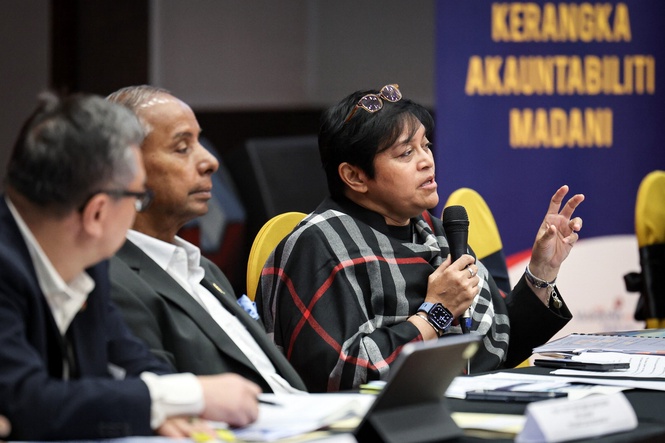
“This is a people’s Bill, especially for families who want answers concerning a death,” she said.
KUALA LUMPUR: The proposed Coroner Bill may only be tabled next year, despite an earlier target to complete the legislation this year, said Minister in the Prime Minister’s Department (Law and Institutional Reform) Datuk Seri Azalina Othman Said.
She said the upcoming Budget session could make next year a more practical timeline for tabling the proposed legislation.
“I asked for it, if possible, to be done this year. But we have the Budget session.
“Perhaps next year would be best,” she told reporters after launching a public consultation on the proposed Bill here today.
Azalina said the legislation was intended to establish clearer procedures for investigating deaths and ensure families were not left struggling to obtain answers.
“We hope that with this Act, we can establish certain SOPs and the questions being raised can be answered.
“We don’t want a situation where, when there is a death, the family has to search around for answers.
“Sometimes they are told it is an official secret or given all sorts of responses. That cannot be the case,” she said.
She stressed that existing procedures for inquests would remain, with the proposed Coroner Act intended to complement the current legal framework and provide greater clarity.
“This is a people’s Bill, especially for families who want answers concerning a death,” she added.
The move was first announced under Budget 2026 last October, when Prime Minister Datuk Seri Anwar Ibrahim said the government’s Law Reform Team was studying comprehensive reforms to criminal and contract laws, including the drafting of a new Coroner Bill.
The work progressed this year, with the Criminal Law Reform Committee discussing a study on the proposed Coroner Act at its meeting on March 16 as part of its wider review of criminal law reforms.
In her speech earlier, Azalina said Malaysia currently conducts inquests under Sections 328 to 341A of the Criminal Procedure Code and Practice Direction No. 2 of 2019.
She said death investigations had become increasingly complex with the involvement of digital evidence, forensic analysis, medical records and multiple agencies.
She said the proposed law was being considered with three main objectives: establishing a clear and comprehensive legal framework; creating a more structured, independent and transparent coroner system; and clarifying the responsibilities of parties involved when a death is reported.
The ongoing study will examine, among other matters, categories of deaths that must be reported, the jurisdiction and independence of coroners, uniform procedures, inter-agency coordination, preservation of evidence, timeframes for action and the rights of families.
However, Azalina stressed that the policy parameters for the Bill had yet to be finalised, with input now being sought from government agencies, legal practitioners, academics, civil society groups and the public.
She pointed to several high-profile deaths in recent years as examples of why Malaysia needed a more independent, thorough and trusted process for investigating deaths.
“There are the cases of the late Muhammad Adib Mohd Kassim, Teoh Beng Hock, as well as deaths in custody such as those involving the late A. Kugan and S. Balamurugan.
“The names I have mentioned are not intended to point fingers or determine who is at fault.
“Instead, they serve as an important reminder that when serious questions arise over a death, the public is entitled to a process that is independent, thorough and trusted.”