
The Netherlands has long been one of the most important sources of chipmaking equipment for Taiwan's semiconductor industry, and TSMC's most advanced production lines depend on a single supplier for extreme ultraviolet (EUV) lithography machines: Dutch firm ASML. But in recent years the Netherlands has also been pulled, directly and indirectly, into the US-China tech war. As Washington keeps tightening export controls on China's chip sector, one Dutch expert warns that Beijing's response is accelerating a push to build its own chipmaking tools domestically, and the next battleground may not be the most cutting-edge machines at all, but a tier below them.
Why DUV Lithography Could Become China's Next Target
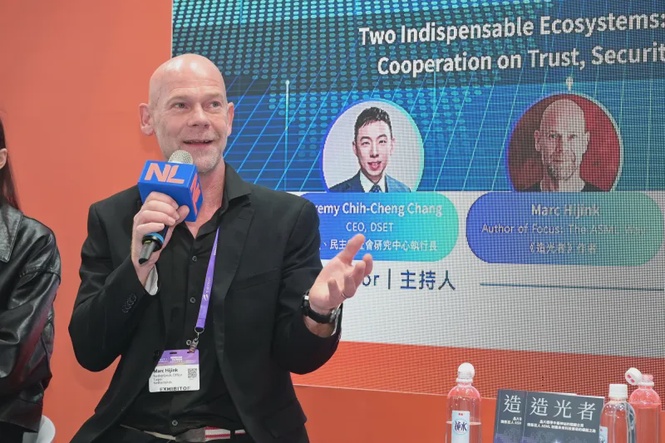
Taiwan's National Science and Technology Council-backed think tank, the Center for Democracy, Technology, Society (DSET), and the Netherlands Office Taipei jointly hosted a panel last week on the sidelines of SEMICON Taiwan titled "Two Indispensable Ecosystems: Deepening Taiwan-Netherlands Cooperation on Trust, Security and Supply Chain Resilience," according to a DSET press release.
Marc Hijink, a senior technology reporter at the Dutch newspaper NRC and author of "Focus: The ASML Way," shared what he has observed over the past year as China pushes to localize its chipmaking equipment industry. He said that against the backdrop of US and Dutch export restrictions on advanced semiconductor manufacturing tools, Chinese companies are accelerating development of alternative equipment, including deep ultraviolet (DUV) lithography machines, a less advanced technology than EUV but still central to chip production. Hijink said he expects ASML to face growing competition from Chinese firms in the DUV equipment market in the years ahead.
Comparing China's industrial model with the ecosystems built by Taiwan, the Netherlands and other allied partners, Hijink argued that China's approach leans heavily on vertical integration, with relatively low levels of trust between companies. By contrast, he said, the semiconductor ecosystem shared by Taiwan, the Netherlands and their partners is built on a highly specialized, horizontally integrated model, one where trust between companies is the key ingredient holding the whole system together.
How Nexperia's Breakup Shows A Fragmenting Chip World
Hijink also pointed to Nexperia as a case study in how geopolitics is reshaping the global semiconductor industry. Nexperia was originally part of Dutch electronics giant Philips' semiconductor business, focused mainly on mature-node chips used in the automotive industry. After the company was acquired by Chinese capital, it was gradually drawn into geopolitical friction that eventually escalated into a standoff between the Dutch and Chinese governments.
Hijink said Nexperia has effectively split into two halves: one operating as a Dutch entity supplying Western markets, the other forming a relatively independent supply system inside China. He called that split a microcosm of the broader fragmentation now underway across the global economy, and said he is currently writing a new book centered on the Nexperia saga. He added that the episode served as a warning for all of Europe, underscoring the need for the continent to more aggressively secure its own chip supply chains, even if building a safer, more reliable supply chain means accepting higher costs for European companies.
Why Taiwan Remains The Trusted Partner The West Needs
DSET national security policy analyst Fang Yi-ran offered a Taiwan-centric view of how Taipei, the Netherlands and the US are working together to counterbalance China's massive industrial capacity. She said Taiwan's fully built-out semiconductor cluster has made it a reliable, trusted partner and supply source for Western markets.
Fang called on European automakers to build long-term, stable partnerships with Taiwan rather than turning to the island only when a supply chain crisis hits. She emphasized that Taiwan is home to a large number of mature-node chip manufacturers, positioning it as a democratic and trustworthy supply chain option outside of China.