Malaysian pharmaceutical company BREGO Life Sciences has started a consumer awareness drive on counterfeit supplements and other fake health products sold online. Called Tidak Pasti? Tidak Beli (Not sure? Don’t buy) and run in support of the Ministry of Health’s Tolak Ubat Tidak Sah (TOBaTS) campaign, it asks shoppers to check a product and its seller before paying, because a convincing listing is no proof that the box is real.
The problem is not a small one. Citing Pharmacy Enforcement Division figures, Health Minister Datuk Seri Dr Dzulkefly Ahmad has said that illicit medicines worth more than RM132.4 million, covering over 64,000 products, were seized nationwide from 2023 to 2025. Most were unregistered health supplements and traditional remedies mixed with steroids such as dexamethasone, along with slimming products containing sibutramine.
Quick checks before you buy
- Where to buy: hospitals, clinics and authorised pharmacies. BREGO says it sells its own products only through these channels and not on online marketplaces.
- Registration: look up the MAL number on the pack in the National Pharmaceutical Regulatory Agency (NPRA) product search.
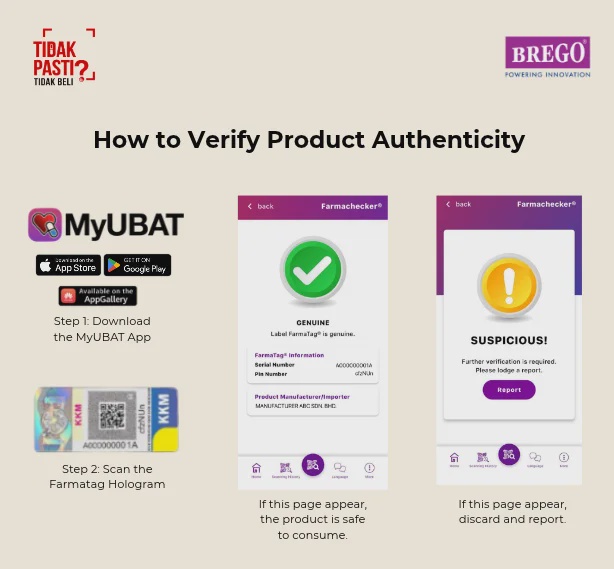
- Hologram: scan the FarmaTag security hologram with the Ministry of Health’s MyUBAT app.
- Red flags: a price far below the usual, a shop the brand does not recognise, or big health promises with little detail.
- Still unsure: don’t buy, and ask a pharmacist or doctor first.
Why counterfeit supplements are hard to spot
Fakes no longer look obviously fake. Counterfeiters copy packaging, branding and labels closely enough to pass a quick glance, and some online listings reuse a brand’s own product photos to appear legitimate.
BREGO says it has found more than 50 online shops selling counterfeit versions of its products. None of them was authorised by the company.
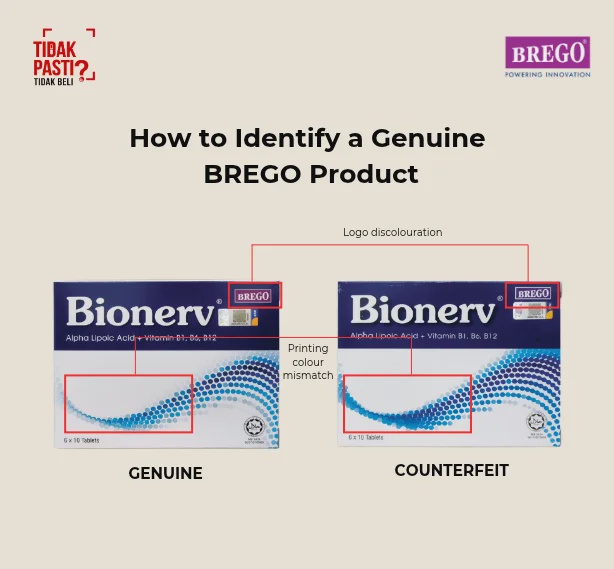
One of the products copied is Bionerv, BREGO’s tablet combining alpha lipoic acid with vitamins B1, B6 and B12. The campaign’s images put a genuine box from an authorised source beside a counterfeit bought online. The differences are easy to miss: the BREGO logo on the fake is discoloured, and the printed colours of the blue wave pattern do not match. The counterfeit tablet is also a different shape from the original.
Four warning signs of counterfeit supplements online
- A price that looks too good. Counterfeits are often sold well below the normal price to pull in buyers.
- A seller the brand does not list. Check whether the shop is an authorised distributor before ordering.
- Packaging that is slightly off. Watch for spelling mistakes, odd fonts, colour differences or flimsy materials.
- Bold health claims with few details. Be careful with listings that promise a lot but say little about where the product comes from.
How to check if a supplement is genuine
Spotting counterfeit supplements by eye is only a first step. For registered pharmaceutical, traditional and health supplement products, the MAL registration number on the packaging can be checked against NPRA’s official product search.
The pharmaceutical safety hologram, FarmaTag, can be scanned with MyUBAT, which reads every version of the hologram. Download the app from the App Store, Google Play or AppGallery and point it at the hologram. A green “Genuine” result means the label is recognised. A “Suspicious!” result means the label needs further checking, and the campaign’s advice is not to use the product and to report it.
Neither check settles the question on its own, since holograms and registration numbers can also be copied. That is why the source still matters. BREGO, for one, distributes only through hospitals, clinics and authorised pharmacies.
What counterfeit supplements can do to your health
Losing money is the smaller risk. Counterfeit or unregistered products may contain undeclared ingredients, uncontrolled doses of active compounds, banned substances or contaminants, so the buyer has no way of knowing what they are actually taking.
The campaign lists poisoning, allergic reactions, bleeding and dangerous interactions with prescription medicines among the possible effects. Some reactions are sudden. Others build up over repeated use, which makes it hard to link the problem back to a supplement.
Anyone who suspects they have taken counterfeit supplements should stop using them, keep them with their packaging, and see a doctor or go to a hospital for a medical assessment.
Bought something you’re unsure about? What to do
- Stop using it if you think it may be counterfeit.
- Keep the evidence: the packaging, hologram, receipt and order details.
- Report the listing to the online marketplace you bought it from.
- Report to the authorities: the Ministry of Health’s Pharmacy Enforcement Division at 03-7841 3200, or the Ministry of Domestic Trade and Cost of Living (KPDN) through its e-Aduan portal.
- Tell the brand through its official channels so it can help verify the product.
Not sure? Don’t buy
BREGO says the campaign will continue with more efforts to help consumers recognise the risks of counterfeit supplements and health products. Its core advice is simple: look past the photos, reviews and price tag, verify the product and the seller, and ask a qualified healthcare professional when in doubt.
For more on the issue, read about the steps to check the source of medicines sold online, shared at a forum in Kuala Lumpur earlier this month. BREGO’s earlier community work includes its BREGO Cares bone health screening programme.
BREGO Life Sciences is a Malaysian healthcare company whose products include Bionerv. More at brego.com.my.
The post Counterfeit Supplements Online: BREGO Campaign Shows How to Check appeared first on RISEMALAYSIA.my.