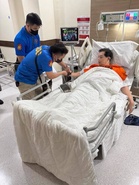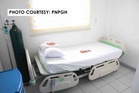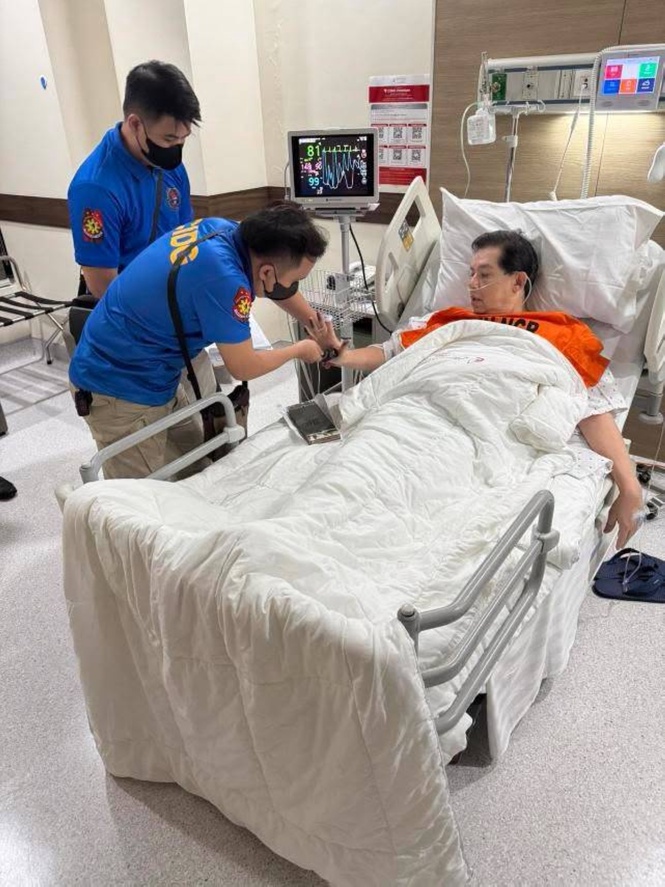
MANILA, Philippines — Doctors treating former speaker Martin Romualdez gave differing accounts before the Sandiganbayan on Thursday over the circumstances of his admission to Cardinal Santos Medical Center, as the court scrutinized his continued hospital confinement.
Dr. Kurt Allen Sibayan, the hospital’s admitting physician, testified that he was not allowed to examine Romualdez after the former speaker arrived at the hospital at around 4 p.m. on Sept. 7, 2026.
“We were advised that we were not allowed inside the patient’s room,” Sibayan told the court, identifying attending physicians Rody Sy and Rosalio Torres as the doctors who relayed the instruction.
Sibayan testified that Romualdez’s current condition was not an emergency case, but agreed with Associate Justice Ronald Moreno that the arrangement in which he was admitted directly to a hospital room without passing through the emergency room was “unusual.”
Sibayan added that Romualdez did not pass through the emergency room but was brought directly to a hospital room despite complaining of chest pain.
Although designated as the admitting physician, Sibayan said he was only asked to prepare Romualdez’s medical abstract on Sept. 9, and was not allowed to enter the room.
Torres later took the witness stand and contradicted Sibayan’s testimony, saying Sibayan had seen Romualdez and had relayed the former speaker’s medical condition to Torres.
Torres testified that a member of Romualdez’s staff had informed him that the former speaker complained of chest pains at around 9 a.m. on Sept. 7.
“I advised that he be confined to look into this problem,” Torres said.
Torres maintained that Romualdez should remain confined at Cardinal Santos because he was at “high risk of possible heart attack.”
“In case of emergency, he would have [need] an hour [to be treated]. We believe he may not be afforded that one hour [if he is to be moved to a new facility],” Torres told the court.
When Moreno asked what required Romualdez’s continued confinement, Torres cited unstable angina with underlying coronary disease, which he described as an impending heart attack.