Have you witnessed someone collapsing outdoors while trekking or at work? You shy away, unsure what to do, or are looking for a 4-digit number at the scene. Then you must read this article and share it with your family, friends, and community members. You never know when it will come in handy and save someone's life.
In light of recent news about sudden cardiac events during physical activities, it's more crucial than ever to equip yourself with the knowledge of Cardiopulmonary Resuscitation (CPR). This life-saving technique can make the difference between life and death in emergencies.
News report on Cardiac arrest.
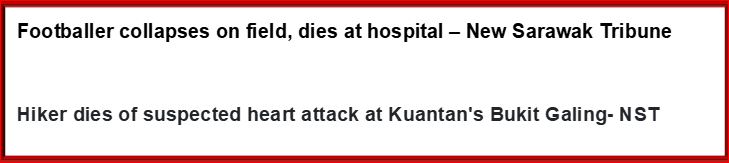
Cardiopulmonary resuscitation (CPR) has been proven to significantly increase the chances of recovery. It provides critical oxygenated blood flow to vital organs until advanced medical assistance can arrive. Hence, understanding and learning CPR is indispensable to saving lives.
Studies show that the chances of survival dramatically increase when CPR is performed promptly; victims who receive CPR from a bystander (Orang Awam or Pemerhati) experience a nearly two-fold increase in survival rates compared to those who do not. This stark contrast underlines the critical importance of public CPR training, as immediate intervention can significantly affect outcomes. In addition, research indicates that integrating advanced technologies, such as automated external defibrillators (AEDs), further enhances survival rates during cardiac events.
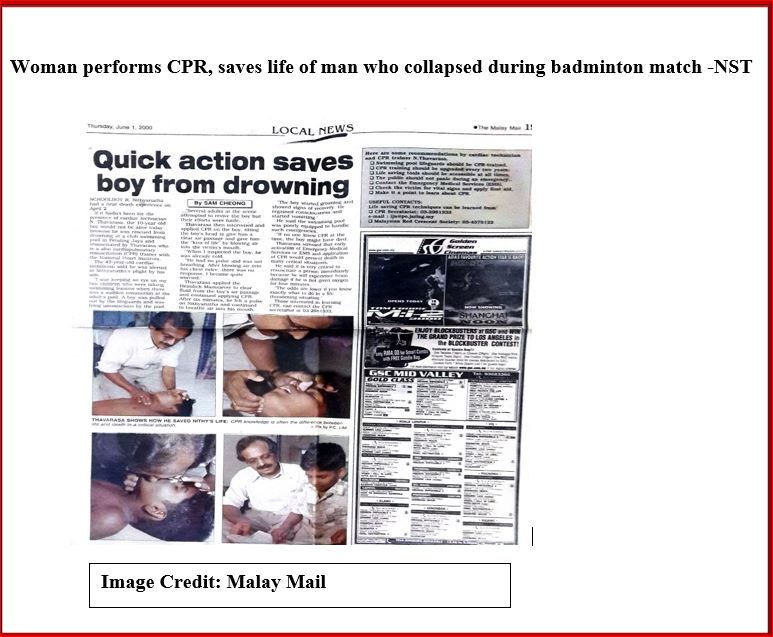
Time is of the essence when it comes to cardiac arrest. Look for these signs:
1) Sudden Collapse.
2) Loss of consciousness/unresponsiveness.
3) No breathing.
or abnormal breathing, i.e., gasping (a specific type of abnormal breathing pattern often occurring during cardiac arrest). It is characterized by irregular, labored breaths that may sound like snorting, gurgling, or moaning. Scan the victim’s chest for rise and fall.
4) No pulse.
While checking for a pulse is not always necessary before starting hands-only CPR, if you do check and find no pulse, this confirms the need for immediate chest compressions.
5) Seizure-Like Activity (Fits or Convulsion):
The person may exhibit seizure-like movements, including jerking or shaking of the body.
If you observe these symptoms, act immediately. Every second counts!
HANDS ONLY CPR was introduced by AHA (American Heart Association) in 2008.
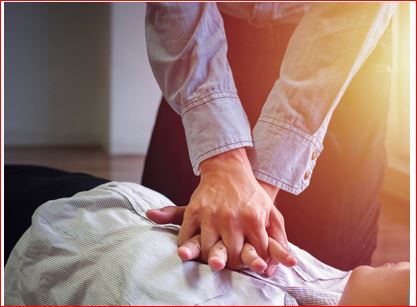
Is a simplified method for bystanders who are not trained in CPR to assist individuals experiencing sudden cardiac arrest. This approach emphasizes the importance of chest compressions without needing rescue breaths, making it more accessible for untrained individuals or those who may feel uncomfortable performing traditional CPR.
Overall, performing any form of CPR is better than doing nothing at all; initiating hands-only CPR can significantly double or even triple a victim's chance of survival until professional help arrives.
When to Use Hands-Only CPR.
Hands-only CPR is recommended in various scenarios.
1 )Witnessing Cardiac Arrest/Collapse: If an adult collapses and does not respond or breathe normally, hands-only CPR should be initiated immediately.
2) Unwitnessed Collapse: If you find an adult or adolescent who has collapsed and you are unsure about their condition, you should also begin hands-only CPR.
3) Unfamiliar Victims: Bystanders may feel uncomfortable giving rescue breaths to strangers due to concerns about hygiene or lack of confidence in performing breaths correctly.
4) Lack of Training: For individuals without training in traditional CPR, including rescue breaths, hands-on CPR provides a viable option that can still significantly increase survival chances.
Steps to Perform Hands-Only CPR.
In hands-only CPR, you do not check for a pulse or breathing before starting compressions. The focus is on immediate action when witnessing a cardiac arrest situation.
The first mantra: As rescuers, DO NOT PANIC and STAY CALM.
1. Verify scene safety: Make sure the scene is safe for you and the victim. Look for Hazards: Before approaching, scan the area for potential dangers such as traffic, fire, chemicals, or unstable structures.
2. Check for responsiveness: Check if the person is responsive by calling their name or shaking their shoulder.
3. Call for Help: If there is no response, call emergency services 999 before starting CPR.
4. Position the Victim: Ensure the person is lying flat on their back on a firm surface.
5. Perform chest compressions.
Kneel beside the victim and place your hands, one on top of the other, in the center of the chest. Kindly refer to the below video link.
Keep your arms straight and push down hard and fast, aiming for a depth of at least 2 inches (5 cm) at a rate of 100-120 compressions per minute. Let the chest rise completely between compressions. A helpful tip is to time your compressions to the beat of the song "Stayin' Alive" by the Bee Gees, which has an appropriate rhythm.
Learn Hands-Only CPR - YouTube (Please dial 999 in Malaysia)
Video credit to AHA- solely for educational purposes.
*6 You should continue performing hands-only CPR until one of the following occurs:
- Emergency Services arrive.
- The victim shows signs of recovery – begins to breathe normally or shows signs of consciousness.
- You are physically unable to continue – unable to maintain effective compression or someone else take over.
Now that you are aware of hands-only CPR, you can assist someone when the time comes.
Some Personal Advice:
Do not take packages offered by various organizations, as some packages consist of -Basic life support (BLS) including adults, children, and infants, this can be very confusing going through all these modules unless you are a healthcare professional.
So, it’s advisable to choose which module according to your needs if you have adults who are at risk—adult family members, workplace employees, teachers, and coaches sign up for adult CPR and/or child CPR. You can sign up for child and/or infant CPR if you are a caregiver and parent. It will be cost-effective and can be done in a couple of hours.
CPR training will be enough to provide lifesaving care in offices, schools, and outdoor/indoor situations.
It is advantageous to take CPR training incorporating an AED; familiarity with its operation can enhance your effectiveness in an emergency.
You can register for the CPR course at St. John Ambulance. Two hours of CPR+AED are free every last Sunday of the month, including theory, demo, and practical sessions. There is no assessment and no certificate. For more details, register at https://firstaid.sjam.org.my/learncpr/
Don't wait; invite your next of kin, friends, and community to not miss this opportunity.
Other facilities that provide CPR/BLS training include:
National Heart Association Malaysia,
and National Heart Institute (IJN).
https://cpr.ijn.com.my/contact.php
T. Navaratnam is a content creator under the Newswav Creator programme, where you get to express yourself, be a citizen journalist, and at the same time monetize your content & reach millions of users on Newswav. Log in to creator.newswav.com and become a Newswav Creator now!
The User Content (as defined on Newswav Terms of Use) above including the views expressed and media (pictures, videos, citations etc) were submitted & posted by the author. Newswav is solely an aggregation platform that hosts the User Content. If you have any questions about the content, copyright or other issues of the work, please contact Newswav.