
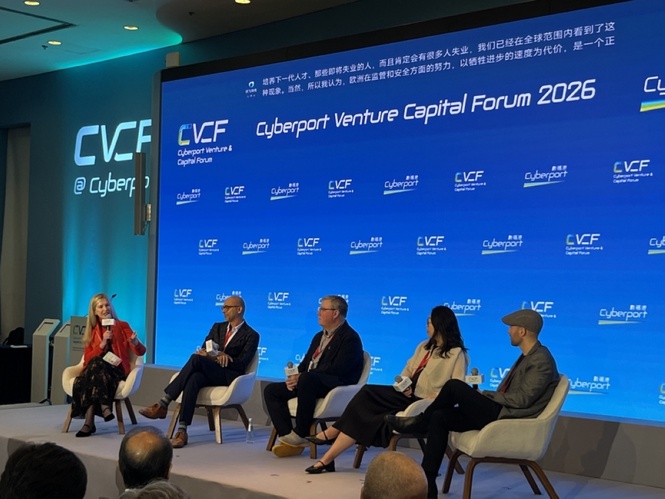
HONG KONG — Hong Kong’s Cyberport is open to establishing partnerships with Philippine agencies and technology organizations, with potential cooperation in information and communications technology (ICT) and customer service outsourcing, its chief public mission officer said during the Cyberport Venture & Capital Forum 2026 on Nov. 4.
Eric Chan, chief public mission officer of Cyberport, said the government-owned digital technology hub and artificial intelligence (AI) accelerator is developing international partnerships to help its start-ups gain access to overseas markets, funding, professional services and technology support.
“Yes, of course,” Chan said when asked whether Cyberport was exploring partnerships with agencies in Southeast Asia, including the Philippines.
He said Cyberport has established an international development team tasked with identifying partners in different markets. Its strategy is to work with one government-endorsed partner and one commercial partner in each country as a starting point.
“Wherever are interested to commit to that kind of support on a two-way street, then we are interested to talk to them,” Chan said.
Asked which Philippine sectors could be of interest, Chan cited the country’s established outsourcing industry.
“To my limited knowledge, Philippines has been a big ICT outsourcing and also customer service outsourcing centers. So maybe in that areas, for any of our companies working in those areas, we think Philippines would be a perfect target,” he said.
Chan described the partnerships as reciprocal arrangements through which Cyberport and its overseas counterparts could help companies enter each other’s markets, connect with potential customers and investors, and access local business networks.
Cyberport has signed more than 20 innovation collaboration agreements, he said, adding that the organization was looking to broaden its international network beyond its established relationships in Europe and the United States to include the Middle East, South Asia and Central Asia.
AI, cybersecurity, digital assets
Cyberport is also expanding its support for companies working in AI, blockchain, cybersecurity and data science, which Chan identified as its four technology clusters.
“We have gathered 40-50 good companies here” in cybersecurity, he said, including international companies that work with other members of the Cyberport community on product design and deployment.
Chan said Cyberport requires companies in its incubation program to undergo cybersecurity training and product vulnerability testing before graduating. The measures are intended to ensure that start-ups meet security standards before releasing products associated with the organization.
The hub also works with authorities, police and cybersecurity experts on exercises designed to improve the technical skills and security awareness of its community members.
The emphasis on cybersecurity comes as Cyberport expands its AI and digital asset activities. Chan said the organization’s community includes more than 2,400 companies, of which at least 500 are involved in AI.
He said Cyberport had built AI infrastructure for Hong Kong and was supporting research projects through government funding. Its community also includes companies working in financial technology, digital assets, blockchain and smart living, including health technology, education technology and gerontechnology.
On the question of AI investment returns, Chan said businesses were moving beyond preliminary experiments toward restructuring workflows and deploying AI in operational settings.
“People started from testing the idea, what it could be done with AI. Now very much transform into how it should be done,” he said.
He cited the expansion of Cyberport’s generative AI sandbox, initially developed for banks and later extended to insurance companies, securities firms and mandatory provident fund trustees. The projects increasingly involve workflow restructuring and agentic AI, with companies looking for efficiency gains.
Chan said Cyberport was also working with policymakers and regulators to help companies test financial technology applications in controlled environments. He cited more than 250 proof-of-concept projects supported through its collaboration with regulators and said 50 percent of the first batch of digital asset and blockchain pilot projects had been commercialized.
Governance remains part of AI expansion
Chan said AI development should include risk management, governance and ethical considerations, rather than focusing solely on technology deployment.
“We need to educate people. Not just on just pushing the technology, but also on how you plan to do it. That includes risk management. That includes AI governance, the ethical use of AI and all these,” he said.
He added that Cyberport was working with stakeholders on governance frameworks, standards and cybersecurity measures, while its AI service center provides support for companies undertaking AI transformation.
The organization has also launched an AI for All training initiative intended to reach students, parents, older people and underprivileged communities, working with nongovernmental organizations and educators.
“As an AI accelerator, yes, we are pushing AI because we don’t want people to miss out on this opportunity. But on the other hand, we would like to also help educate market on the necessary governance or guardrails they need to put in place,” Chan said.
Investor caution over AI expansion
Rebecca Fannin, founder and chief content officer of Silicon Dragon Ventures, said investors and technology companies should remain cautious about the possibility of an AI investment bubble.
Silicon Dragon Ventures is an events and media platform that Fannin said she has run for 15 years, covering technology innovation and venture capital hubs around the world. She raised concerns about the scale of AI investment, safety risks and the growing infrastructure requirements of the technology.
“I think we have to be cautious of an AI bubble,” Fannin said, pointing to signs that investors were becoming more concerned about spending and the financial performance of companies in the sector.
She also cited the growing controversy surrounding data center construction, particularly its demands on water, electricity and land.
“The use of water, the use of electricity, the use of land that could be used for agriculture, for instance,” she said.
Fannin said governments and investors needed to examine more carefully where data centers are built as AI adoption expands. She also cautioned that an investment downturn could force weaker companies out of the market.
“If they’re just me-too products, they’re going to go out of business,” she said. “And you’re going to see a separation of the winners from the losers.”
Despite the risks, Fannin said the technology itself would remain even if the investment market contracted. She also argued that cooperation between the United States and China was important, particularly on AI safety.
“There are some aspects where we can — China and US can cooperate,” she said. “In fact, they were cooperating before.”
The Cyberport Venture & Capital Forum 2026, held under the theme “Scaling in a Changing World: Winning the Next Competitive Cycle,” brought together venture capitalists, entrepreneurs and industry leaders to discuss AI, digital assets, regional investment and cross-border expansion.
Cyberport said its start-up community had raised more than HK$74.5 billion in cumulative funding and welcomed 19 listed companies and two unicorns over the past year. The organization also signed memorandums of understanding with Gobi Partners and Thailand’s National Innovation Agency to strengthen cross-border innovation and investment links.