
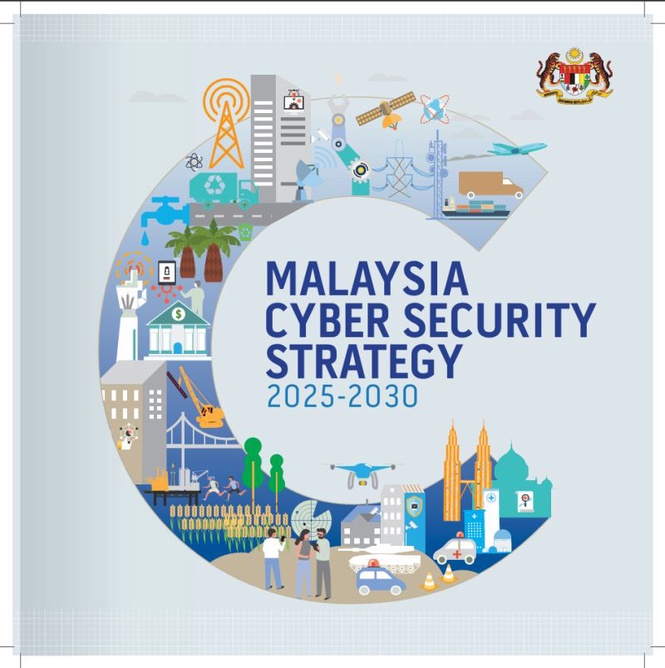
Malaysia’s launch of the Malaysia Cyber Security Strategy (MCSS) 2025–2030 at the National Cyber Defence & Security Exhibition and Conference (CYDES) 2025 marks a critical turning point in the nation’s digital security journey.
More importantly, it signals a long-overdue shift from reactive cybersecurity measures to a doctrine of proactive national cyber resilience.
The strategy is ambitious: 16 strategic goals and seven core objectives. It is a whole-of-nation framework that seeks to unite government, industry, academia and society under a single cybersecurity agenda.
Credit must be given to the National Cyber Security Agency (Nacsa) for pushing this agenda forward at a time when ransomware, artificial intelligence (AI)-powered cybercrime, digital espionage and critical infrastructure attacks are escalating globally.
Of equal importance is the recent launch of the Cyber Security Cryptography Development Centre (CSCDC), which has been tasked with strengthening Malaysia’s cryptographic expertise and preparing the country for post-quantum security challenges.
Crucially, the MCSS 2025–2030 comes at a defining moment for regional cyber cooperation.
Southeast Asian nations are simultaneously advancing the Asean Cybersecurity Cooperation Strategy 2026–2030, an initiative aimed at strengthening collective cyber resilience among member states through enhanced intelligence sharing, more harmonised policy frameworks, regional cyber exercises, capacity development and the protection of critical infrastructure.
In this context, Malaysia’s national strategy cannot function in isolation. Its long-term effectiveness will depend significantly on how well it integrates with wider Asean cyber coordination efforts, particularly in a threat landscape where cyber risks transcend national borders with ease.
However, strategies do not secure nations. Execution does.
Malaysia has produced no shortage of policy blueprints over the years. Many were ambitious. Many were celebrated at launch events. Too many eventually became shelfware – admired in presentations but absent in implementation.
MCSS 2025–2030 cannot be allowed to suffer the same fate.
The real challenge begins now.
The first priority must be governance. Nacsa should immediately establish a permanent cross-agency implementation task force bringing together the Digital Ministry, financial regulators, critical infrastructure operators, enforcement agencies, academia and private sector leaders.
The CSCDC must sit at the core of this structure as the lead technical executor for national cryptographic readiness.
What Malaysia needs next is not another vision document, but a detailed execution roadmap.
The 16 strategic goals must be broken into measurable phases: short-term priorities such as AI security governance and national cyber coordination mechanisms; medium-term objectives focused on talent development and operational resilience; and long-term ambitions surrounding innovation ecosystems, sovereign cyber capabilities and quantum-resistant infrastructure.
Without sequencing, accountability and measurable milestones, even the strongest strategy risks collapsing under bureaucratic inertia.
Transparency is equally essential.
Quarterly public dashboards tied to key national indicators – incident response times, critical national infrastructure compliance rates, ransomware trends and workforce readiness – would transform cybersecurity governance from opaque administration into measurable national performance.
Funding will determine whether this strategy survives contact with reality.
Cybersecurity cannot continue operating as a peripheral budget item while the nation digitises every layer of its economy.
Malaysia should ring-fence a dedicated annual allocation – potentially beginning at RM500 million – to fund national Computer Emergency Response Team (CERT) enhancements, cryptographic modernisation, cyber defence exercises, talent pipelines and strategic research and development.
This investment would also support Malaysia’s ability to contribute meaningfully to Asean-wide cyber resilience objectives under the Asean Cybersecurity Cooperation Strategy 2026–2030, particularly in areas such as cross-border incident response coordination, regional threat intelligence exchange and the protection of interconnected digital supply chains.
The cost of preparedness will always be cheaper than the cost of recovery.
The private sector must also be brought into the equation through meaningful incentives.
Tax breaks for compliant organisations, co-funded cybersecurity training and grants for innovation partnerships would create stronger industry participation instead of relying solely on voluntary cooperation.
At the same time, Malaysia must confront one of its most pressing structural weaknesses: talent.
A national cybersecurity strategy without a national cybersecurity workforce is merely an aspiration disguised as policy.
Malaysia urgently needs mandatory Chief Information Security Officer (CISO) certification standards, board-level cyber governance programmes and robust cyber education investments.
The nation must target training 10,000 cybersecurity professionals by 2028 through university-industry partnerships, with CSCDC leading in cryptography and post-quantum security expertise.
The Asean Cybersecurity Cooperation Strategy 2026–2030 prioritises regional workforce development and talent mobility, enabling Malaysia to build domestic skills and emerge as a hub for advanced training, cryptographic research and cyber leadership.
Cyber resilience must also extend beyond institutions into society itself.
Cyber hygiene education should become embedded in schools, SMEs and community programmes.
A digitally connected nation cannot remain digitally vulnerable at the citizen level.
Regulatory enforcement will ultimately determine credibility.
The Cyber Security Act 2024 must evolve into a living enforcement mechanism aligned directly with MCSS priorities.
Mandatory reporting obligations, sector-specific resilience standards, independent audits and national cyber exercises should become standard practice across critical sectors such as finance, energy, telecommunications and healthcare.
Voluntary compliance alone will not secure national infrastructure.
At the same time, Malaysia has an opportunity to position itself as a regional cybersecurity leader.
Investments in AI-driven threat intelligence, quantum-resistant technologies and regional cyber collaboration could elevate the country’s standing within Asean and beyond.
Joint exercises, intelligence-sharing frameworks and international partnerships will be critical in an era where cyber threats no longer respect borders.
As Asean implements its Cybersecurity Cooperation Strategy 2026–2030, Malaysia must lead in forging regional cyber norms, trusted digital ecosystems and resilience against AI cybercrime, ransomware, supply chain attacks and quantum threats.
Interconnected digital economies demand urgent cooperation.
How will MCSS 2025–2030 become a success?
Not through events, rhetoric or pillars – but through measurable national security gains.
A national cybersecurity strategy differs from national cybersecurity transformation primarily through operational discipline.
This includes clear timelines, defined budgets, assigned ownership, public accountability, annual reporting to Parliament and unwavering execution.
Malaysia has declared its cyber ambitions – the true test now lies not in strategy, but in whether the nation can operationalise resilience before the next crisis exposes the gap between aspiration and execution.
Murugason R. Thangaratnam is a cybersecurity practitioner and Adjunct Professor of Practice.
The views expressed here are the personal opinion of the writer and do not represent that of Twentytwo13.