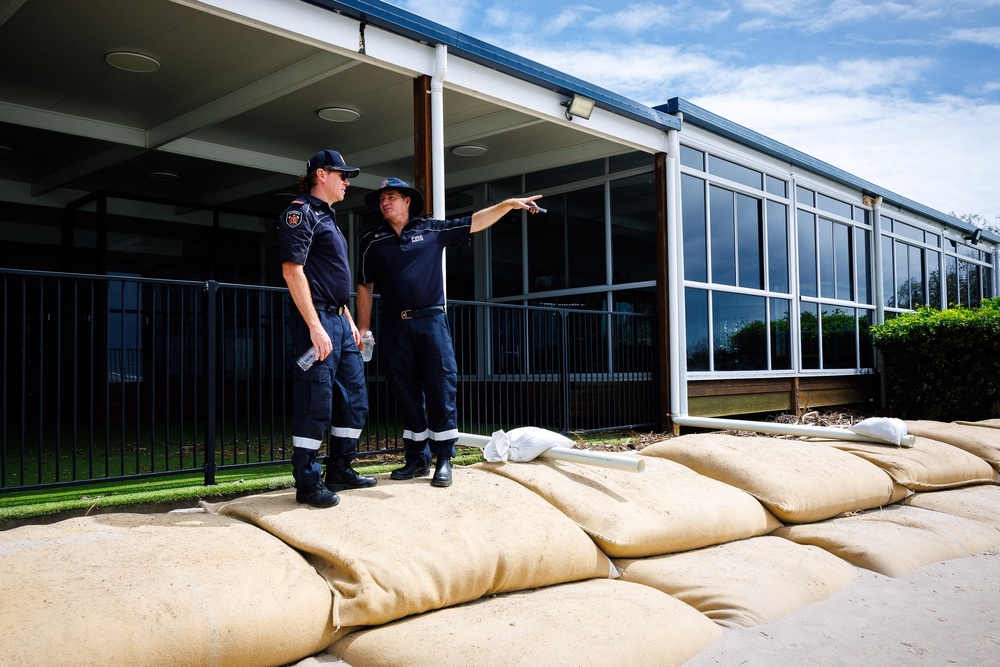
Australia is bracing for severe flooding as Cyclone Alfred nears, with the rare storm on the country's eastern coast expected to bring torrential rain, destructive winds, and storm surges.
The tropical cyclone is now forecast to make landfall early on Saturday, after its progress towards the coast dramatically slowed. Alfred was 240km east of Brisbane and moving west at just 7kmph on Thursday, with sustained winds near the centre gusting to 130kmph.
Forecaster Thomas Hinterdorfer from Higgins Storm Chasing said earlier that the storm slowing down would be the "worst case scenario", as it means a longer period of very heavy rainfall while the cyclone straddles the coast.
Strong winds have already cut power to thousands of homes, and Brisbane Airport has been closed, with hundreds of flights now suspended. The State Emergency Service has ordered evacuations in Lismore and other parts of northern New South Wales by 9pm.
Prime minister Anthony Albanese urged residents to exercise caution, saying that while the cyclone "has slowed up somewhat... that is not all good news".
Authorities are searching for a possible missing jetskier off the northern New South Wales coast, as rough seas pose life-threatening risks.
Read More
KEY POINTS
- Brisbane Airport closed and all flights cancelled ahead of Cyclone Alfred
- Cyclone Alfred landfall delayed as Australia braces for impact
- Lismore residents urged to evacuate as flooding threat looms
- Australia faces travel disruption as flights cancelled
- Search underway for possible missing jetskier
- Prime minister issues warning to residents
Surfers ignore urgent warning, threat of £7,700 fines
13:45
,
Steffie Banatvala
Surfers have been catching record-breaking waves on the Gold Coast, south of Brisbane, in what the acting mayor has called “reckless behaviour”.
“I am just staggered that people would be so stupid. It is a huge act of stupidity,” acting Gold Coast Mayor Donna Gates said.
It comes despite threats of fines of about £7,700.
Eastern coast hit with record-breaking waves
13:30
,
Steffie Banatvala
Australia’s eastern coast has been hit with record-breaking waves.
A 12.4 metre wave hit the Gold Coast famed for its popular sandy beaches south of Brisbane.
The wave is the largest to be picked up by their monitoring station yet.
Gales already developing on the coastal fringe
13:15
,
Steffie Banatvala
“We’re already seeing gales developing on the coastal fringe,” Bureau of Meteorology forecaster Sarah Scully told the AFP news agency.
“There have been very large waves and powerful swells. That’s generated by Alfred lingering in the Coral Sea and creating a whole lot of wave energy.”
Prime minister issues warning to residents as Cyclone Alfred stalls off Australia's east
13:00
,
Namita Singh
Cyclone Alfred has stalled off Australia's east coast, delaying its expected landfall, as officials shut airports, schools and public transport.
Queensland residents are stockpiling supplies and sandbagging homes against likely flooding when the category-two storm hits.
The storm is now expected to make landfall by Friday evening near Brisbane, Australia's third-most populous city, the Bureau of Meteorology said in its latest update, compared with a prior projection of a landfall by early Friday.
The storm's destructive reach will stretch across the border regions of the states of Queensland and New South Wales, bringing heavy rain, flooding and damaging winds.
"It has slowed up somewhat, that (landfall) will now be at a later time," prime minister Anthony Albanese told reporters.
"That is not all good news. The risk is that in slowing up, (the cyclone) increases in its intensity but at this stage it is still predicted to be category two as it crosses onto land."
Locals express relief over storm delay, gives ‘a little bit more of a breather'
12:00
,
Namita Singh
Storm warnings on Thursday stretched for more than 500km (311 miles) across the northeast coast, as giant seas whipped up by the cyclone eroded beaches, and officials urged residents in flood-prone areas to evacuate soon.
Cyclone Alfred stalled off the coast overnight, said Dean Narramore, forecaster at Australia's weather bureau.
Mr Narramore said the stalling could result in "a longer and prolonged period of heavy rainfall, particularly in northern New South Wales" leading to life-threatening flash flooding.
Heavy rain from the weather system has already drenched some regions before the cyclone's landfall, Narramore said.
Sara Robertson and her family have moved all their valuables from their home in the rural town of Murwillumbah to a motel ahead of the storm."I'm glad we've got a little bit more of a breather, feeling very tired today and we still have a lot to do," Robertson told ABC News after moving computers and electronics into the motel.
Tropical Cyclone Alfred is slowing down – here’s why that makes it more dangerous
11:51
,
Namita Singh
Tropical Cyclone Alfred, which had already been moving at a sluggish pace, has slowed even further now, delaying the landfall and raising serious concerns about prolonged storm impacts for Australia’s eastern coast.
Initially expected to make landfall late Thursday or early Friday, the latest forecast shows Alfred is now moving at a speed of just 7kmph, slowed down by half of its speed on Wednesday.
The storm may not reach the coast until early Saturday now, meaning millions in southeast Queensland and northern New South Wales will endure damaging winds, torrential rain, and dangerous surf conditions for much longer than anticipated, writes Stuti Mishra.
Ice Cube stuck due to Cyclone Alfred
11:11
,
Namita Singh
Ice Cube has been left trapped inside his Australian hotel thanks to Cyclone Alfred, with the rapper joking that the local beach could be "in the lobby" at any minute.
People on the projected path of Cyclone Alfred have been asked to "act now" and leave before the situation gets worse as an “extremely rare” Category 2 storm barrels towards Australia’s southeastern coast.
Brisbane is shutting down trains, buses and ferry services from Wednesday and several matches and events have been cancelled in Queensland and New South Wales.
More in this report:
Australia’s strongest cyclones: The devastating impact of past storms
10:42
,
Namita Singh
Tropical Cyclone Alfred is hovering off Queensland's coast, unleashing powerful winds and dangerous surf, reigniting memories of Australia’s most destructive cyclones.
Coastal communities are bracing for impact, recalling the devastation left by past storms.
Cyclone Yasi (2011)
One of the most powerful cyclones in Australia’s history, Yasi struck Mission Beach as a Category 5 storm with winds reaching 285 kmph.
Thousands were evacuated, preventing widespread casualties, though over 1,000 homes were damaged and 200,000 properties lost power.
The cyclone caused AUD1.4bn in damage, with agriculture suffering a AUD300m loss.
Cyclone Larry (2006)
Also a Category 5 storm, Larry battered Innisfail and the surrounding areas, destroying 10,000 homes.
While no lives were lost, it devastated Queensland's banana industry, wiping out 80 per cent of the nation’s crop. The damage was estimated at AUD540m.
Cyclone Monica (2006)
Regarded as the most intense cyclone recorded in the Australian region, Monica hit the Northern Territory’s coast at peak strength.
The Maningrida community suffered severe damage, though Monica quickly weakened after landfall.
Cyclone Tracy (1974)
Australia's deadliest modern cyclone, Tracy, hit Darwin on Christmas Day, killing 66 people and flattening 80 per cent of the city.
Winds exceeding 217 kmph left thousands homeless, and three-quarters of the population was evacuated.
Reconstruction took years, with damages estimated at AUD200m.
Cyclone Mahina (1899)
The deadliest storm in Australia's recorded history, Mahina claimed over 400 lives, mostly among Torres Strait and Pacific Islander workers in the pearling industry.
The storm surge was estimated to have reached up to 13m, swallowing entire fleets and coastal settlements.
As Cyclone Alfred looms, authorities warn residents to prepare, drawing lessons from these past disasters.
Where to take shelter as Cyclone Alfred nears Queensland
09:55
,
Namita Singh
Emergency services are on high alert as Cyclone Alfred threatens to bring destructive winds, heavy rainfall, and a storm surge later this week.
Brisbane is expected to come to a standstill, with schools and daycares closing on Friday and public transport shutting down from tonight. Even typically safe areas, such as Biggera Waters on the Gold Coast, are forecast to experience flooding.
In Lismore, businesses are preparing for the worst, fearing a repeat of the devastating floods from three years ago.
Authorities have urged residents in high-risk areas to evacuate, with cyclone and flood refuge centres set to open across Brisbane from Friday morning. With four million people in the storm’s path, officials are bracing for impact as the category 2 cyclone moves closer to the coast.
Meteorologist Thomas Hinterdorfer, from Higgins Storm Chasing, advised those staying behind to seek shelter in the safest part of their homes.
"Anywhere from the most interior room in your house, to a bathroom and ideally with a mattress over you, it's just that little bit of extra protection," Mr Hinterdorfer told News.com.au.
"Try to stay away from windows and doors that could obviously break or blow in."
Brisbane’s homeless at risk as cyclone approaches
09:34
,
Namita Singh
As Cyclone Alfred nears Brisbane, most residents will take shelter indoors, but more than 1,300 people facing homelessness remain vulnerable to the dangerous conditions.
With heavy rain and destructive winds expected late on Friday, support workers are racing against time to bring those sleeping rough to safety.
Karyn Walsh, chief executive of the non-profit organisation Micah Projects, said the urgency of the situation was being met with disbelief.
“Every time we tell people it’s urgent, they don’t believe us,” Ms Walsh told Australian Broadcast Corporation.
Many homeless individuals lack access to news updates and may not realise the risks of staying outdoors.“People won’t see the danger, and with a cyclone, you need to come inside before the storm,” she added.
“It’s really hard to convey it to people, and you just have to keep going back. But we will keep going back as long as it is safe to drive.”
In preparation, staff and volunteers have been removing tents from open spaces such as Musgrave Park, while the Northwest Community Group has set up emergency shelters with around 100 air mattresses.
“There are those that have gone in early, but there are those who won’t go anywhere until there is imminent danger,” Ms Walsh said. “Because it isn’t raining yet, people think they still have time.”
Lismore residents urged to evacuate as flooding threat looms
09:30
,
Namita Singh
Lismore MP Janelle Saffin has urged residents to leave their homes ahead of expected flooding, acknowledging the difficulty of evacuating but stressing the importance of safety.
“It’s difficult to leave your home. If you get an evacuation order, please do it. I want you safe, your family wants you safe, your neighbours want you safe – we all do,” Ms Saffin said.
She assured residents they could bring their pets to evacuation centres.
The State Emergency Service (SES) has ordered evacuations in Lismore and other parts of northern New South Wales by 9pm on Thursday.
Acting Chief Superintendent Stuart Fisher warned that worsening conditions could make rescue efforts more challenging.
“The weather is deteriorating rapidly for us. Whilst it may look like the rivers aren’t flooding, there is high concern that they will start flooding tonight and continue into tomorrow,” Mr Fisher said.
Storm damage begins in flood-prone NSW as power lines collapse
09:29
,
Namita Singh
Severe winds battering New South Wales’ Northern Rivers region have begun causing damage, with a power pole brought down in Ballina on Thursday evening as heavy rain and gusts intensified.
Residents in West Ballina have reported power outages, while the State Emergency Service (SES) has urged the flood-prone town to prepare for possible evacuation.
Essential Energy told Sydney Morning Herald that around 10,000 homes and businesses from Tweed Heads to Bulahdelah have lost electricity after trees and debris struck power lines.
The energy provider warned that access to some areas remains restricted due to intense rainfall, meaning "power may be interrupted for extensive periods”.
Thousands ordered to evacuate as floods threaten Northern Rivers
09:19
,
Namita Singh
Thousands of residents in New South Wales’ Northern Rivers region have been ordered to evacuate as rising floodwaters threaten homes and infrastructure.
The State Emergency Service (SES) has directed around 7,000 people in Lismore, Fingal Head, Billinudgel, Uki, Bungawalbin, Tumbulgum, and parts of Coraki and Kyogle to leave before 9pm, giving them just three hours’ notice.
“If you remain in the area, you may become trapped without power, water, and other essential services,” the SES warned.
“It may be too dangerous for NSW SES to rescue you, and buildings may not be able to withstand the impact of flood water.”
Evacuation warnings have also been issued for East Coraki, parts of Bowraville, Bungawalbin, Doonbah, North Woodburn, and surrounding areas. Those outside immediate evacuation zones have been urged to stay indoors unless directed otherwise.
⚠️Emergency Warnings - Evacuate before 9:00pm Thu 06 March 2025 for locations:
— NSW SES (@NSWSES) March 6, 2025
Uki
Fingal Heads
Tumbulgum
North Lismore
South Lismore
Lismore CBD
East Lismore
Billinudgel
Low lying parts of Kyogle
Bungawalbin
Low lying areas of Coraki pic.twitter.com/mr3XUymJCt
Authorities have advised residents to stay with family or friends where possible or seek refuge at evacuation centres. Officials have urged the public to check Hazard Watch for real-time updates.
Ice Cube and Isla Fisher among celebrities stranded as Cyclone Alfred looms
09:15
,
Namita Singh
American rapper and actor Ice Cube is among those stuck on the Gold Coast as Australia braces for Tropical Cyclone Alfred.
The musician, in the country for his Australian tour, is scheduled to perform in Sydney on Friday but remains trapped as severe weather conditions intensify. Speaking to The Project, he joked about the experience, saying the beach outside his hotel looked like it was “going to be in the hotel lobby in a minute.”
“It is pretty cool. I haven’t been through a cyclone before. I can check this off my bucket list for sure,” he said.
Actress Isla Fisher also shared a selfie with her followers, saying she was “hunkered down waiting for the cyclone.”
Ms Fisher has been filming Spa Weekend on the Gold Coast alongside Leslie Mann, Michelle Buteau, and Anna Faris. It remains unclear whether her co-stars are also affected, as they have not shared any updates.
Brisbane residents uncertain over free parking at shopping centres amid flood risk
09:12
,
Namita Singh
Uncertainty remains over whether residents in Brisbane’s low-lying areas can park their cars at shopping centres for free to protect them from potential flooding.
Queensland premier David Crisafulli urged businesses to support those seeking refuge for their vehicles.
“Let me answer it this way, if someone takes the initiative to go and put their car into a safe place, I would hope that they are supported in that journey,” Mr Crisafulli said at a press conference.
“And we want everyone to be good corporate citizens and good community citizens at the moment," Sydney Morning Herald quoted him as saying.
A spokesperson for Scentre Group, which operates Westfield shopping centres, confirmed that parking was free at locations within the cyclone warning zone on Thursday.
However, they cautioned that they could not guarantee the safety of vehicles stored there during or after the cyclone.
Pictured: Australians brace for Cyclone Alfred
08:41
,
Namita Singh
Deadly bacterial disease surges in Queensland after severe flooding
08:24
,
Namita Singh
Cases of the deadly bacterial infection melioidosis have surged in north Queensland following this year’s devastating floods, with 119 infections reported—more than three times the number recorded in the same period in 2024. Sixteen people have died so far.
Of the confirmed cases, 106 were detected in Cairns and Townsville. The disease, caused by the soil-dwelling bacterium Burkholderia pseudomallei, thrives in tropical regions and is typically triggered by environmental disruptions such as flooding.
The bacteria can enter the body through cuts, inhalation, or contaminated water consumption.
Associate Professor Jeffrey Warner, a microbiology expert at the Australian Institute of Tropical Health and Medicine, described melioidosis as an “opportunistic infection” that primarily affects those with underlying health conditions, including diabetes and kidney disease. Heavy alcohol consumption also increases susceptibility.
The disease, often mistaken for severe respiratory infections, can rapidly progress to pneumonia and sepsis.
“Even when people present in well-resourced hospitals, the disease can be fatal,” the Guardian quoted Dr Warner as saying.
With Tropical Cyclone Alfred approaching, experts warn that further infections could arise, though the greatest health risks from flooding are likely to be mosquito-borne illnesses, fungal infections, and waterborne diseases.
Authorities have urged residents to take precautions, including wearing protective clothing and avoiding direct contact with floodwaters.
PM Albanese: ‘We are there to support you’
07:49
,
Namita Singh
Cyclone Alfred was 240km east of Brisbane and moving west on Thursday with sustained winds near the centre of 95kmph and gusting to 130kmph, Bureau of Meteorology manager Matt Collopy said.
The storm is expected to maintain its wind strength before hitting land. But the greatest fears are for the expected flooding over a wide area.
Modelling shows that up to 20,000 homes in Brisbane, a city largely built on a river floodplain, could experience some level of flooding.
Prime minister Anthony Albanese said 660 schools in southern Queensland and 280 schools in northern New South Wales were closed on Thursday as weather conditions worsen.
The federal government had delivered 310,000 sandbags to Brisbane and more were on the way, Mr Albanese said.
"My message to people, whether they be in southeast Queensland or northern New South Wales, is we are there to support you. We have your back," Mr Albanese told reporters in the national capital Canberra.
Brisbane Airport closed and all flights cancelled ahead of Cyclone Alfred
07:41
Brisbane Airport has announced that it is suspending operations as Australia braces for Cyclone Alfred. The airport said it would only keep its terminals open for defence operations.
Qantas Airways said its international operations from Brisbane would be suspended until at least noon on Saturday and domestic flights until Sunday morning.
More than 1,000 schools in southeast Queensland and 250 in northern New South Wales were closed on Thursday, while public transport in Brisbane has been suspended.
Over 5,000 properties in southeast Queensland and thousands in northern New South Wales are without power as officials warned there would be more outages when the wind speed increases.
Defence forces ready to provide support, says PM
07:29
,
Namita Singh
Prime minister Anthony Albanese said the country's military would be ready to support the emergency services during the cyclone and its aftermath.
Heavy rain from the weather system has already drenched some regions, said Dean Narramore, forecaster at Australia's weather bureau.
Mr Narramore said the cyclone's stalling could result in "a longer and prolonged period of heavy rainfall, particularly in northern New South Wales" leading to life-threatening flash flooding.
Weather bureau revises landfall forecast as Cyclone Alfred behaves like ‘unwanted houseguest’
07:28
,
Namita Singh
Cyclone Alfred stalled off Australia's east coast on Thursday as officials shut airports, schools and public transport while residents stockpiled supplies and sandbagged homes against flooding expected when the category-two storm hits.
The storm is now likely to make landfall by Saturday morning near Brisbane, Australia's third-most populous city, the Bureau of Meteorology said in its latest update, compared with a prior projection of landfall by early Friday.
The storm's destructive reach will stretch across the border regions of the states of Queensland and New South Wales, the bureau said, bringing heavy rain, flooding and damaging wind.
"Alfred is behaving at the moment like a completely unwanted houseguest. It's told us it's going to be late but linger even longer," New South Wales Premier Chris Minns told reporters.
"Unfortunately that means the window for destruction in our community - heavy rains, winds, powerful surf - is longer than we would have otherwise liked."
Storm warnings on Thursday stretched for more than 500km across the northeast coast, as huge waves whipped up by the cyclone eroded beaches, and officials urged residents in flood-prone areas to evacuate soon.
Cyclone Alfred mapped: When and where will the Category 2 storm make landfall?
07:18
,
Namita Singh
Tropical Cyclone Alfred is closing in on southeast Queensland and northern New South Wales, with authorities warning residents to “prepare now” for the “extremely rare event”.
Millions of people in Queensland and northern New South Wales (NSW) are under warnings to hunker down or evacuate with flights, trains, buses and schools suspended.
Meteorologists warn the cyclone will bring destructive winds of up to 120kmph, life-threatening flash flooding, and 8-metre waves, reports Stuti Mishra.
Scientists explore cyclone intervention to curb future disasters
07:11
,
Namita Singh
Scientists are investigating ways to disrupt cyclones before they form, as climate change intensifies the frequency and severity of storms.
Associate Professor Roslyn Prinsley, Head of Disaster Solutions at the Australian National University (ANU), said current disaster preparedness strategies are no longer sufficient to counter escalating cyclone risks.
“As climate change escalates cyclone disaster risks, traditional vulnerability and exposure reduction measures are proving insufficient,” she told our Asia climate correspondent Stuti Mishra.
With Cyclone Alfred threatening heavily populated areas in Southeast Queensland, Dr Prinsley emphasised the urgency of exploring new solutions. ANU researchers are examining direct intervention methods, such as cooling ocean waters in cyclone formation zones using underwater pipes and injecting aerosols into the atmosphere.
“Our findings suggest that aerosols—microscopic airborne particles—show particular promise for influencing tropical cyclones during their formative stages,” she said.
Although such technology cannot be deployed in time to mitigate Alfred’s impact, Dr Prinsley stressed its potential to protect future communities from devastation.
“Developing these intervention capabilities could protect future communities from similar threats,” she said.
Researchers believe that successful cyclone intervention could not only save lives but also prevent billions in disaster recovery costs.
Queensland braces for severe flooding as Cyclone Alfred approaches
06:26
,
Namita Singh
Acting Police Commissioner Shane Chelepy has warned communities in cyclone-affected regions to brace for severe flooding and storm surges as Cyclone Alfred nears the Queensland coast.
“This is significant rainfall. It won’t only cause flash flooding in areas that are most impacted but prolonged riverine flooding, and it’s important we are preparing now for this potential rainfall,” Mr Chelepy said in a live update.
With waterways already saturated, he cautioned that rivers and creeks would likely swell rapidly under intense rainfall.
Emergency services, he assured, are fully mobilised and ready to respond. However, he urged residents to take immediate precautions, including sandbagging their properties, elevating furniture in low-lying homes, and storing essential documents in waterproof containers.
Mr Chelepy also stressed the dangers of driving through floodwaters.
“This risky behaviour puts yourself, your family, but also our emergency service workers at severe risk when we have to come and rescue you,” he said.
Authorities have called on the public to remain vigilant as Cyclone Alfred brings dangerous weather conditions over the coming days.
Australian government delivers more than 300,000 sandbags to Brisbane
06:24
,
Namita Singh
The federal government had delivered 310,000 sandbags to Brisbane and more were on the way, prime minister Anthony Albanese said.
"My message to people, whether they be in southeast Queensland or northern New South Wales, is we are there to support you. We have your back," he told reporters in the national capital Canberra.
A shortage of sandbags in Brisbane, a city of more than three million people, led some to buy sacks of potting mix as an alternative, according to Damien Effeney, a chief executive of a rural supplies business.
"I think between availability and the time that people have to queue to get sandbags, they're just making the easier choice and grabbing potting mix," he told the Australian Broadcasting Corporation, adding one customer bought 30 bags from his store at Samford on Brisbane's northwest fringe.
Several Brisbane sandbag collection points were either empty or people had to line up for hours to collect available sandbags. A beach volleyball business complained some of its sand had been stolen to fill bags.
Cyclone Alfred delays landfall and sparks flood fears
06:22
,
Namita Singh
Brisbane streets were largely empty of traffic and supermarket shelves had been stripped bare of basics including bread, milk, bottled water and batteries.
Public transport in the area was stopped from Thursday and hospitals were limited to performing emergency surgeries until the danger had passed.
Strong winds had cut power to 4,500 homes and businesses in northern New South Wales on Thursday, officials said. Rivers were rising across the region due to rain and emergency teams were preparing to start evacuating people from low-lying areas on the New South Wales side of the border.
The coast near the border has been battered for days by abnormally high tides and seas.