
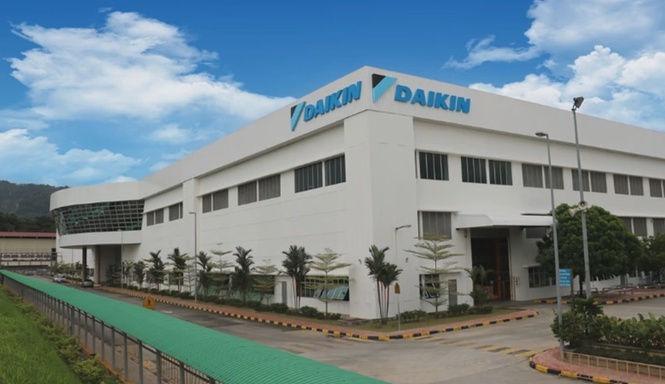
Daikin Malaysia strengthens sustainability efforts through GreenRE and Sunway University partnerships, plus MIDA certification for refrigerant recovery
DAIKIN MALAYSIA Sales & Service Sdn Bhd has strengthened its sustainability efforts through new partnerships with GreenRE and Sunway University, while presenting a certification to the Malaysian Investment Development Authority (MIDA) for sustainable refrigerant and resource recovery.
The initiatives were announced during International Sustainability Week (ISW) 2026 at the Malaysia International Trade and Exhibition Centre (MITEC), held in conjunction with World Green Building Week 2026.
Daikin Malaysia said the partnerships were aimed at encouraging more sustainable practices in Malaysia’s built environment, including energy-efficient cooling, responsible refrigerant management and greater collaboration between industry and academia.
The company signed a Memorandum of Collaboration (MoC) with GreenRE to explore initiatives promoting sustainable cooling solutions and the adoption of energy-efficiency and environmental considerations throughout the building lifecycle.
Daikin Malaysia managing director Lawrence Song said decarbonising the built environment required collaboration between businesses and organisations involved in setting sustainability standards.
“At Daikin, our philosophy ‘Beyond Cooling’ means taking full accountability for the lifecycle impact of our solutions. But true decarbonisation across Malaysia’s built environment cannot be achieved by any single company alone,” he said.
Song said the collaboration would also provide opportunities for pilot projects involving high-efficiency heating, ventilation and air-conditioning (HVAC) technologies.
Daikin Malaysia also signed a Memorandum of Understanding with GreenRE and Sunway University to promote knowledge exchange, industry-academia collaboration and sustainability initiatives.
Sunway University president Professor Sibrandes Poppema said the university was working with the corporate sector on what it described as the region’s first net-zero carbon building.
He said the project would use passive cooling technology and material innovation, with the aim of offsetting embodied carbon from construction within 18 years and achieving a zero-emission campus by 2030.
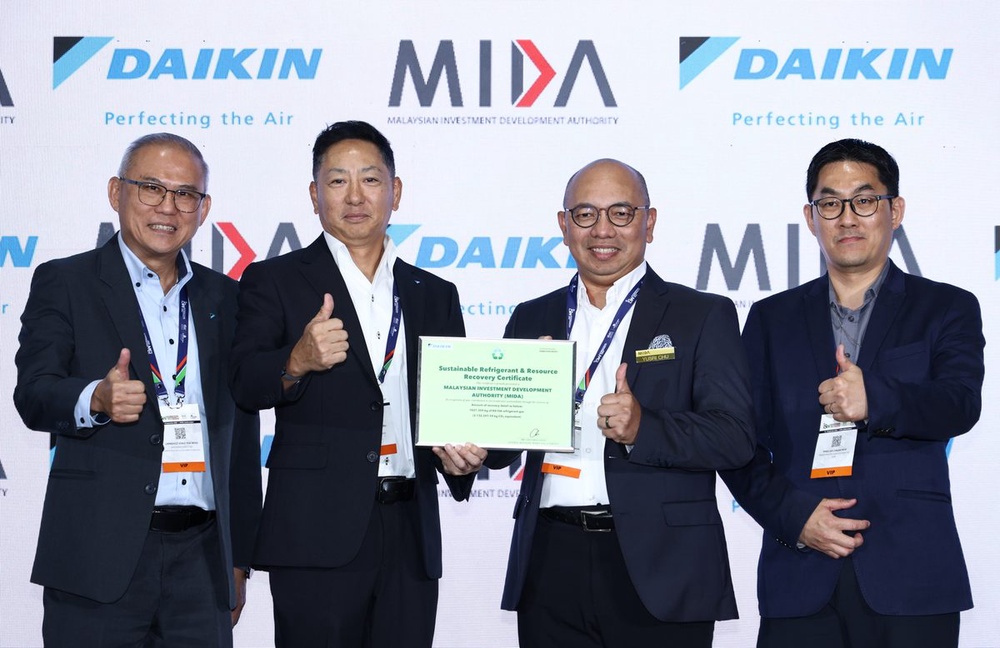
Another highlight was the presentation of the Sustainable Refrigerant & Resources Recovery Certification from Daikin Malaysia to MIDA.
The certification recognises efforts related to refrigerant recovery and resource management, areas that have become increasingly important as Malaysia advances its environmental and energy-transition agenda.
MIDA executive director Yusri Hasnan Chu Abu Bakar, who delivered remarks on behalf of MIDA chief executive officer Datuk Sikh Shamsul Ibrahim Sikh Abdul Majid, said industry-led initiatives could contribute to the country’s energy transition.
He cited Daikin Malaysia’s work on the MIDA Sentral headquarters as an example of how sustainability objectives could be translated into practical measures.
The building’s HVAC retrofit, which began as a pilot in 2021, used Daikin’s Remote Monitoring System and VRV Health Check to assess system performance and identify areas for improvement.
Daikin Malaysia said the approach resulted in a 27% improvement in efficiency and subsequently led to a full VRV replacement programme carried out from July 2025 to August 2026.
As part of the project, 1,021.359kg of R410A refrigerant was recovered. Based on the project’s assessment, this was equivalent to approximately 2,132.6 tonnes of carbon dioxide equivalent (CO₂e).
Yusri said the MIDA Sentral retrofit resulted in an emissions reduction equivalent to the carbon absorption of 88,858 rain trees, highlighting the potential environmental benefits of responsible asset management.
He said such initiatives supported the broader objectives of the New Industrial Master Plan 2030 (NIMP 2030) and the National Energy Transition Roadmap (NETR).
Daikin Malaysia said its sustainability approach extends beyond improving the energy efficiency of cooling equipment to include digital monitoring, refrigerant recovery, resource management and responsible management of equipment throughout its lifecycle.
The company said it would continue working with industry and academic partners on initiatives aimed at supporting more energy-efficient and environmentally responsible buildings in Malaysia.