
The discovery of a dead star has offered a rare insight into the fate of the Earth when our own Sun burns out.
An international team of astronomers using the European Southern Observatory’s Very Large Telescope (VLT) in Chile found an unusual disc of debris surrounding a white dwarf – the dense, burnt-out core of a star known as J1328−1450.
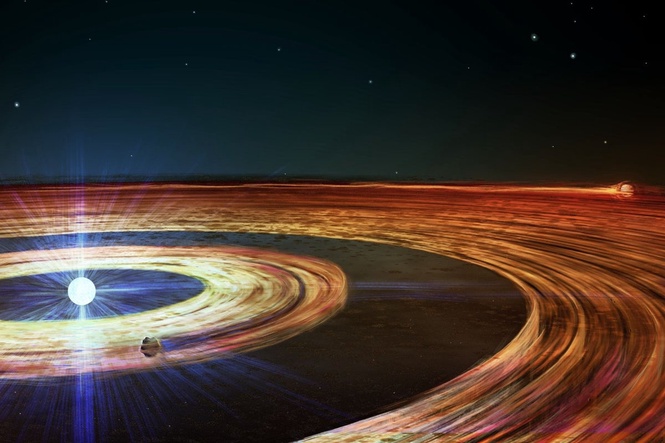
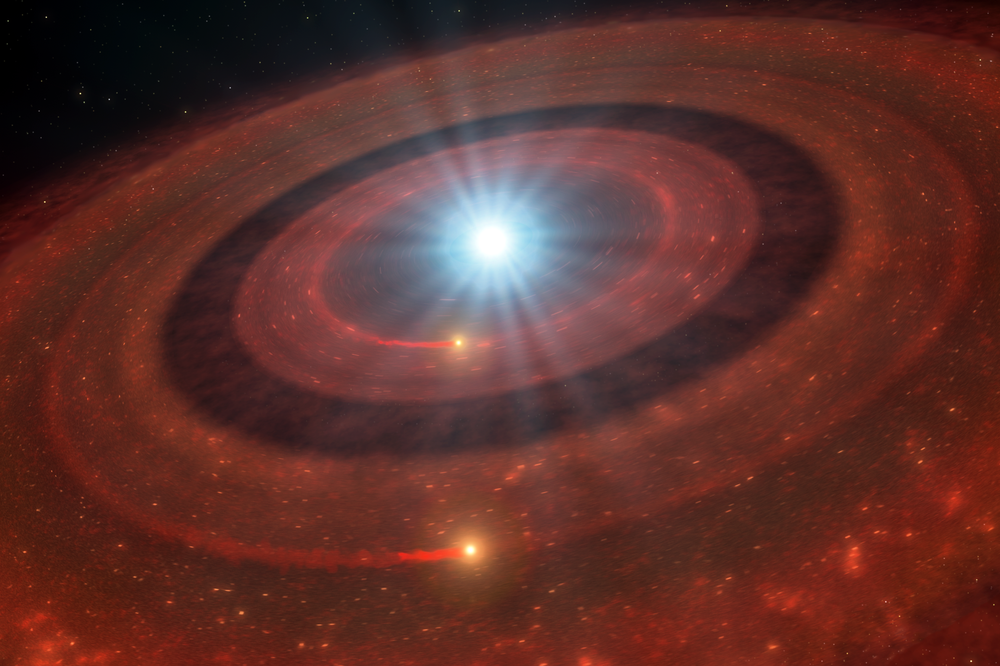
The debris, which consists of the remains of planets that once orbited the star, formed two distinct rings of material separated by a gap.
“The system is a rare glimpse of the violent, chaotic process by which a planetary system meets its end, and it hints that dead stars can have disc structures far more complex than previously realised,” said Gentile Fusillo, who is affiliated with the INAF-Astronomical Observatory of Trieste.
The astronomers believed the structure of the discs is maintained by two planet-like bodies, one of which has similar properties to an asteroid and the other is similar in size to the Moon.
The findings were published in the journal Nature Astronomy in a paper titled ‘A double debris disc around a white dwarf sculpted by two planetary bodies’.
“We have known for some time that planets may survive beyond the transformation of their central star, but this is the first example of a complex system with a double debris disc and potentially two surviving planetesimals,” said Nicola Gentile Fusillo, an astronomer at the University of Trieste in Italy and lead author of the study.
When stars like the Sun run out of fuel, they shed their outer layers and destroy nearby planets to create a disc of debris
When white dwarfs have been observed in the past, the disc of debris has appeared as a single, flat structure.
Observations with the VLT of J1328-1450 instead revealed two concentric rings of gaseous material separated by a distinct gap.
“The structure we see in this system is particularly intriguing because the two gaseous rings are remarkably stable and remain separated by a gap,” said co-author Felipe Lagos-Vilches, an astronomer at the University of Warwick in the UK and the Universidad Técnica Federico Santa María in Chile.
The debris disc also contained calcium, oxygen and magnesium, suggesting that the planets that were engulfed by the burnt-out star were made up of similar materials to the planets found in our Solar System.
Our Sun is expected is expected to expand into a red giant in several billion years, before fully burning out and becoming a white dwarf.
The process will likely destroy Earth, judging by the observations made of J1328-1450, but some outer planets may survive.
Dr Lagos-Vilches said: “The system therefore offers a remarkable glimpse of what the future of planetary systems, including systems like our own, might look like.”
Read MoreAstronomers have just found the first green star. Here’s why it matters
A huge explosion in space lasted for 27 days. Astronomers don’t know why
SpaceX to attempt ‘profound’ feat in next Starship launch
Lunar surface meteor strikes on minds of Nasa bosses in developing Moon base
Van Gogh’s ‘Starry Night’ doesn’t depict what we first thought, scientists say
The Orionid meteor shower peaks today in the UK. Here’s how to catch a glimpse