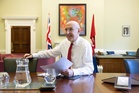
SENATE President Sherwin Gatchalian on Wednesday acknowledged the risk of a deadlock with the House of Representatives over the 2027 national budget, as lawmakers race against a tight, highly compressed calendar to ensure the spending bill is signed before the year ends.
“We need to pass this before the end of the year,” Gatchalian said, highlighting the budget’s role in driving domestic growth.
“A deadlock is what we are trying to avoid because this is time-bound. Both chambers want this finished because it serves as our most important economic stimulus tool,” he said.
Fears of a fiscal delay have mounted as the Senate inherits a House-approved version of the budget that introduces sharp departures from the executive branch’s original plan. Gatchalian admitted that bridging the gap between the two versions will likely trigger intense political friction, potentially threatening the timely release of crucial economic funds.
“Last year, we clashed, and there were times the bicameral conference was canceled altogether,” Gatchalian recalled. “It is not far-fetched to expect heavy, intense deliberations this time around as part of the process, but we must find common ground.”
Impeachment pressure
Compounding the threat of a budget standoff is a severe scheduling bottleneck. The Senate must simultaneously host a full-scale impeachment trial against Vice President Sara Duterte, a dual mandate Gatchalian described as “very challenging.” The Senate leader conceded that a November passage is no longer realistic, officially pushing the fiscal timeline deep into December. To mitigate the risk of a government shutdown or a reenacted budget — which would freeze new infrastructure and economic stimulus projects — Gatchalian said lawmakers are fully prepared to sacrifice their year-end recess.
“Our target is to approve and ratify it before the end of the year,” he said. “I am certain that we will work through the Christmas season if required. We have no choice. Even during Christmas, we will work to finish this budget.”
Logistical strains
The threat of a deadlock is further exacerbated by logistical hurdles during the upcoming Bicameral Conference Committee (Bicam) reviews. Media queries pointed out that deploying the mandatory contingent of six to seven senators to iron out budget differences with the House could break the vital quorum required to legally sustain the parallel impeachment proceedings.
Gatchalian acknowledged the risk.
“That is genuinely challenging. If we lose our quorum at the trial to run the Bicam, it complicates everything. We will have to negotiate with our counterparts in the House to arrange the logistics.” For now, the Senate leadership is deferring adjustments regarding potential deep cuts or realignments to the Senate Committee on Finance chairman, Sen. JV Ejercito, who is tasked with consolidating the chamber’s version to present a unified front before facing the House panel.
ARAL funding
Senators are pressing for the full restoration of funding for the Academic Recovery and Accessible Learning (ARAL) Program after discovering it was omitted from the proposed Fiscal Year (FY) 2027 National Expenditure Program (NEP).
Despite receiving P8.9 billion in the FY 2026 General Appropriations Act through congressional allocations, the FY 2027 NEP contains zero dedicated funds for the initiative, while the House version of the budget provides a sparse P350 million. The Department of Education is requesting P15.98 billion to expand the program, citing a minimum baseline of P8 billion required to maintain basic operations.
Lawmakers expressed alarm over the defunding of a program credited with significant learning gains. Gatchalian highlighted an impact evaluation conducted with Youth Impact and the World Bank, which revealed that ARAL helped pull over 1.37 million students out of the struggling reader category, successfully bringing 730,000 learners to their proper grade level.
JAVIER JOE ISMAEL