THE Philippines’ defense and national security chiefs are united in their commitment to strengthening a security partnership with Japan.
During the 72nd Anniversary of Japan’s Self-Defense Forces, Department of National Defense (DND) Secretary Gilberto Teodoro Jr. and National Security Adviser Eduardo Oban Jr. underscored that Japan-Philippines defense and security cooperation is the cornerstone of the two countries’ “Comprehensive Strategic Partnership.”
To address shared challenges, they also emphasized the importance of maintaining regional peace and stability, as well as strengthening deterrence through cooperation with like-minded countries, in accordance with international law.
In his speech, Teodoro said that both countries “are experiencing shared challenges and it is but right that we work to face these challenges together under the aegis of the rule of international law and Unclos and under the UN Charter.”
He reaffirmed that security ties with Japan will further strengthen with the enforcement of the countries’ Reciprocal Access Agreement (RAA), a legal framework governing the deployment and status of visiting forces from the Armed Forces of the Philippines (AFP) and the Japan Self-Defense Forces (JSDF).
“We have worked through the past few years to a new dynamism, to a new vibrance for which we not only commit to strengthening our country’s resilience but also shared deterrence,” he said.
Oban, meanwhile, noted in his speech that since its establishment in 1954, the JSDF “has transcended strategic expectations across seven decades of geopolitical evolution, redefining the parameters of modern excellence and defense resilience among our forces.”
The National Security Adviser also thanked the JSDF for extending “consequential support and assistance in fortifying our national defense posture, accelerating our military equipment upgrades and expanding critical partnerships, humanitarian assistance, and regional peace.”
Ambassador Kitagawa Katsuro highlighted Japan’s defense policy and the evolution of the Self-Defense Forces as a trusted organization capable of responding to both domestic and international demands. He also touched upon Japan’s diplomatic policy toward the updated “Free and Open Indo-Pacific” and reaffirmed Japan’s commitment to contribute to regional stability and prosperity by working together with allies and like-minded countries.
The reception featured a video message from Japan’s Minister of Defense Koizumi Shinjiro, as well as presentations of various defense equipment.
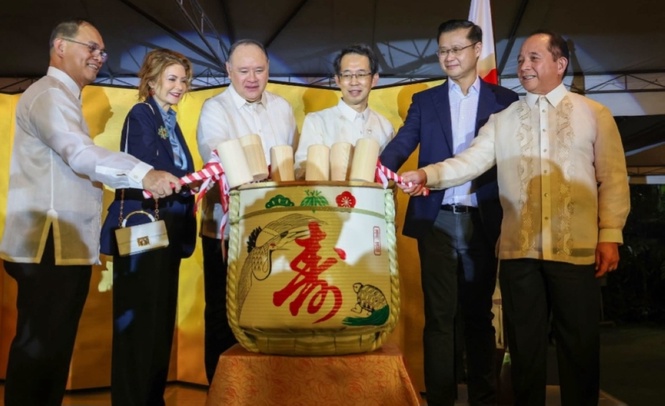
The ceremony included the breaking of Kagami Biraki, a wooden sake barrel, to symbolize luck, prosperity, and deeper bilateral ties.