
Thirty years after death of physician and politician Tan Chee Khoon, family and former colleagues say his defence of debate and accountability remains relevant
PETALING JAYA: Thirty years after the death of physician-turned-politician Tan Sri Dr Tan Chee Khoon, his family is observing the Malaysia Day period by urging the country to remember a principle he spent his life defending. They say Tan, once dubbed Mr Opposition, believed that dissent is not a threat to democracy but is one of its foundations. For his youngest daughter, Tan Poh Lai, the anniversary is a chance to look beyond her father’s own story.
“Today, we feature one son but there are many sons and many daughters of Merdeka. There are still many more who contributed to the formation and birth of this country,” she said.
Chee Khoon was among them.
Poh Lai said her father viewed holding the government to account not as opposition for its own sake, but as a necessary check and balance in a parliamentary democracy.
Three decades after his death, that conviction still offers a reminder that patriotism does not always mean agreeing with those in power. As Malaysians marked Malaysia Day yesterday, it was also a timely reminder of the role debate and disagreement play in nation-building.
Merdeka, after all, was founded on ideals of freedom, justice, democracy and harmony.
The seven cries of “Merdeka!” by Tunku Abdul Rahman Putra Al-Haj remain one of the defining images of the nation’s birth. The National Archives describes the new Federation of Malaya as a democratic, independent and sovereign country based on freedom and justice, committed to the welfare of its people and harmony among its races.
Chee Khoon lived those principles in his own way.
In the early years after Merdeka, political differences were not always drawn along racial lines. The Socialist Front brought together the Labour Party of Malaya, whose membership was largely non-Malay, and Parti Rakyat, which was predominantly Malay.
In Penang, the Labour Party grew into a major political force, taking control of the George Town City Council in the December 1957 local elections.
By the 1961 local elections, the Socialist Front held 13 of the council’s 14 seats.
Local government elections were suspended in 1965 during the Indonesia-Malaysia Confrontation, ending that avenue of electoral contest.
Chee Khoon entered Parliament in 1964 as a Labour Party candidate, winning the Batu seat and becoming Leader of the Opposition. He and Lim Kean Siew were the only two Labour MPs returned that year, after government arrests and ISA detentions had severely weakened the Socialist Front.
In 1969, he was elected under Gerakan before later forming Pekemas. A stroke in 1976 ended his active political career and he did not contest the 1978 general election. Pekemas was dissolved in 1982.
Leaving Parliament, however, did not mean leaving public life. In 1977, Nanyang, and later The Star, invited him to write a regular column, “Without Fear or Favour”, through which he continued to comment on political developments long after his own seat was gone.
In 1980, the then Yang di-Pertuan Agong Sultan Ahmad Shah conferred on him the PSM, which carries the title Tan Sri.
A voice beyond Parliament
Economist Prof Jomo Kwame Sundaram first met Chee Khoon in 1977, soon after returning from the United States with a PhD to research the new villages of the Kinta Valley.
“I visited him in his clinic on Batu Road and discovered that he had had a stroke a year earlier, on Nov 5, 1976.
“In that brief encounter with him, I noticed that the stroke had slowed him down considerably. Nonetheless, he expressed great interest in my study, gave me tips about living in the new villages, things to look out for, and insisted that I return to see him again,“ he told theSun.
They met again in mid-1978, this time in Jinjang, the largest of the new villages and part of Chee Khoon’s former Kepong constituency. Chee Khoon was still running his clinic there, treating patients and introduced Jomo to Dr Tan Seng Giaw, the younger colleague who would go on to become Kepong MP.
Their paths continued to cross through the political and intellectual circles around Aliran in the 1980s, where Jomo came to know a politician whose interests extended well beyond Parliament.
Jomo recalled that at an Aliran forum on the arms race in 1981, Chee Khoon’s extensive military library and grasp of strategy surprised those who knew him chiefly as a doctor and politician. In 1984, Aliran named him its Outstanding Malaysian of the Year. In his acceptance speech, he described dissent as indispensable to parliamentary democracy.
Asked whether Chee Khoon’s withdrawal from active politics had contributed to his ideals being discussed less in public life, Jomo said: “Perhaps this did affect, did make a difference, but there were other factors as well.”
The bigger shift, he said, was that Malaysian politics itself had changed after 1969. The politics of Chee Khoon’s era was “a very different type of politics” – the Socialist Front’s opposition to the Alliance government was rooted largely in ideology and policy, Jomo said, “rather than the kinds of issues right now, which tend to be ethnic issues”.
Opening a window to Sabah
Political scientist Dr Francis Loh Kok Wah, who first met Chee Khoon in the late 1970s and came to know him through Aliran, recalled the breadth of his public life after politics.
Alternative sources of news were limited at the time, he said.
“There was very limited access to alternative news. Aliran was one of the few alternative voices then, making Chee Khoon’s ‘Without Fear or Favour’ columns an important source of political commentary.”
One issue Loh found particularly significant was Chee Khoon’s exposure of the authoritarian rule of then Sabah chief minister Harris Salleh, including his treatment of Pairin Kitingan and the Kadazan-Dusun community.
“Dr Tan’s columns about this entire episode awakened a whole generation of us in Semenanjung about goings-on in Sabah.”
The columns, later collected in A Triumph for Democracy, also shaped Loh’s own path. After reading them and consulting Chee Khoon, he decided to visit Sabah – the start of two decades of research and writing on Sabah politics, much of which he shared with Chee Khoon.
Chee Khoon remained involved with Aliran, becoming the first chairman of its Trust Board in 1986, a post he held until 1994. In 1996, Aliran devoted an entire issue of Aliran Monthly to commemorating his life, describing him as a Malaysian patriot and servant of the people – a champion of the poor who stood for multiracialism, democracy, the rule of law and justice for all. It also remembered him as a man of faith, committed to working with people of other religions to build peace and justice.
What does Merdeka mean now?
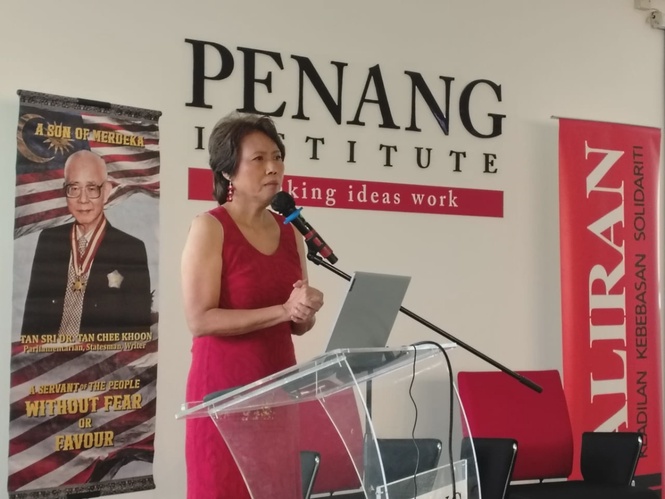
For Poh Lai, that legacy should not remain confined to history books. It was the idea behind a three-city Merdeka roadshow that began in Kuala Lumpur on Aug 23, followed by Ipoh on Sept 3 and Penang on Sept 5.
The Penang forum, “Merdeka, Multiracialism and Dissent, Without Fear or Favour”, was organised by Penang Institute and Aliran, with Poh Lai and Loh as speakers.
Poh Lai said Malaysians needed to come together to discuss the ideals that shaped Merdeka, “to see how we can practise it, or how it is relevant to today”. Many Malaysians, she said, did not know who her father was.
But those who did know Chee Khoon remember the force of his convictions.
“He believed that the opposition was a very worthy part of democracy, and dissent was a very honourable thing. And he lived his life that way.”
Thirty years after his death, as Malaysians once again gather to celebrate the country they share, his story is a reminder that freedom, justice, democracy and harmony – the ideals of Merdeka – are built not only in agreement, but in the willingness to disagree well.
Because Merdeka was never just about seven cries of “Merdeka!” It was also about what Malaysians would do with the freedom that followed.