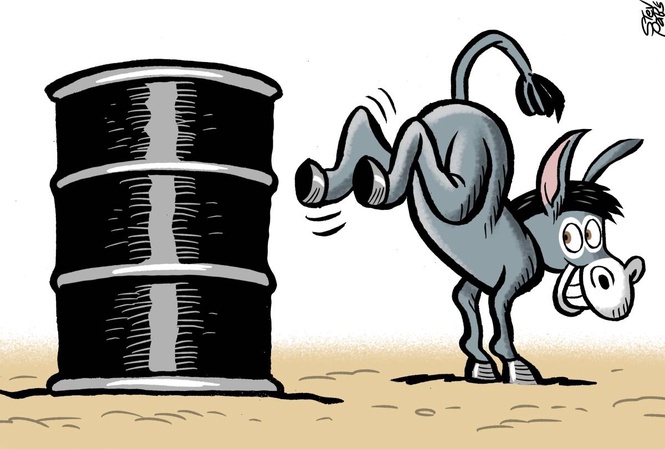
OIL prices started falling in the aftermath of the US midterm elections, a great relief for Asian countries like the Philippines that are heavily dependent on Gulf oil, oil-starved countries where elevated oil prices are the equivalent of an existential crisis. And the reason why the Nov. 3 election results caused the oil price drop — with the Philippines announcing price drops every week since the elections — is straightforward enough.
The rebuke of the Republican candidates who have been enabling the authoritarian government of Donald Trump means that by January, the Democrat-controlled US Congress will no longer fund the senseless war in the Gulf region partly initiated by Trump. We all know that without the funding, the Gulf war will cease and there is no available off-ramp for Trump to fund that war.
The war is the reason behind the oil supply disruptions and the destruction of vital oil-related infrastructure in the oil-rich Gulf areas. With the war paused primarily because of the Republican shellacking, oil supply is slowly stabilizing and crude oil — and oil distillate — prices have been going down.
The Democrats’ control of both houses of the US Congress will take place in January yet, more than a month from now, but the impact of their victory over the Trump-enabling Republicans has resulted in the softening of oil prices, which, I repeat, is a great relief for the Philippines. There is also a real possibility that crude oil prices will drop to $70 per barrel soon, barring any unhinged decision on the part of Trump to order the bombing of Iran anew in the limited window between now and early January. Which will mean greater relief for a Philippine economy badly battered by historically high oil prices. And whose economic lifeline, OFW remittances, relies heavily on the employment of Filipinos in the Gulf region. The Gulf states employed around 2 million Filipinos before Trump’s senseless war.
There is no doubt about the verity of this political equation. When candidates committed to democratic norms triumph over candidates enabling the authoritarian impulses of an autocrat wannabe like Trump, like what happened in Nov. 3, senseless wars like the Gulf conflict will cease to be funded. Strategic decision-making and sense of country claw their way back into the policy-making process. Brazen exercise of executive power, like the power unilaterally exercised by Trump in initiating the Gulf war, will be reined in. Under a democracy, Congress, a co-equal branch with the executive, can stop executive overreach and the abuse of presidential powers. With the certainty that guardrails will be placed on Trump’s overreach and the certainty that democracy-adhering Democrats will not fund the Gulf war, the elevated oil prices started to fall.
The positive spillover effect of that Democratic victory, also a victory for democratic norms, was not only felt in the Philippines but spread out into the other oil-dependent countries.
Elections, without argument the most important political exercise in a democracy, have consequences, like the Nov. 3 midterm elections in the US. Had the Republican Party led by Trump and beholden to Trump triumphed in that midterm vote, the slide of oldest democracy in the world to full-blown illiberalism would have been a great possibility. But voters reclaimed the democratic tradition of the US and rebuked the party of Trump and the administration’s warmongering. Many commentators said that the Nov. 3 midterms was the most consequential in the contemporary history of America.
With the clipping of Trump’s war-waging powers now a certainty, the other issue related to the Nov. 3 elections that is likewise deeply relevant to the global economy is tariffs. In April 2025, Trump announced what he called his “Liberation Day” tariffs, punitive tariffs on countries big and small, tariffs so broad and expansive that even uninhabited tundra populated by penguins and islands with no trade with the US whatsoever, got punitive tariffs.
Economists called the April 2025 tariff impositions, the “greatest trade shock in history.” The senseless Gulf war was called “the greatest oil shock in history” as it crippled the movement of Gulf oil into oil-dependent countries like the Philippines. The bombing of Iran by the US and Israeli forces on Feb. 28 pushed Iran to close the Strait of Hormuz through which 20 percent of the global oil trade passes. The Philippines was 80 percent dependent on Gulf oil moved through the Strait of Hormuz before the bombing.
Will the Democrat-controlled US Congress reclaim its tariff-setting powers after taking over the two chambers in early January? Many sectors of the Philippine economy hope so and if that tariff-setting power is reclaimed by the Democrat-controlled Congress, legislation will void the tariffs imposed by Trump without legal basis. With the global tariff arrangement settling down to where it was before April 2025, seamless global trade will be the immediate result and the economic bonanza for the Philippines and other major trading partners of the US will be immense. A bonanza as major as the softening of oil prices.
Democracy, with its built-in guardrails against abuse of power and destructive and unfair policies, will end the “greatest trade shock in history” and the “greatest oil shock in history.” Resulting in a better world and, in particular, removing two heavy economic pains on the Philippines.