
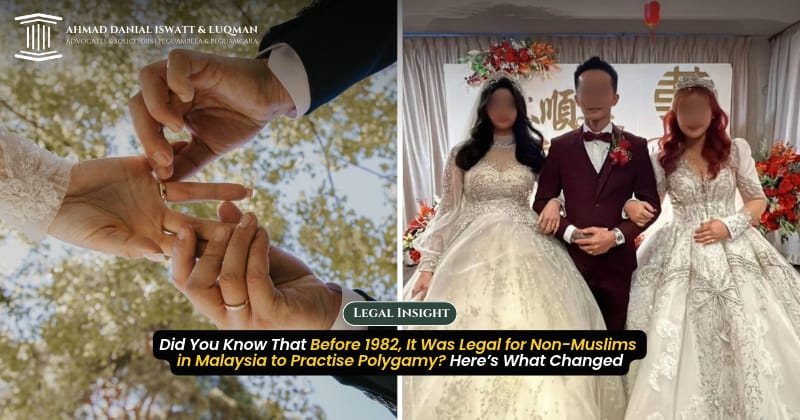
It remains little-known among the public, particularly younger demographics, that before 1 March 1982, non-Muslim family law in Malaysia lacked a unified civil framework. Instead, the legal system recognised a diverse patchwork of customary, personal, and religious marriage traditions inherited from the British colonial era.
Under this pluralistic framework, non-Muslim men legally possessed the capacity to contract and maintain polygamous unions through traditional rites, public family recognition, or indigenous customary law.

However, things swiftly changed after the enactment and enforcement of the Law Reform (Marriage and Divorce) Act 1976, which fundamentally altered this landscape. By establishing a mandatory civil registry and enforcing strict statutory monogamy, the law marked a major turning point in Malaysian legal history.
Here’s everything you should know.
The pluralistic foundations of pre-1982 family law
The preamble and historical application of the Law Reform (Marriage and Divorce) Act 1976 highlight a legal reality where personal status was dictated by community customs rather than uniform statutory edicts. The British colonial administration generally followed a policy of non-interference with native and religious laws regarding domestic matters, provided they did not conflict with public policy or natural justice.
Consequently, non-Muslim personal laws operated through distinct customary streams.
Chinese customary heritage and the recognition of concubines

Under traditional Chinese custom, a non-Muslim Chinese man domiciled in the Straits Settlements or Malay States held the legal capacity to enter into polygamous unions. This structure distinguished between a principal wife (Taai-Chai) and multiple secondary wives or concubines (Tsip).
- Evidentiary Standards: These relationships did not require formal state registration or religious solemnisation; instead, colonial courts looked for indicators such as mutual consent, public recognition of status within the family circle, and continuous cohabitation.
- Judicial Precedent: Landmark judicial decisions, such as In the Estate of Choo Eng Choon, Decd. (1908) (famously known as the "Six Widows Case") and Re Loh Toh Met, Decd. [1961] 1 MLJ 234, firmly established that Chinese customary marriages were legally valid and that children born from secondary wives possessed legitimate inheritance rights.
Hindu customary traditions

Traditional Hindu marriage laws, shaped by diverse cultural practices brought from the Indian subcontinent during the migration waves of the 19th and early 20th centuries, also legally recognised polygamous unions contracted through traditional religious rites.
- Unless couples actively opted into colonial monogamous marriage registries, their traditional rites dictated their matrimonial capacity.
- As affirmed in cases like Karpen Tandil v. Karpen (1895) 3 S.S.L.R. 58, these customary practices meant that a Hindu man was legally free to marry more than one wife under his personal law.
Native and indigenous Adat
For indigenous populations, including the Orang Asli of Peninsular Malaysia and the diverse native communities of Sabah and Sarawak, marriages were governed strictly by tribal Adat (customary laws). These indigenous frameworks naturally accommodated various forms of customary family structures, including polygamy.
Crucially, these indigenous legal traditions were preserved and remain active today. Native communities possess an autonomous court system, the Native Courts, which operates completely outside the Civil Registry (JPN).
The Law Reform (Marriage and Divorce) Act 1976
As Malaysia matured as an independent nation, the coexistence of conflicting personal laws, lack of registration uniformity, and the legal complexities surrounding inheritance and women's rights prompted a major public policy review. The Royal Commission on the Non-Muslim Marriage and Divorce Laws ultimately recommended a complete overhaul.
This culminated in the Law Reform (Marriage and Divorce) Act 1976, which officially came into force on 1 March 1982. The statute fundamentally reshaped the legal definition of marriage for all non-Muslims in Malaysia:
- Enforcement of strict monogamy: Under Section 5 of the Act, any person married under the law after the appointed date is legally incapable of contracting another valid marriage under any law, religion, custom, or usage, whether inside or outside Malaysia.
- Closure of customary loopholes: Section 5(4) mandates that no non-Muslim marriage may be solemnised through custom or religion unless it strictly complies with the civil requirements of the Act.

How the law treats non-Muslim polygamy in Malaysia today
With the complete transition to a mandatory monogamous civil framework, any attempt to contract a plural marriage outside the bounds of the statute is treated as a serious violation of Malaysian law.
- Criminal prosecution: Any person who contracts a marriage during the lifetime of their spouse, unless the previous marriage has been lawfully dissolved or annulled, faces criminal prosecution under Section 494 of the Malaysian Penal Code. Conviction carries severe penalties, including up to 7 years in prison and a fine.
- Civil nullity (Void Ab Initio): Any subsequent polygamous or customary "second marriage" attempted after March 1982 is deemed an absolute nullity under civil provisions. Consequently, the secondary partner possesses zero legal standing as a spouse, no automatic right to spousal maintenance under civil law, and no automatic civil inheritance rights to the estate upon intestacy.
The legal evolution from 1982 marks a definitive break with Malaysia's colonial and early post-independence pluralistic past. By replacing a patchwork of Chinese, Hindu, and British-administered customary allowances with the uniform statutory mandate of the Law Reform (Marriage and Divorce) Act 1976, Malaysia drew a hard legal line: for non-Muslims, the era of legal polygamy officially closed, anchoring family law firmly to the principles of statutory monogamy and formal civil registration.

For more legal insights such as this, do follow us on Instagram, TikTok, Facebook, or visit our official website. You can also read our articles on the popular Malaysian news aggregator app Newswav.
About us

Ahmad Danial Iswatt & Luqman is an esteemed law firm that delivers best-in-class legal solutions to individuals, businesses and legal entities in Malaysia and beyond. We offer ease of mind to our wide range of clients by dismantling complex legal challenges with novel solutions through exceptional legal advisory and representation.
Our distinguished partners of diverse backgrounds and expertise have achieved significantly favourable results in all levels of courts in Malaysia, from high-profile civil and criminal litigation proceedings to complex cases in which the outcomes have become binding precedents for the laws of the country. Backed by a growing team of exceptional lawyers and capable support staff, we aspire to be at the forefront of the legal sphere to satisfy our clients’ dynamic demands and ever-increasing complexity.
ADIL Legal (office@adillegal.com) is a content creator under the Newswav Creator programme, where you get to express yourself, be a citizen journalist, and at the same time monetize your content & reach millions of users on Newswav. Log in to creator.newswav.com and become a Newswav Creator now!
The User Content (as defined on Newswav Terms of Use) above including the views expressed and media (pictures, videos, citations etc) were submitted & posted by the author. Newswav is solely an aggregation platform that hosts the User Content. If you have any questions about the content, copyright or other issues of the work, please contact creator@newswav.com.