Malaysia built a safety net for gig workers. Almost nobody knows it is there.
Here is a question worth sitting with for a moment. You are a delivery rider. It is 8pm on a Wednesday, raining, and you are weaving through Klang Valley traffic with a bag of nasi lemak and teh tarik strapped to your bike. A car cuts you off. You go down.
What happens next?
If your answer involves insurance, hospital coverage, or income replacement while you recover, good. If your answer is "I have no idea," that is exactly why this article exists.
What Is SOCSO and Why Should Gig Workers Care?
Most Malaysians who have worked in a formal job know SOCSO as that small deduction on their payslip every month. SOCSO, also known as PERKESO, is Malaysia's Social Security Organisation. It provides workers with financial protection against workplace accidents, occupational diseases, permanent disability, and death. When something goes wrong at work, SOCSO is supposed to be the safety net that catches you.
The catch has always been this: SOCSO was designed for employees with employers. The system assumed someone was paying contributions on your behalf every month. If you are a Grab driver, a Foodpanda rider, a freelance photographer, or a home cleaning service provider, there is no employer doing that for you. For years, that meant the gig economy was largely left outside the safety net entirely.
The Self-Employment Social Security Scheme, known in Malay as Skim Keselamatan Sosial Pekerjaan Sendiri or SKSPS, was introduced to change that. And in 2026, it got significantly bigger.
What Actually Changed This Year
There are two major updates to understand for 2026, and both of them matter if you work outside a traditional employment arrangement.
The first is the expansion of SKSPS coverage to five new self-employment categories beyond the original ride-hailing and delivery sectors. Home cleaning services, mobile beauty and grooming, private tutoring, freelance photography and videography, and personal fitness training are now included. This expansion is expected to bring approximately 180,000 additional workers under social security protection for the first time.
The second, and arguably bigger, change is the introduction of LINDUNG 24/7, a new SOCSO protection scheme that kicked in this month. For years, SOCSO coverage was largely limited to accidents that happened during working hours or while commuting. Thousands of claims were rejected because the accident happened outside official work hours. Under LINDUNG 24/7, eligible workers now receive round-the-clock accident protection, regardless of when the accident occurs. That is a genuinely significant upgrade.
Who Is Covered Under SKSPS
The scheme covers a wide range of self-employed Malaysians. The full list of eligible sectors includes goods and food delivery, e-hailing drivers, agriculture and fisheries, construction, manufacturing, street vendors, IT and data services, professional services, arts and entertainment, household services, and healthcare workers operating independently.
If you fall into any of these categories and you are a Malaysian citizen or permanent resident without an employer contributing to SOCSO on your behalf, you are eligible to register.
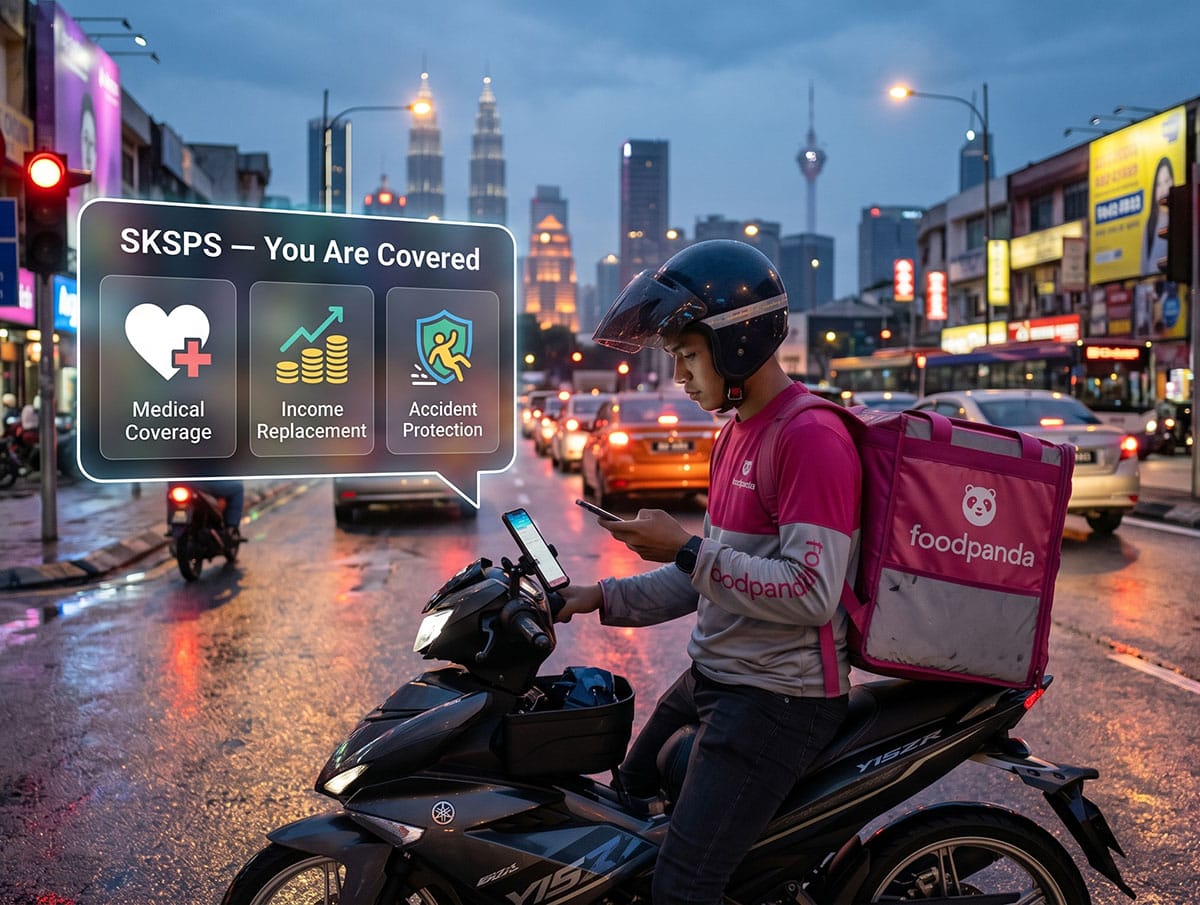
The protection you get once registered is not token coverage either. Benefits under SKSPS include medical expense reimbursement for work-related injuries, temporary disablement benefit which replaces your income while you are on medical leave, permanent disablement benefit if you are left unable to work, and dependant benefit for your family if you die from a work-related accident.
For a delivery rider or Grab driver whose entire livelihood depends on their ability to get on a bike or in a car every day, the temporary disablement benefit alone could mean the difference between recovering at home without financial panic versus having to get back on the road too soon because the bills will not wait.
How Much Does It Actually Cost
This is the part that surprises most people. The contributions under SKSPS are genuinely affordable, especially given what they cover.
Under the scheme, self-employed individuals choose a contribution amount based on their declared monthly earnings. The government has also historically offered subsidy matching of up to 80% on certain plan tiers, meaning some gig workers can get covered for as little as RM46.60 per year on the subsidised plan. That is roughly RM4 a month for accident and disability coverage that could be worth hundreds of thousands of ringgit in benefits if the worst happens.
To register, head to the PERKESO Matrix Portal or walk into any of the 54 SOCSO offices nationwide. The process is straightforward. You will need your MyKad, your choice of contribution plan, and the first payment. Coverage begins from the date and time your contribution is received.
The Awareness Gap Nobody Is Closing
Here is the uncomfortable truth. Most gig workers in Malaysia have no idea any of this exists.
The SKSPS scheme has been around since 2017. The expanded coverage has been rolling out over several years. And yet if you walked up to ten delivery riders at a petrol station right now and asked how many of them have registered for SKSPS, the honest answer is probably not many.
This is not laziness or indifference. It is a knowledge gap that the government has not done nearly enough to close. There is no visible public campaign. No QR code on Grab's app. No pop-up notification when you sign up to deliver for Foodpanda. The information exists, but it is buried in government portals and HR blogs that most gig workers are not reading between shifts.
For someone who just finished secondary school and signed up as a delivery rider because it was the quickest way to start earning, the concept of SOCSO contributions and self-employment protection schemes is completely foreign. Nobody told them. The platforms they work on have no legal obligation to inform them. And so they ride unprotected, day after day, in conditions that make accidents statistically inevitable.
I once had a delivery rider get into an accident while bringing my order. My food did not make it. More importantly, I genuinely worried whether the rider was okay. The thought of someone getting injured doing a job partly because I wanted food delivered to my door without any coverage or income replacement if they could not work the next day is a difficult one to sit with.
My Take
I will be honest, I am in a similar boat. Running Creative Mojo as a solo business means I am self-employed without an employer contributing to SOCSO on my behalf. My own SKSPS contribution has been on the to-do list without action, partly because making the business profitable enough to cover all bases has taken priority, and partly because I simply did not know enough about how it worked.
Writing this article has been educational for me too. The cost is lower than I assumed. The coverage is broader than I thought. And the LINDUNG 24/7 expansion makes it more relevant than ever for anyone working independently.
If you are self-employed in any capacity, whether you are a delivery rider, a freelance creative, a fitness trainer, or running your own small operation, look up SKSPS this week. Spend 15 minutes on the PERKESO portal. The contribution is genuinely affordable and the protection you get in return is the kind that most of us hope we will never need but will be enormously grateful for if we do.
The government built this safety net. They just forgot to tell most of the people it was meant to catch.
Kamarul Azwan (k.azwan@gmail.com) is a content creator under the Newswav Creator programme, where you get to express yourself, be a citizen journalist, and at the same time monetize your content & reach millions of users on Newswav. Log in to creator.newswav.com and become a Newswav Creator now!
The User Content (as defined on Newswav Terms of Use) above including the views expressed and media (pictures, videos, citations etc) were submitted & posted by the author. Newswav is solely an aggregation platform that hosts the User Content. If you have any questions about the content, copyright or other issues of the work, please contact creator@newswav.com.