

When the Prime Minister of Malaysia, Datuk Seri Anwar Ibrahim, stood at the podium of Parliament on October 10, 2025, and uttered three shocking words: "diesel subsidy targeting succeeded", the courtroom was silent for a second. Behind the jargon of the budget and figures, there is anxiety on the village road, in the small docks of fishermen, in the logistics depots, who will be left behind in this reform?
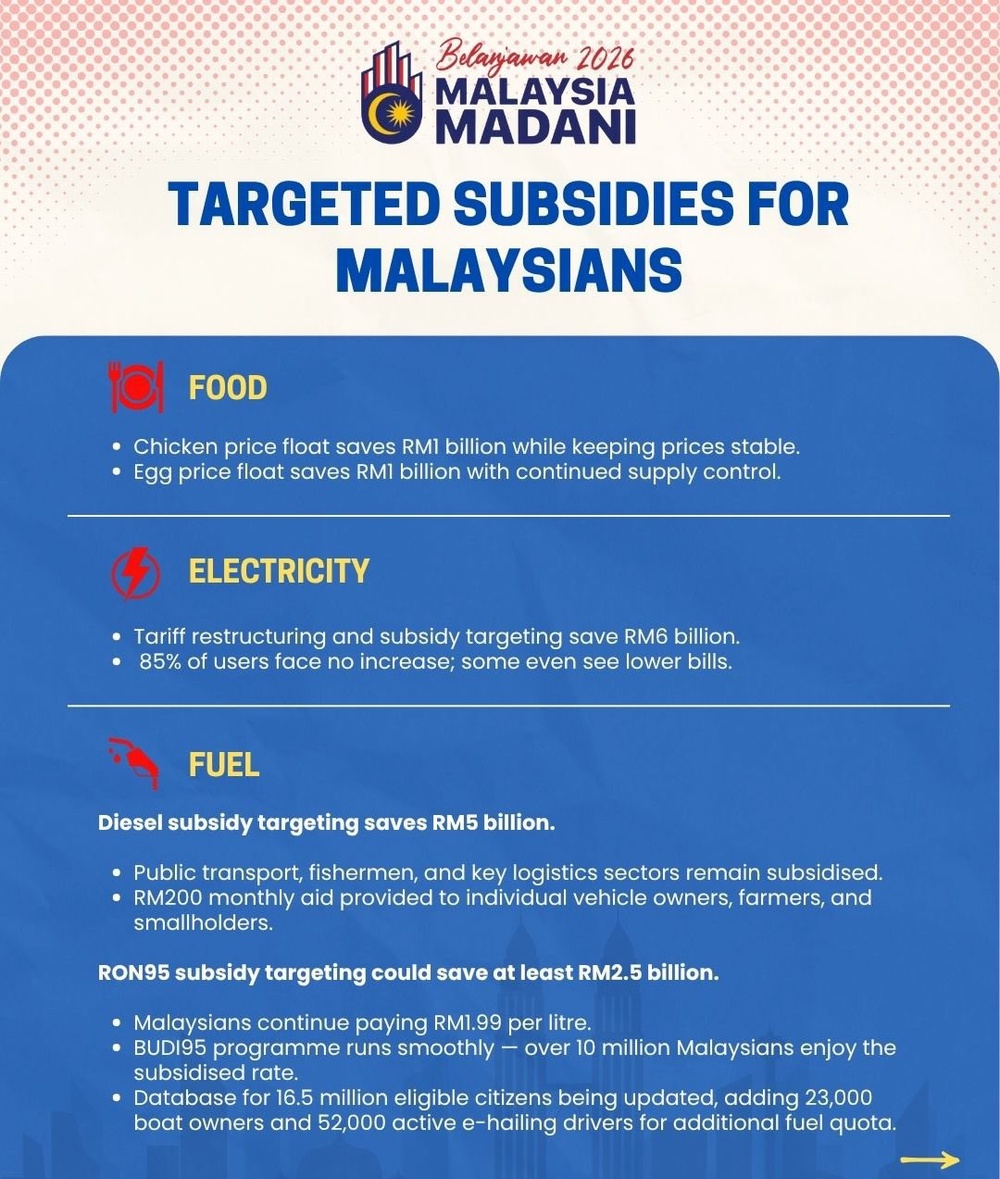
According to a report by the Malaysia Gazette, the implementation of the diesel subsidy targeting is expected to save the government around RM5 billion per year. In fact, it was drafted in the context of greater savings, the overall targeted subsidy peaked at RM15.5 billion in Budget 2026. ("Targeted subsidies: Government saves RM15.5 billion a year", Malaysia Gazette) (MalaysiaGazette)
However, behind the fiscal jargon, there are social promises: certain public transport, fishermen, and logistics sectors will continue to receive subsidized diesel; while individual owners, farmers, and smallholders will receive RM200 cash assistance per month. MalaysiaGazette reported, "certain public transport, fishermen and logistics sectors continue to receive subsidized diesel prices. 200-ringgit a month is given to individual owners, farmers and smallholders." (MalaysiaGazette)
These reforms seem like a delicate balance between fiscal efficiency and social protection. This is where the story lies between the big numbers and the small hopes of ordinary people.
The move to target diesel subsidies is not a new decision for the Malaysian government. Since June 9, 2024, the Ministry of Finance Malaysia has launched the introduction of the Individual Diesel Cash Assistance (BUDI-Diesel) to facilitate the distribution of benefits to eligible private diesel vehicle owners. ("Government Implements Diesel Subsidy Targeting In Peninsular Malaysia", MOF) (Ministry of Finance)
The principle: instead of subsidies being opened to anyone who buys diesel, subsidies are channelled more specifically to consumers who really need it based on eligibility criteria such as diesel vehicle ownership, income, and work sector. This reflects a paradigm shift: from broad subsidies to targeted subsidies.
In the Budget 2026 Engagement Council, the government stressed that despite the diesel subsidy target, certain public transport, fishermen, and logistics sectors are still eligible for subsidized diesel prices. ("Budget 2026 Engagement Council", MOF) (Ministry of Finance)
This means that many diesel users are believed to remain protected, but the individual schemes of diesel car owners, farmers, and smallholders will go through an application and verification process to be eligible to receive RM200 per month.
In a Bernama News report, it was mentioned that since the implementation of the targeting, overall subsidised diesel sales have decreased by 30%, resulting in savings of more than RM600 million per month, a figure that shows annual savings of more than RM4 billion. ("Overcoming the Important Challenges of Targeted Subsidies", Bernama) (BERNAMA)
However, the report also notes that subsidies continue to be provided for the public transportation, fishermen, and logistics sectors. Thus, the decrease in subsidy consumption occurs mainly from sectors that are no longer feasible, namely non-eligible users.
However, according to Astroawani.com, the targeting of diesel subsidies is expected to save RM5 billion a year while maintaining subsidies for key sectors. ("Budget 2026: RM15.5 billion savings from subsidy reform", Astro Awani) (Astro Awani)
From a budgetary legal point of view, these savings are important: state resources are no longer drained on high-income users or companies that have been enjoying subsidies "widely". Perhaps that is the background behind the kingdom's courage to use the word targeting.
In coastal areas, diesel is often a major component of fishermen's operating costs from charging boats to powering engines. The policy that fishermen continue to receive subsidized diesel prices is a breath of fresh air. But does it really work?
Some small fishermen reported difficulties in registering permits and verification. Some complain that the list of registered fishermen is incomplete, or that subsidized subsidies are limited. In the Engagement Ceremony, the government mentioned that the database has been updated to provide additional quotas for 23,000 registered boat owners. ("Budget 2026 Engagement Council", MOF) (Ministry of Finance)
However, not all fishermen have such easy access to registration: remote locations, complicated administrative paperwork, and limited internet networks are a stumbling block. For them, the announcement that they are "subsidized protected" feels far from reality when their registration is delayed or technically rejected.
The logistics and public transportation sectors, especially city buses, village transportation, and intercity freight shipments, have a high need for subsidized diesel. The government stated that these sectors will remain protected by subsidies. ("Government Implements Diesel Subsidy Targeting...", MOF) (Ministry of Finance)
However, logistics industry players expressed concerns: "what is the definition of 'specific logistics'?", asked a courier company manager. If subsidies are only given to large operators or those that are specifically registered, small actors in small towns are at risk of losing eligibility. Some small village transporters said they had not received clarity about when and how the incentives would be distributed.
For the public transportation sector in big cities, more formal operational administration makes many companies already in a position to meet the criteria. But challenges arise when operations expand to small routes, inland areas, or older fleet types that may not meet new technical specifications or registrations.
The main promise of this reform is direct cash assistance of RM200 per month to individual owners, farmers, and smallholders. The Malaysia Gazette explicitly mentions: "200-ringgit per month is given to individual owners, farmers and smallholders." (MalaysiaGazette)
In a statement from the Ministry of Finance, BUDI-Diesel does target registrants of low-income private diesel vehicles or certain categories. (Ministry of Finance)
For farmers and smallholders who use tractors or diesel engines in farming activities, this assistance can be an injection of operating subsidies. But several smallholders are asking: is RM200 a month enough to cover the rising cost of fuel and maintenance of heavy equipment?
A farmer in a rice area said that in each season, the need for diesel can easily exceed RM200. He hopes that this assistance is not only a fixed nominal, but a flexible quota according to the planting season or operational needs.
Further, the challenge of verification arises farmers who do not have registered vehicles or use diesel engines that are not in the new registration system, can fail the selection process. Administrative errors, incomplete data, or inconsistencies in the village record system are real obstacles.
Targeting reform relies on a national data system of income data, vehicle registration, subsidy usage history, and other eligibility criteria. If the database is inaccurate or updated late, many people who are supposed to be deserving are left behind.
Critics say the discovery of a "leaky system" and a vague definition for excluded categories opens up a loophole of injustice. Anyone can be eliminated simply because the admin documents are incomplete or the margin of error in the address system.
The spirit of subsidies that "reach the people" can be hampered by bureaucracy, internet networks, or data gaps between the central and regional governments. For rural or rural groups, the registration problem often outweighs the expected benefits.
Subsidy reform is a political as well as an economic choice. According to a Reuters report in 2024, Malaysia will start reducing diesel subsidies and directing aid to low-income groups, with estimated savings of around RM4 billion per year. ("Malaysia to cut diesel subsidies, saving $852 million annually", Reuters) (Reuters)
This move is seen as a response to fiscal burden pressures, especially when energy, food, and electricity subsidies are the focus of large state spending. But on the other hand, the government must take care that the reforms do not trigger a wave of protests from sectors that feel "left out".
Economists suggest that targeted subsidy measures should be carried out in a transparent manner, with appeal mechanisms and grievance channels so that people who are wrongly removed from the list can be corrected. The Malaysia Gazette said the previous government delayed the implementation of targeted subsidies because "there was no real political will". ("Targeted subsidies: Government saves RM15.5 billion a year", Malaysia Gazette) (MalaysiaGazette)
For targeting not to exclude vulnerable groups, the role of civil society and the media is crucial. The government needs to open transparent data on the criteria, quotas, and distribution maps of diesel subsidies. Clear communication and public dialogue should be part of implementation.
Furthermore, the complaint and data correction system must be simplified not only through comitative channels, but also through user-friendly digital platforms, regional support, and village assistants who actively assist in registration. Do not let the aid "reach the people" but stop at the village office due to bureaucratic complexity.
AM World (tameer.work88@gmail.com) is a content creator under the Newswav Creator programme, where you get to express yourself, be a citizen journalist, and at the same time monetize your content & reach millions of users on Newswav. Log in to creator.newswav.com and become a Newswav Creator now!
The User Content (as defined on Newswav Terms of Use) above including the views expressed and media (pictures, videos, citations etc) were submitted & posted by the author. Newswav is solely an aggregation platform that hosts the User Content. If you have any questions about the content, copyright or other issues of the work, please contact creator@newswav.com.