AI-powered healthcare faces test of trust, accountability and governance
KUALA LUMPUR: As artificial intelligence (AI) moves deeper into healthcare, a crucial question is emerging for patients and doctors alike: when AI helps determine treatment, where does the machine’s role end and the doctor’s responsibility begin?
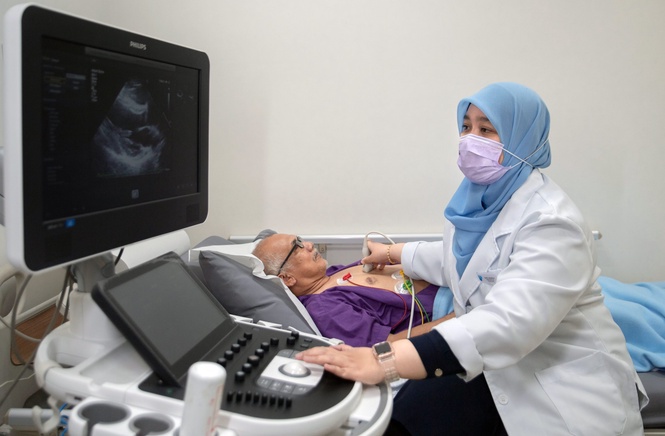
The issue is particularly critical in cardiovascular care, in which treatment decisions could involve complex clinical data, risk probabilities and potentially life-changing consequences.
READ MORE: Teach lawyers to think, not rely blindly on AI
READ MORE: Why AI-powered scams could make us question what feels real
A collaboration between IJN Research Sdn Bhd and technology partners is now exploring how AI could be used to support such decisions without handing clinical judgement over to an AI model.
Technology firm Singularity Connect (SC) co-founder and group CEO Ahmad Fauzi Ali said that while AI was previously used for basic analysis and answering simple questions, it has now evolved into a tool for decision-making.
“The beauty of this partnership with IJN is that we’re looking at medical decisionmaking,” he told theSun in an interview.
He added that the challenge was ensuring doctors could understand and scrutinise the information generated by AI rather than simply accepting its output.
He also said healthcare AI would need to meet governance and certification requirements before it could be accepted in hospitals.
The collaboration was formalised through a memorandum of understanding exchanged on Aug 27 at NICE 2026 at the Kuala Lumpur Convention Centre.
The MoU seeks to explore the development and commercialisation of AI applications for cardiovascular and thoracic care, combining Singularity Connect’s AI capabilities with IJN Research’s clinical expertise.
SC group chief technology officer Thomas Askew said the approach was centred on “decision intelligence”, with AI presenting relevant decision parameters to doctors in a transparent and accountable environment.
He added that the aim was to make the reasoning behind treatment options, risk probabilities and clinical recommendations more visible to doctors and patients.
READ MORE: Pope says concerns about AI ‘should be taken seriously’
READ MORE: 65-year-old woman uses AI to pose as young doctor, dupes man of RM110,000
He also said the system was designed around traceability rather than opaque model outputs.
“We are not using the model to make the decision. We are using pure math. The decision is not being made by the model.”
The issue of data is another consideration as hospitals increasingly explore the use of AI.
Adlan Hercus, co-founder of FEV3R, a subsidiary partner of Singularity Connect Group, said IJN had recognised the value of clinical data for more than 15 years.
He said SC was told that IJN had patient records spanning about 36 years, involving about 38 million records, with each record containing about 27,000 columns of data.
He added that the AI platform would not require IJN’s data to leave its controlled environment.
“One of the first questions they asked was, does our data leave IJN? And we said no. The datasets stay in the country.”
He also said the early direction discussed included adult patients and intensive care data, with IJN’s first level of ICU alone having 114 beds.
Hercus said ultimately, the technology was intended to operate alongside doctors rather than independently of them.
“When we say doctor, there is always a doctor in our picture. At some point, you are always connected to a real doctor. That human in the loop is important.”