Once addiction appears, the general discourse tends to seek easy answers, such as that they have weak willpower, they make bad decisions, or they have bad influences (Earnshaw et al., 2025).[1]
The words are abrupt and authoritative and usually erroneous (Volkow & Blanco, 2023). [2]
Addiction clinicians are more likely to see something more complex: not an abrupt moral breakdown, but an illustration, which usually starts as a coping mechanism (Koob et al., 2020).[3]
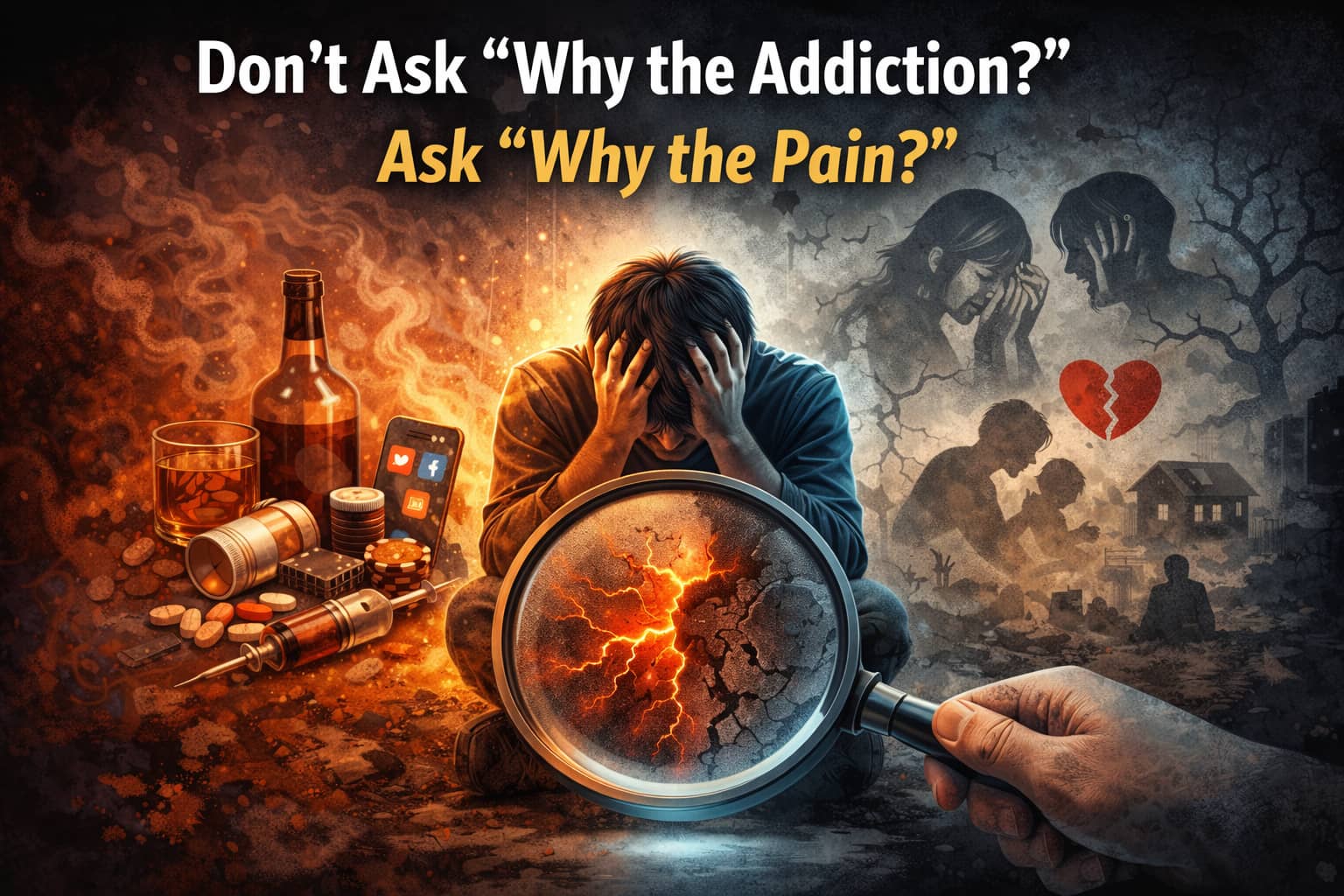
It has been repeatedly argued, by Canadian physician and addiction specialist, Dr. Gabor Mate, that the most useful question is not Why the addiction? But "Why the pain?" (Bramley, 2022).[4]
Such a change is interesting, as it is a shift in what we seek, and what we treat. Rather than focusing on blame, it focuses on what the individual is attempting to survive: emotional distress, trauma, chronic stress, shame, or a lifelong feeling of disconnection with the self and others (Mate & Mate, 2022). [5]
Addiction is often narrowed down to the observable manifestation: the alcoholism, the drugs, the recurrence, and the cycle of vanishing and reemerging in the mass discourse (American Psychiatric Association, 2023). [6]
However, a pain-oriented prism will question what the behavior is doing to the individual (Koob et al., 2020). [7]
It is uneasy as it does not accept ready villains (Earnshaw et al., 2020). [8]
Yet it is also practical. When a behavior is serving as emotional anesthesia, when there is momentary numbness that allows one to live and then takes it away without taking out what it was covering, the person is then exposed and normally floods and then resorts to the same approach that their brain has had trust in (Koob, 2021). [9]
Addiction is usually relief and not rebellion.
Addiction does not often start with self-destruction purposes (Koob et al., 2020). [10]
It usually starts with a necessity to control what appears to be uncontrollable (Mate & Mate, 2022). [11] The source of some of them is anxiety that refuses to subside (American Psychiatric Association, 2023). [12] To other people, it is sorrow, separation, fear, or even humiliation; the sort that is not only painful but personal, such as a sign that they are less than (Koob et al., 2020). [13]
Drugs and addictive behaviors can provide something that seems immediate, a peaceful state of mind, a relaxed state of body, a temporary feeling of power, forgetting their past, or just the ability to make it through the day (American Psychiatric Association, 2023). [14]It does not always turn out to be a pleasure as people imagine (Koob, 2021). [15] Often, it is relief (Koob et al., 2020). [16] And relief is an instructional wise one. When the coping strategies alleviate distress, they are strengthened psychologically. When the brain is taught that this will make the pain go away, it starts to give that choice a priority, even when such a choice may be too expensive in the long term (Koob, 2021). [17] With time, cues develop: a stressful conversation, a specific group of friends, loneliness at night, payday, a fight at home, even boredom (Sinha, 2024). [18] What initially was a choice turns into a habit (Koob, 2021). [19] That is why just stopping may make sense to an outsider and to a prisoner in the cycle; it is impossible (American Psychiatric Association, 2023). [20] Stopping does not just involve the mere cessation of the behavior but also confronting the suffering that the behavior was seeking to avoid (Koob et al., 2020). [21]
It is not really a “moral failure”, but a reaction to suffering.
The work of Mate can be summarized as an attack on stigma: addiction cannot be most effectively defined as a character weakness; it is rather a reaction to pain and alienation. According to this framing, responsibility is not eliminated. Individuals remain liable for the injuries they cause (Bramley, 2023). [22]
But it alters the appearance of responsibility in recovery (American Psychiatric Association, 2023). [23]
In case addiction is a coping mechanism, then recovery cannot be merely resisting urges; it must be creating a life in which urges need not seem to be the only way out (Koob, 2021). [24] It also alters the way we address struggling people. Shame is commonly a result of stigma, and more use is commonly a result of shame (Earnshaw et al., 2020). [25]
Clinical curiosity is introduced in place of moral judgment: A pain-focused approach (American Psychiatric Association, 2023). [26]
What pain is being managed?
What needs were never met?
What wound is still open? What is he or she not trying to feel and why? (Mate & Mate, 2022). [27]
Addiction cannot be justified by those questions. They explain it (Koob et al., 2020). [28]
And the first step is often an explanation of an effective intervention (American Psychiatric Association, 2023). [29]
The brain changes: When High Turns into Escape.
One of the misconceptions is that addiction is all about pursuing pleasure. Another driver, which is highly supported by modern addiction science, is the need to feel better than negative.
Neuroscientist George F. Koob, in a broad survey, defines addiction as a self-perpetuating cycle that contains a withdrawal/negative effect phase, at which point stress systems and emotional distress are heightened, and at which point drug seeking is reinforced in that it alleviates that distress. These are among the reasons why addiction may increase with time (Koob, 2021). [30]
The early usage can either be due to curiosity or social reward (Volkow & Blanco, 2023). [31]
Subsequent use is usually driven by emotional survival, alleviating anxiety, irritability, emptiness, or heavy internal pressure that accumulates with the absence of the substance. Relief becomes the reward. This is not a model where the individual is merely pursuing a high.
This could be an attempt by them to prevent experiencing low moods (Koob, 2021). [32]
This is important since it is how one will go back to use despite having serious consequences (American Psychiatric Association, 2023). [33]
The desire can become less desirable, more of a necessity when the brain has been trained to believe that a drug or act will temporarily quiet down distress (Koob, 2021). [34] That change also contributes to the fact that some conditions in life may make a person vulnerable: chronic stress or unstable housing, loneliness, untreated mental health symptoms, or being in an environment where day-to-day life may seem to be in danger (Sinha, 2024). [35]
When an individual is high in distress, relief is more reinforcing, and the cycle is much harder to interrupt (Koob, 2021). [36]
The secret motor: dissociation and unattended trauma.
It is not a single story of pain under addiction (Volkow & Blanco, 2023). [37] It may be trauma, though it may be years of being unnoticed, unprotected, or unloved (Hoffmann & Hoffmann, 2025). [38]
It may work without reprieve, or duty without ease. It may be a life in which they never had time to experience emotions, or in which being vulnerable was a punishable offense, or in which that individual had to realize that they had to do everything on their own. Dr. Mate puts an emphasis on development and lived experience, and the way early environments influence the nervous system to be tolerant of stress, and the person has the possibility to be healthy regulated (Mate & Mate, 2022). [39] This is related to the observation of many clinicians who have found that cravings tend to become less central when individuals obtain safer relationships, better coping abilities, and a more stable life (Patterson et al., 2025). [40]
It is not that temptation ceases, but the emotional crisis, which must be escaped, starts to subside (Sinha, 2024). [41]
That is to say, the aspect of addiction tends to be less about pleasures and more about security (Koob, 2021). [42]
Behavior does not tell the entire story, but it is the surface part of an invisible conflict (Volkow & Blanco, 2023). [43]
What do these things imply for the recovery process?
In case addiction is anesthesia of emotions, the process of quitting it without a cure may result in one being left vulnerable and naked (Koob et al., 2020). [44]
Just imagine that one is being told to remove his armor during a war, the threat is not over yet, but just their armor has been taken away (Koob, 2021). [45]
That is why the relapses are quite frequent when the treatment is conducted without a focus on the interference with the distress, triggers, and psychological traumas caused by the necessity to make a certain action or experience feel necessary in the first place (Vafaie & Kober, 2022). [46]
A better solution would combine behavioral change with pain-educated support: therapy that produces emotion regulation, community that eliminates isolation, routines that stabilize everyday living, and relationships that recreate safety and trust (American Psychiatric Association, 2023). [47] It is not only to cease use, but to cease the need to get away (Koob et al., 2020). [48] The absence of a substance is not the only meaning of recovery in this lens (American Psychiatric Association, 2023). [49]
It is the existence of the other: security, significance, affiliation, and the possibility to feel without the sense of being overwhelmed. Since for most, the alternative to addiction is not merely sobriety.
It's belonging (Patterson et al., 2025). [50]
References
- American Psychiatric Association. (2023). Top Ten Things Everyone Should Know About Addiction [PDF]. https://www.psychiatry.org/getmedia/e25c07ae-7333-4466-9add-5fe75ffce45e/Addiction-Top-10-Public-FINAL.pdf
- Bramley, E. V. (2023, April 12). The trauma doctor: Gabor Maté on happiness, hope and how to heal our deepest wounds. The Guardian. https://www.theguardian.com/lifeandstyle/2023/apr/12/the-trauma-doctor-gabor-mate-on-happiness-hope-and-how-to-heal-our-deepest-wounds
- Earnshaw, V. A., Mousavi, M., Qiu, X., & Fox, A. B. (2025). Mental illness and substance use disorder stigma: Mapping pathways between structures and individuals to accelerate research and intervention. Annual Review of Clinical Psychology, 21, 85–111. https://doi.org/10.1146/annurev-clinpsy-081423-023228
- Earnshaw, V. A., et al. (2020). Stigma and substance use disorders: A clinical, research, and advocacy agenda. https://pmc.ncbi.nlm.nih.gov/articles/PMC8168446/
- Hoffmann, J. P., & Hoffmann, C. S. (2025). Childhood trauma and adolescent substance use: An integrative perspective. https://pmc.ncbi.nlm.nih.gov/articles/PMC12427455/
- Koob, G. F. (2021). Drug addiction: Hyperkatifeia/negative reinforcement as a framework for medications development. Pharmacological Reviews, 73(1), 163–201. https://pmc.ncbi.nlm.nih.gov/articles/PMC7770492/ (DOI: https://doi.org/10.1124/pharmrev.120.000083)
- Koob, G. F., Powell, P., & White, A. (2020). Addiction as a coping response: Hyperkatifeia, deaths of despair, and COVID-19. American Journal of Psychiatry, 177(11), 1031–1037. https://doi.org/10.1176/appi.ajp.2020.20091375
- Maté, G., & Maté, D. (2022). The Myth of Normal: Trauma, Illness, and Healing in a Toxic Culture. Avery. (Publisher page: https://www.penguinrandomhouse.com/books/608273/the-myth-of-normal-by-gabor-mate-md-with-daniel-mate/)
- Patterson, M. S., et al. (2025). Exploring support provision for recovery from substance use disorder among members of a sober active community. Scientific Reports. https://pmc.ncbi.nlm.nih.gov/articles/PMC11906603/
- Sinha, R. (2024). Stress and substance use disorders: risk, relapse, and treatment outcomes. Journal of Clinical Investigation. https://www.jci.org/articles/view/172883
- Vafaie, N., & Kober, H. (2022). Association of drug cues and craving with drug use and relapse: A systematic review and meta-analysis. JAMA Psychiatry, 79(7), 641–650. https://pmc.ncbi.nlm.nih.gov/articles/PMC9161117/ (DOI: https://doi.org/10.1001/jamapsychiatry.2022.1240)
- Volkow, N. D., & Blanco, C. (2023). Substance use disorders: a comprehensive update of classification, epidemiology, neurobiology, clinical aspects, treatment and prevention. World Psychiatry, 22(2), 203–229. https://pmc.ncbi.nlm.nih.gov/articles/PMC10168177/ (DOI: https://doi.org/10.1002/wps.21073)
Salman Sami (salmansami1971@gmail.com) is a content creator under the Newswav Creator programme, where you get to express yourself, be a citizen journalist, and at the same time monetize your content & reach millions of users on Newswav. Log in to creator.newswav.com and become a Newswav Creator now!
The User Content (as defined on Newswav Terms of Use) above including the views expressed and media (pictures, videos, citations etc) were submitted & posted by the author. Newswav is solely an aggregation platform that hosts the User Content. If you have any questions about the content, copyright or other issues of the work, please contact creator@newswav.com.