As Southeast Asia’s gig economy accelerates, a bold move by Indonesia is shaking the foundations of ride-hailing economics - and raising an urgent question for Malaysia: will regulators step in to protect driver-partners, or allow market forces to dictate their fate?
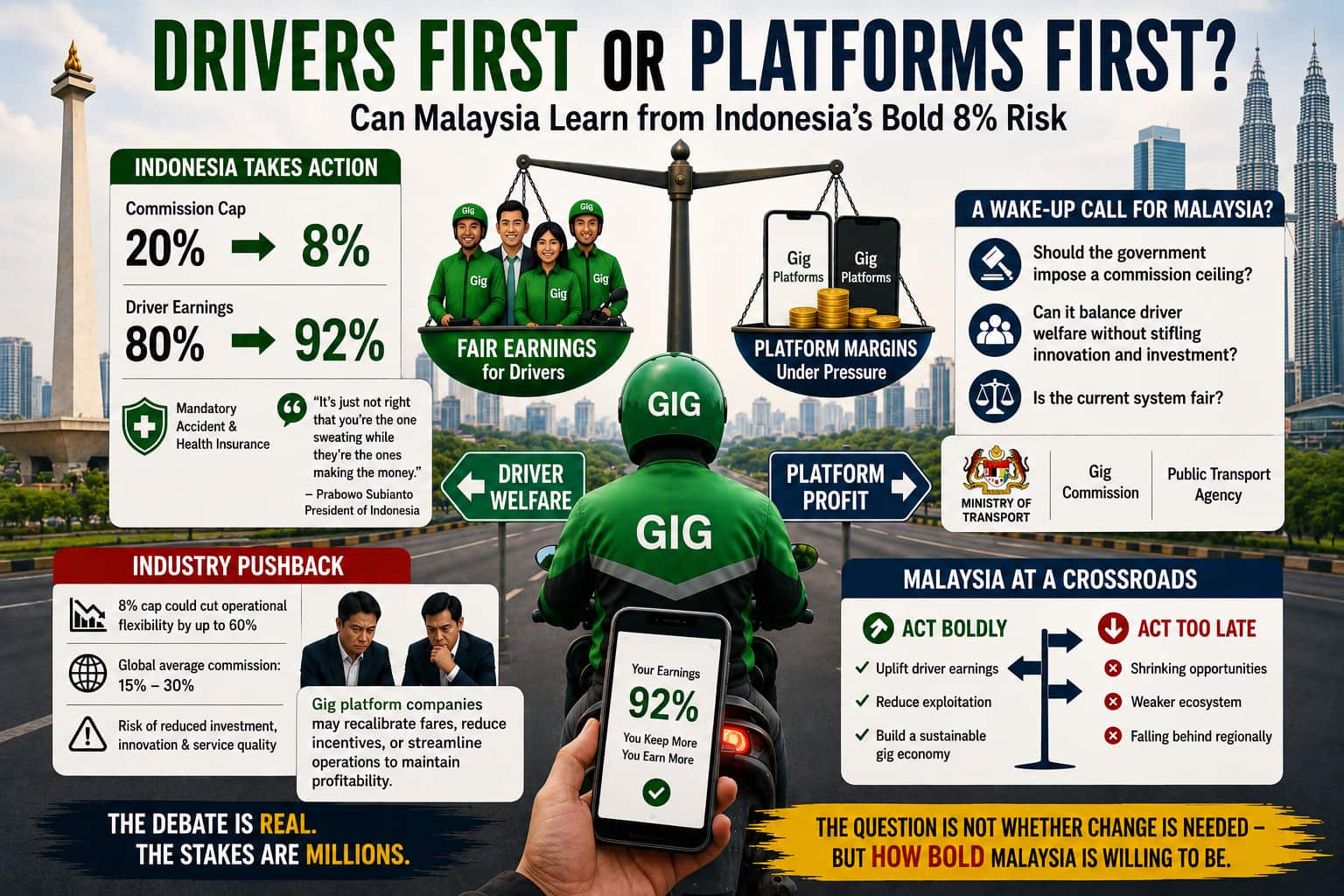
In a decisive policy shift, Indonesian President Prabowo Subianto announced a new cap limiting ride-hailing companies to a maximum commission of just 8%, slashing it from the previous 20%. More significantly, the regulation mandates that drivers must receive at least 92% of trip earnings - a dramatic redistribution of income in favor of those on the ground.
The move is not merely economic; it is political and moral. “It’s just not right that you’re the one sweating while they’re the ones making the money,” Prabowo remarked - a statement that resonates deeply with millions of gig workers across the region, including Malaysia.
A Wake-Up Call for Malaysia?
Malaysia’s ride-hailing ecosystem - dominated by regional giants like Grab Holdings - operates within a regulatory grey area where commission structures, incentives, and driver welfare are often opaque. While agencies such as the Ministry of Transport, the proposed Gig Commission, and the Land Public Transport Agency (APAD) have begun exploring gig worker protections, no policy has yet matched the scale or clarity of Indonesia’s intervention.
Indonesia’s new regulation goes beyond commission caps. It also requires platforms to provide accident and health insurance - a long-standing demand among gig workers who face daily risks with minimal safety nets.
For Malaysia, this raises pressing questions: Should the government impose a commission ceiling? Can it balance driver welfare without stifling innovation and investment? And most importantly - is the current system fair?
Industry Pushback: A Delicate Ecosystem at Risk?
Not everyone is celebrating. Industry groups in Indonesia warn that an 8% cap could disrupt the delicate economics of digital platforms. The Indonesian Association of Mobility and Digital Delivery Industry (MODANTARA) argues that such a low margin may reduce operational flexibility by up to 60%, forcing companies to rethink pricing, incentives, and even service availability.
Globally, ride-hailing platforms typically take between 15% and 30% commission - making Indonesia’s policy potentially the lowest in the world. Critics fear this could deter foreign investment and weaken innovation in a sector that supports millions of drivers and small businesses.
Companies like GoTo Group and Grab Holdings in Indonesia are already bracing for impact. Executives have signaled they may recalibrate fare structures, reduce incentives, or streamline operations to maintain profitability.
The Malaysian Dilemma: Reform or Risk Falling Behind?
Malaysia now stands at a crossroads. On one hand, stronger regulation could uplift driver earnings, reduce exploitation, and create a more sustainable gig economy. On the other, overly aggressive intervention risks shrinking the very ecosystem that provides flexible income opportunities to thousands.
The reality is that Malaysia’s gig workers - from e-hailing drivers to delivery riders - have long voiced concerns over shrinking earnings, rising costs, and inconsistent incentives. Yet policy responses have been gradual, often reactive rather than proactive.
Indonesia’s move may not be a perfect model, but it is a powerful catalyst. It forces policymakers in Malaysia to confront a difficult truth: the gig economy cannot remain a regulatory afterthought.
A Regional Turning Point?
Whether Malaysia chooses to emulate, adapt, or reject Indonesia’s approach, a bold truth emerges - the debate over fairness in the gig economy is no longer theoretical. It is unfolding in real time, with millions of livelihoods at stake.
The question now is not whether change is needed - but how bold Malaysia is willing to be.
By: Kpost
Information Source:
TheStar , Reuters , Tempo , TheEdge , SinarDaily
Kpost (ckhorsk@gmail.com) is a content creator under the Newswav Creator programme, where you get to express yourself, be a citizen journalist, and at the same time monetize your content & reach millions of users on Newswav. Log in to creator.newswav.com and become a Newswav Creator now!
The User Content (as defined on Newswav Terms of Use) above including the views expressed and media (pictures, videos, citations etc) were submitted & posted by the author. Newswav is solely an aggregation platform that hosts the User Content. If you have any questions about the content, copyright or other issues of the work, please contact creator@newswav.com.