
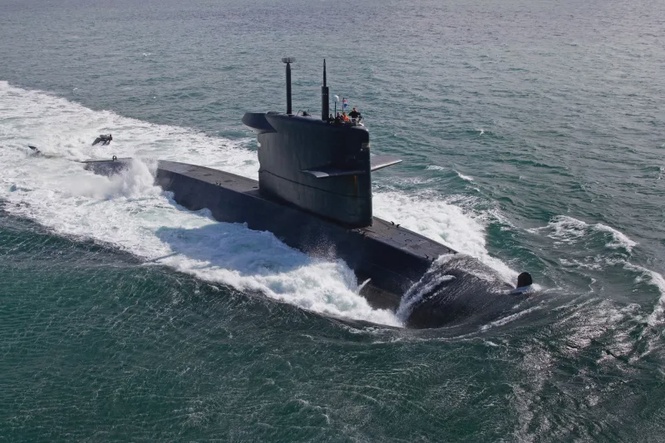
The Dutch submarine that once crept within torpedo range of a US aircraft carrier without being detected is headed for the scrapyard. The Royal Netherlands Navy is dismantling the Walrus after more than 30 years of service, stripping its last working parts to keep an aging submarine fleet at sea until French-designed replacements arrive in 2033.
In an announcement posted on October 12, 2026, the Netherlands Ministry of Defence said tugboats were towing the submarine on a floating pontoon from the Den Helder naval base, the navy's main home port on the North Sea, to Amsterdam. There, its hull will be cut apart and recycled, and part of its steel will be melted down.
How the Walrus Slipped Past a US Carrier Group
The boat's place in naval lore was sealed in 1999, during the US-led exercise JTFEX 99-1. According to defense outlet Army Recognition, the Walrus closed to about 1,500 meters of the aircraft carrier USS Theodore Roosevelt while the carrier was guarded by eight escort warships and anti-submarine aircraft.
No one found it. The Dutch commander fired green smoke grenades to mark a successful simulated torpedo attack, then slipped beneath the carrier and went on to simulate strikes against the escorts. The episode is still cited as a lesson that a large screen of warships does not by itself guarantee protection against a quiet diesel-electric submarine.
The Walrus was built for exactly that kind of work. Designers gave the class generous room for fuel and supplies, allowing the boats to operate far from Dutch waters for long stretches on reconnaissance, exercise, and patrol missions across the world's oceans. After the Cold War, the class became the backbone of the Netherlands' undersea defense.
Cannibalized to Keep Its Sister Boats Running
By the time it left Den Helder, the Walrus was little more than an empty hull. The navy formally retired it about three years ago after a long lay-up ashore, and engineers have since removed every installation and component that still worked. The Defence Ministry said those parts will help keep the navy's other submarines operational.
The ministry put the boat's condition bluntly: after three decades at sea, the Walrus had been "completely used up." With its decommissioning, it has also lost the "Zr.Ms." prefix carried by ships in active Dutch naval service.
A Thin Dutch Undersea Force Until 2033
The scrapping highlights a squeeze facing the Netherlands, a NATO member that relies on its submarines for intelligence gathering and long-range patrols. Its replacements are still years away.
Dutch State Secretary for Defence Gijs Tuinman and Naval Group CEO Pierre Eric Pommellet signed the contract for four Orka-class expeditionary submarines in Den Helder on September 30, 2024, Naval News reported. "The road to new submarines runs through France and the Netherlands," Tuinman said at the signing. The Orka class belongs to Naval Group's Barracuda family, and the deal was paired with a 20-year industrial cooperation agreement that brings Dutch companies and research institutes into work on key systems.
The Defence Ministry expects the first Orka-class boat in 2033 and the last in 2037. Until then, the navy must make do with its remaining Walrus-class submarines, partly kept alive with parts from the boat that gave the class its name.
A Design Family Tree That Reaches Taiwan
The Walrus entered service in 1992 as the lead ship of its class. It was developed and built in Rotterdam by shipbuilder Rotterdamsche Droogdok Maatschappij (RDM), displaced about 2,450 tonnes, measured 67.7 meters long, carried a crew of up to 52, and had a maximum range of 18,000 kilometers. It was armed with Mk 48 heavyweight torpedoes and Harpoon anti-ship missiles.
Its lineage matters well beyond Europe. The Walrus class is a successor to the Dutch Zwaardvis class and to Taiwan's Chien Lung class, the pair of Dutch-built submarines still serving in Taiwan's navy. Taiwan's first indigenous submarine, the Hai Kun, also draws on the Zwaardvis design.
As the Walrus is broken up in Amsterdam, its design DNA lives on in the waters around Taiwan, where quiet diesel-electric submarines remain central to deterring a far larger navy.
Social Media Links & Editor Tag - Penny