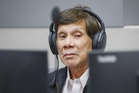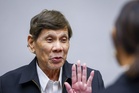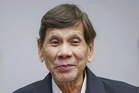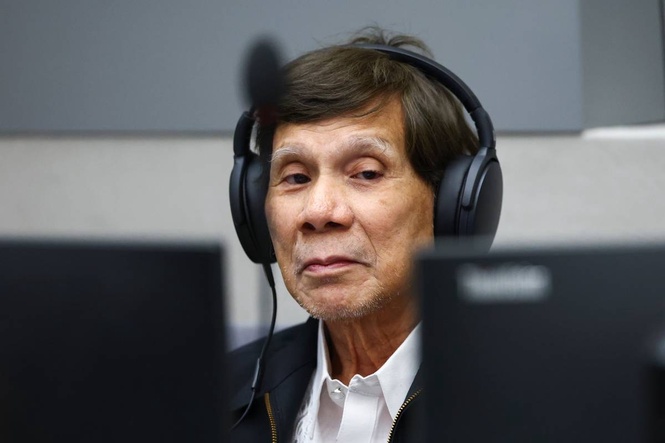
THE HAGUE, Netherlands — Former president Rodrigo Duterte appeared in person at the International Criminal Court (ICC) for the first time on Wednesday, as he faces charges over his “war on drugs” that killed thousands.
The 81-year-old had appeared by videolink when he was first brought to the court in The Hague, but had since skipped various hearings, with his defense team citing poor health.
Dressed in a dark suit, white shirt and no tie, the former president sat impassively as the proceedings opened, resting his chin on his hands.
President Judge Joanna Korner noted his appearance in court for the first time, and said he could leave the court at any time without seeking permission from the bench.
Duterte, who is facing charges of crimes against humanity, has missed a series of hearings since his arrest last year. Medical reasons were cited for his absence, but the court’s judges ruled in January that he was healthy enough to stand trial.
Duterte’s charges stem from his alleged involvement in dozens of killings as part of his so-called war on drugs while in office, first as the mayor of Davao City and later as president. He denies the charges against him.
Wednesday’s hearing was to discuss evidence disclosure and come up with a timetable for the trial, which will open in November.
“He’s fully aware that you’ll expect to see him sooner rather than later,” Duterte’s lead counsel Peter Haynes told the judges during the June hearing, referring to his client.
Duterte was arrested in March 2025 and was set to appear in court in The Hague in September last year. However, the hearing was delayed after a pretrial panel of judges granted a “limited postponement” to give the court time to determine whether Duterte was fit enough to take part in the proceedings.
Following an assessment by a panel of medical experts, judges ruled that Duterte is “fit to take part in the pretrial proceedings.” The ICC has been looking into mass killings in crackdowns overseen by Duterte since 2018. Estimates of the death toll during Duterte’s presidential term vary, from the more than 6,000 that the national police have reported up to 30,000 claimed by human rights groups.
According to the prosecutors, police and government hit squads carried out dozens of killings at Duterte’s orders, motivated by the promise of money or to avoid becoming targets themselves.
A month after the court in February 2018 announced a preliminary investigation into the violent drug crackdowns, Duterte said the Philippines would withdraw from the ICC.
Last year, judges rejected a request from Duterte’s legal team to throw out the case because of the Philippine withdrawal. Countries cannot “abuse” their right to withdraw from the court’s foundational Rome Statute “by shielding persons from justice in relation to alleged crimes that are already under consideration,” the decision says.
Earlier this year, an attempt by authorities to arrest Sen. Ronald dela Rosa, wanted by the ICC in connection with the drug killings, dissolved into gunfire in the Senate in May. No one was hurt. The court had unsealed an arrest warrant for dela Rosa, who served as national police chief under Duterte. Dela Rosa went into hiding following the Senate standoff and remains on the run.
Two months later, the Senate, acting as an impeachment court, opened the trial of Duterte’s daughter, Vice President Sara Duterte. If convicted of the charges, which include amassing unexplained wealth and publicly threatening the family of the current president, Ferdinand Marcos Jr., she may be permanently disqualified from holding public office. She denies the charges.
Memory loss
The former president is suffering from severe memory loss that means he sometimes forgets his lawyer’s name, according to the defense team preparing his case at the ICC.
His trial is scheduled to start on Nov. 30, but judges are weighing whether he is mentally fit to be tried and ordered a medical assessment by three experts.
That assessment has not been made public, but Duterte’s defense and the ICC prosecutor reacted to it in documents dated Sept. 14 but published on the ICC website on Tuesday.
Duterte “suffers from significant memory impairment that prevents him from retaining recent information and reliably accessing memories,” according to the 13-page defense submission.
This makes it impossible for him to engage with the case “let alone give proper instructions to his lead counsel, whose name he only sometimes remembers,” said his chief defense lawyer, Peter Haynes.
Haynes said he was being forced to prepare the case without meaningful input from his client.
The prosecution, in its own heavily redacted seven-page submission, concluded Duterte was “capable of meaningfully exercising his procedural and fair trial rights, and that he is fit for trial.” Under ICC rules, proceedings cannot continue if an accused is unable to understand the charges or participate meaningfully in his or her defense.
‘Incomplete and inadequate’
The defense also took aim at the panel of doctors, saying their report was “incomplete and inadequate,” and calling for them to be cross-examined.
According to the defense submission, the experts concluded Duterte “may not have been fully applying himself” during testing, making the results difficult to interpret.
Trial adjustments
ICC prosecutors have backed measures proposed by court-appointed experts to facilitate Duterte’s effective participation in his trial, including adjustments to hearing start times and other arrangements.
The measures were outlined in a public redacted filing dated Sept. 14 in which Acting Prosecutor Mame Mandiaye Niang presented the Office of the Prosecutor’s observations on the joint and individual reports of a three-member panel of experts that reassessed Duterte’s fitness to stand trial.
The prosecution said the experts’ recommendations were reasonable and deferred to the ICC Registry on their practical feasibility and to Trial Chamber III on whether they should be adopted.
Some details of the proposed arrangements remain redacted in the public version of the seven-page filing.
The prosecution said the panel had concluded unanimously that Duterte is capable of meaningfully exercising his procedural and fair trial rights, and is fit to stand trial.
“Based on the unanimous findings in the Experts’ Reports, the Chamber should conclude that Mr. Duterte is capable of meaningfully exercising his procedural and fair trial rights, and that he is fit for trial,” the prosecution said.
The panel proposed adjustments intended to facilitate Duterte’s effective participation in the proceedings. These include changes to hearing start times and other measures during court hearings, although portions of the recommendations are withheld from the public version.
The prosecution noted that any adjustment to the hearing schedule would have to take into account the testimony of witnesses and other demands of the trial.
It said exceptions may therefore be necessary to any proposal for later hearing starts.
Monitoring
The panel also recommended periodic reassessment of Duterte’s condition.
The prosecution, however, said there is no continuing statutory obligation for an ICC Chamber to reassess the fitness of an accused who has been found fit to stand trial.
It cited Rule 135(4), which applies when an accused has been found unfit to stand trial.
The prosecution said regular reassessments may consequently not be necessary in Duterte’s case.
But if the Chamber decides that another assessment should be conducted, it recommended that the same panel carry it out to ensure continuity.
The prosecution also argued that the Chamber does not need to convene a separate hearing on Duterte’s fitness.