
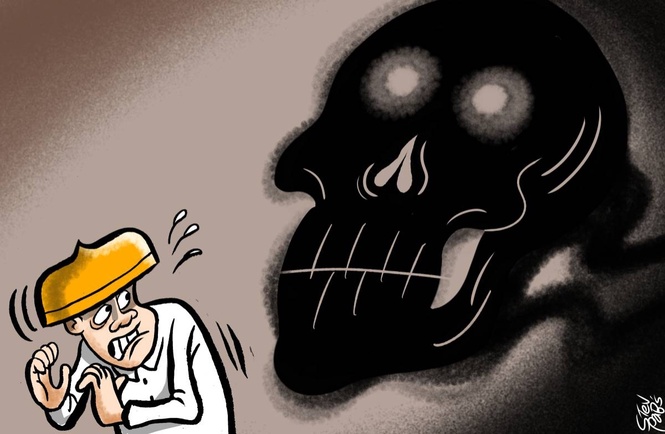
NOT all medical doctors would want to be in the scrub suit of Dr. Raquel Fortun, the country’s leading forensic pathologist. Examining the bodies of the victims of Rodrigo Duterte’s bloody war on drugs after the exhumation from their poor men’s graves is not for the faint of heart. Tougher is the part of providing the indisputable evidence to belie what was the stated cause of death in every examined victim’s official death certificate
Fortun does not only painstakingly examine the freshly exhumed bodies, which in some cases are in a state of near-disintegration; she has the additional task of speaking truth to acts of impunity during the Rodrigo Duterte regime.
Instead of “sepsis” or “heart attack” or “severe pneumonia” as written by compromised doctors in the official death certificates, Fortun would write down, post-examination, the true causes behind the death of the drug war victims: multiple and lethal gunshot wounds. Or death after a severe beating using a blunt and deadly instrument. Those corrections are intended to debunk a standard practice during the Duterte presidency to certify drug war deaths as cases of “severe pneumonia” or “myocardial infarction.” Were the doctors who issued the fake death certificates willing accomplices? Or issued the fakeries under duress? That we don’t fully know. Now, Fortun is asking the Philippine Medical Association to look into the case of the doctors who engaged in literally doctoring the true cause of death of the drug war victims. At least five doctors have been identified by Fortun as falsely certifying the death certificates of the drug war victims.
“When it names the wrong cause of death, it can hide the violence and skew the country’s death statistics,” Fortun said of what she called the “miscertification” of the death certificates of Duterte-era drug war victims. Fortun is part of the Truth Commission, an ad hoc body that is trying to look deeper into the bloody war on drugs of the Duterte administration, the same war on drugs that anchors the ongoing trial of Duterte at The Hague for alleged “crimes against humanity.”
Fortun and the other members of the Truth Commission are not the only ones kept busy by the drug war deaths during the Duterte years — totaling 6,000 according to the official account, and 30,000 according to human rights organizations. Law enforcement agencies are desperate to find and arrest former Duterte-era PNP chief and now senator Ronald “Bato” dela Rosa. Dela Rosa has an unserved warrant of arrest from the International Criminal Court. He has been named one of the several “co-conspirators” of Duterte in that bloody war. Another senator, Bong Go, has been named co-conspirator as well but no warrant has yet been issued by the ICC against him.
A P50-million bounty has been placed for dela Rosa’s speedy capture.
You have to multiply P50 million dozens of times to reach the amount of P41 billion, the same amount allocated by the Duterte administration during the pandemic years to purchase Covid-related medical supplies. An inquiry held by the Senate Blue Ribbon Committee during the Duterte years on how that jumbo fund was used led the general public and the media to call that fund the “Pharmally scam.” Around P11 billion of supply contracts under that fund, according to the Senate inquiry, was awarded to a newly registered pharmaceutical company called “Pharmally Pharmaceuticals.” Hastily registered in 2019 with a mere P625,000 in paid-up capital — and with so many false information filed in its general information sheet (GIS) — Pharmally should have been automatically disqualified outright from major government-held supply bids.
Lo and behold, Pharmally was awarded a total of P11 billion in supply contracts despite the many red flags. The Senate found that the Department of Health had released the P41 billion fund to the procurement office of the Department of Budget and Management. The DBM’s procurement office led by one Lloyd Christopher Lao, assisted by aides cum crooks, facilitated the award to Pharmally, which then supplied P11 billion worth of overpriced, unusable, rotting supplies for the Covid response. The Pharmally supply contract was later called “the biggest and most scandalous” case of state-sponsored official corruption because P11 billion was lost in orgies of impossible corruption.
The Office of the Ombudsman recently filed plunder charges against those believed responsible for the scam, one of the lingering horror legacies of the Duterte administration that up to today is being litigated.
But the Ombudsman case is not even the end of the ghastly Pharmally saga. Senators that looked into the case of Alice Guo, the former Bamban, Tarlac mayor now jailed for faking her Filipino citizenship, found that part of the proceeds from the Pharmally scam was reinvested into the POGOs hosted by the land development company in Bamban co-founded by Guo. Scam money helping fund POGOs.
We all know now that the Pharmally scam is no longer the biggest case of official corruption in the history of our corrupted polity. That supreme badge of disrepute now belongs to the so-called “Floodgate,” the depressing flood control funds corruption that wasted hundreds of billions in government infrastructure funds. Those looking into the origin story of “Floodgate” — which is the subject of a current Senate investigation — said it started in 2016, the year Duterte became president. Sarah and Curlee Discaya, the public faces of “Floodgate,” bagged P207 billion of public works contracts from 2016 to mid-2025, according to Senate records. That mind-boggling figure was mostly lost in orgies of corruption.