The e-Jamin system has operated for five years without a formal government contract, with RM130.8 million in bail funds invested by vendor Dapat Vista, says PAC.
KUALA LUMPUR: The e-Jamin system, a court bail payment service under the Office of the Chief Registrar of the Federal Court (PKPMP), has been operating for five years since 2020 without a formal contract with the federal government.
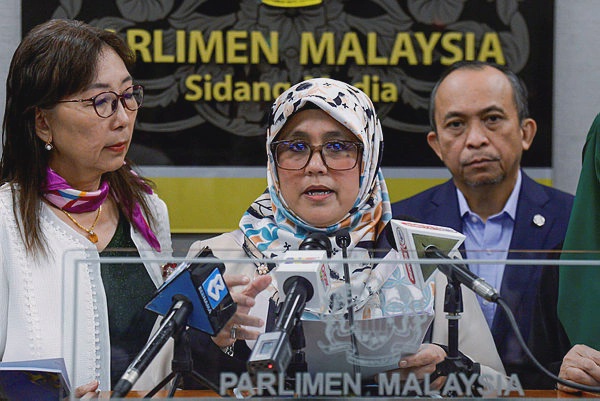
Public Accounts Committee (PAC) chairman Datuk Mas Ermieyati Samsudin said the system operated without a Letter of Appointment, Letter of Acceptance (SST), Letter of Intent (LOI) or any formal contractual agreement with the government.
“The e-Jamin system was initiated following a 2017 study by Dapat Vista to facilitate the court bail payment process and was implemented as a proof-of-concept (POC) approved by the Chief Justice. However, its implementation did not adhere to prevailing government financial and procurement procedures.
“e-Jamin operations across 192 courts nationwide have been running for five years since Jan 10, 2020, without any formal contractual agreement,” she told a press conference at the Parliament building today.
Mas Ermieyati, who is also the Masjid Tanah Member of Parliament, said the findings were based on four proceedings on the management of the e-Jamin system held between Nov 4 and Dec 2, 2025.
She said the proceedings involved witnesses from the Prime Minister’s Department (JPM), Ministry of Finance (MOF), the Attorney General’s Chambers (AGC), PKPMP, the Accountant General’s Department of Malaysia (JANM) and the e-Jamin system operator, Dapat Vista Sdn Bhd.
She said that, of the RM193.71 million in bail deposits held in the account as of Dec 31, 2024, Dapat Vista was found to have invested RM130.8 million under the company’s name, generating annual interest of between RM4 million and RM5 million.
Mas Ermieyati said bail monies paid through e-Jamin were deposited into the company’s commercial accounts, and the failure to account for the funds in the Consolidated Trust Account was in breach of Article 97(1) of the Federal Constitution and Section 7 of the Financial Procedure Act 1957.
She added that the PAC also found that the guarantee mechanism lacked a trustee structure, performance bond or insurance, effectively leaving the guarantor as an unsecured creditor exposed to financial risk in the event of the company’s bankruptcy.
The PAC also found an unverified balance discrepancy of RM557,258 between the e-Jamin system records and the company’s bank statements.
Mas Ermieyati said a previous directive to suspend the e-Jamin system for three days had sparked widespread objections due to concerns over delays in the release of accused persons.
She said the MOF subsequently decided to continue using the existing system free of charge under a formal agreement involving a trustee bank structure.
“The PAC also concluded that the five-year period of contract-free operations, facilitated by repeated special exemptions, represented an excessively long period of financial non-compliance, especially given that the government possesses its own alternative channels for bail management, such as the eCourt Finance (eCF) system, electronic fund transfers (EFT) and the iPayment system,” she said.
In light of this, Mas Ermieyati said the PAC recommended that PKPMP and the MOF expedite negotiations to finalise a formal agreement with Dapat Vista to safeguard bail funds.
The committee also urged the government to finalise the definition of “public funds” to prevent confusion among agencies, while ensuring that the management and accounting of security deposits comply with Article 97(1) of the Federal Constitution and Sections 4 and 7 of the Financial Procedure Act 1957.
“PKPMP is also advised to develop its own in-house security deposit module via eCF or e-Kehakiman to avoid vendor dependency and ensure 100 per cent ownership of government data, in addition to expediting the reconciliation of criminal security deposit account balances and implementing periodic monitoring.
“The PAC also wants the MOF, AGC and National Digital Department to tighten controls on information and communication technology procurement to ensure that no vendor operates without a valid contract from the first day of implementation.
“The MOF also needs to tighten the granting of special financial exemptions to uphold the principles of good governance,” she said.
The PAC’s statement on the matter was tabled in the Dewan Rakyat today after the issue received the committee’s special attention during a briefing on the Auditor General’s Report No. 3/2025 on Oct 8, 2025.
According to the Auditor General’s Report (LKAN) 2/2024, the balance of the Criminal Bail Deposit Account under the e-Jamin system stood at RM182.94 million as of Dec 31 last year, down RM10.77 million from RM193.71 million previously.
“Criminal bail deposit receipts through the e-Jamin system were not accounted for as deposits in the Federal Government’s Financial Statements.
“This is because the deposits remain under the control of the external entity managing them and have not been remitted to the federal government,” the report stated.
The report noted that as the legal instruments governing the management and collection of the funds had yet to be finalised, the MOF granted a special exemption from compliance with financial procedures for the management of receipts through the e-Jamin system until Aug 31, 2026.
Feedback from JANM dated Aug 27 stated that the PKPMP had submitted the Cabinet Memorandum (MJM) and agreement documents to the relevant parties, but they had yet to be tabled at a Cabinet meeting.
“Consequently, in a letter dated Aug 20, 2026, PKPMP requested an extension of the special exemption from MOF regarding compliance with financial procedures for managing bail receipts through the e-Jamin system, to allow the MJM to be tabled and the necessary Cabinet approval to be obtained,” the report stated.