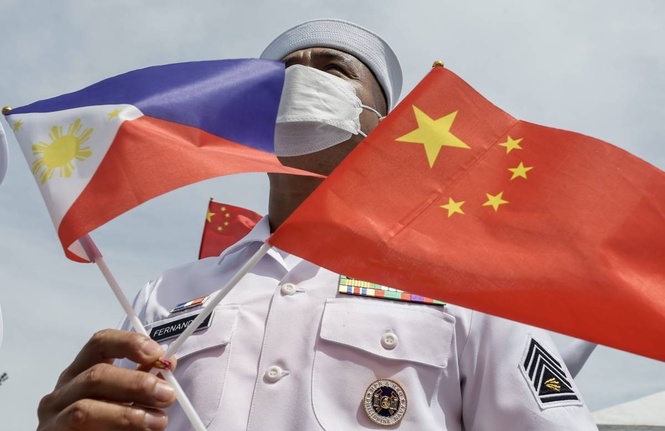
A COALITION of 24 business, labor, industry and other organizations urged the government to ease tensions with China and pursue a more coordinated diplomatic approach, warning that strained bilateral relations could jeopardize trade, investments, jobs and other Philippine economic interests.
In a joint appeal, the organizations called on the Philippine and Chinese governments to exercise restraint, avoid inflammatory rhetoric and resolve disagreements through established diplomatic channels rather than public exchanges.
They stressed that the Philippines must protect its sovereignty and sovereign rights under international law while maintaining economic cooperation with China.
The groups cited the two economies’ deep trade and investment ties, noting that China and Hong Kong accounted for nearly 30 percent of Philippine international trade, with China accounting for 26.3 percent of exports and 27 to 29.5 percent of imports, based on figures cited in the appeal from the Philippine Statistics Authority for the first semester of 2026.
In contrast, the Philippines represents only 0.3 to 0.5 percent of China’s total global trade, they said.
The organizations warned that worsening tensions could undermine investor confidence, disrupt supply chains, increase costs and affect businesses, workers, consumers and communities.
They also pointed to China’s role as a supplier of essential goods, industrial inputs, machinery, electronics, strategic raw materials and renewable energy technologies supporting Philippine industries and the country’s clean energy transition.
“The Filipino people deserve a government that protects sovereignty while expanding prosperity. Entrepreneurs need stable markets; workers, secure livelihoods; consumers, affordable essentials; and farmers and manufacturers, reliable inputs and wider market access. The country also needs investment, technology, energy security, clean energy solutions, and sustained growth. These priorities should take precedence over public exchanges that distract from practical cooperation,” they said.
The signatories urged the government to adopt a centralized, coherent and consistent foreign policy, with diplomatic positions articulated by designated authorities through coordinated institutions and established channels.
They also called for stronger economic cooperation in trade, investment, tourism, energy security, electric mobility and solar deployment, as well as technology transfer, local production and the creation of decent jobs.
At the same time, the groups said the country should pursue strategic diversification by strengthening domestic industries, expanding local manufacturing and developing alternative sources of critical supplies.
“Constructive relations with China do not require abandoning Philippine sovereignty, overlooking legitimate concerns, or compromising an independent foreign policy,” the groups said. “Effective diplomacy means defending national interests while avoiding unnecessary escalation.” The organizations said the Philippines should pursue a foreign policy that is principled but pragmatic, resolute but diplomatic, and anchored in protecting sovereignty, economic security and long-term development.
“We respectfully appeal to Philippine and Chinese authorities to lower the temperature, restore disciplined diplomatic engagement, and build a stable, respectful, and productive bilateral relationship. Let us pursue principled diplomacy over public antagonism, economic cooperation over avoidable friction, and strategic foresight over short-term political posturing,” they said.
“The ultimate measure of diplomacy is whether it protects national interests, prevents avoidable conflict, creates opportunities, and improves the lives of our people — not who prevails in a public exchange,” the groups added.
Among the signatories were the Employers Confederation of the Philippines, Philippine Chamber of Commerce and Industry, Federation of Filipino-Chinese Chambers of Commerce and Industry, Federation of Free Workers, Philippine Exporters Confederation, Semiconductor and Electronics Industries in the Philippines Inc., and Foundation for Economic Freedom.