As of the date of writing, July 7th 2025, the reviewed and expanded Sales and Service Tax [herein referred to as SST] increase put forward by our Finance Minister Dato' Seri Anwar Ibrahim has gone into effect, as was stated in Budget 2025. In a statement by the Finance Ministry, the ministry noted that this measure aims to strengthen the country's fiscal position by increasing revenue and broadening the tax base. However, does it truly serve the people, or is it a quick band-aid solution that would yield more social harm than good? Is it truly something that progressives should celebrate or fear? Should Regressive Taxation have a place in any serious conversation about Malaysian politics in this day and age? All these and more will be explored in this article.
Background
As detailed by The Edge Malaysia, the revised taxes are detailed in the table below:
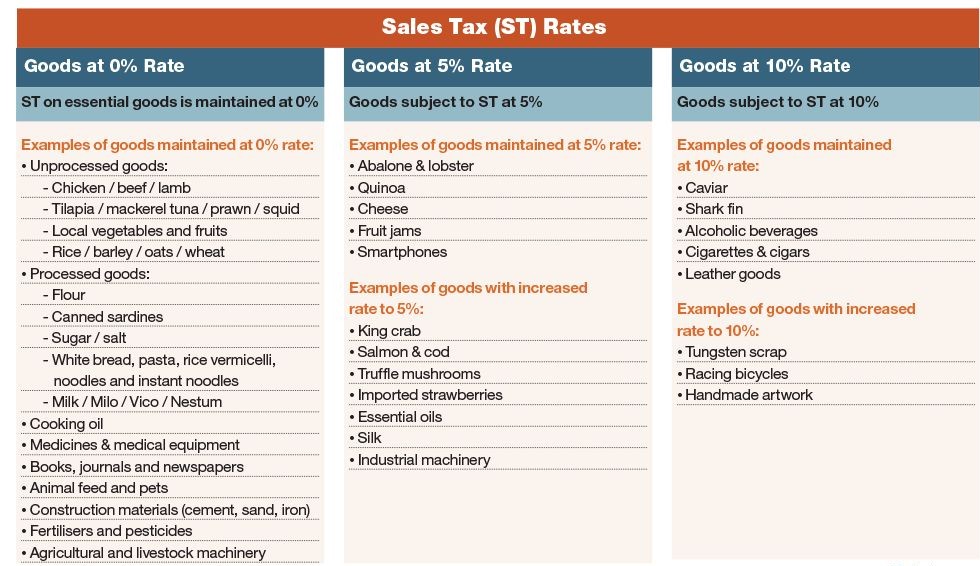
By contrast, the tax increased from 6% to 8% on the Following Services:
- Leasing and rental services will be taxed at 8%, with exemptions for residential rentals, reading material, and MSMEs with annual rental revenue below RM500,000.
- Construction services will see a 6% duty applied to providers exceeding RM1.5 million in annual revenue, though residential buildings and public facilities in residential buildings are exempted.
- Financial services based on fees or commissions will be taxed at 8%, but basic banking and Shariah-compliant financing, foreign exchange gains, and capital market services remain exempt.
- Private healthcare services for non-citizens will be levied at 6% for operators with annual revenue exceeding RM1.5 million, while Malaysian citizens are fully exempt across all healthcare categories, including traditional and allied health services.
- Private education will be charged a 6% tax on high-end private schools (those charging over RM60,000 per student per year) and non-citizen higher education students. Malaysian citizens are exempt across the board.
- Beauty services, such as facial treatments and hairdressing, will be taxed at 8% if the provider's taxable value exceeds RM500,000 annually.
Analysis on the Tax Itself
On the surface, the tax increases do hit the wealthiest Malaysians the hardest, and it certainly seems that way. However, a serious conversation needs to be had over the role of a regressive tax in a developing nation like ours. Let's present the facts as they really are.
In November last year, a report by Dollars and Sense reported that over the course of the pandemic, with comparisons of data between 2019 and 2022, that lower income households (defined as households earning sub RM2000/month), were the most affected with a 100% income drop. It is worth noting that this does not mean they lost all of their income, but rather that their potential for growth was completely wiped out. However, contrary to popular belief, the rich actually thrived with households who earned more than RM12,000/month experienced income growth between 2.0% and 6.6%. With lower-income families already struggling with the cost of living, and multiple sources indicating that regressive taxes disproportionately affect the poorest, one must seriously consider whether they have a place in modern society.
When it comes to the increases, the impact is something that leaves a lot to be desired. According to Business Today Malaysia, as reported on June 29th, 2025, it is noted that the SST increases will contribute only 0.2% to the headline inflation rate, but this can be misleading as the increase will not be felt uniformly across all sectors. For example, a new 5% tax on industrial machinery might increase the price of certain manufacturing goods, which are essential for everyday life, ranging from toothpaste and other personal care products to basic apparel and other food items, which businesses will inevitably pass onto the consumer which increases the price despite the good itself being in the 0% tax bracket.
What we see in our society today is clearly a band-aid solution to a problem which might only exacerbate as time goes on. However, there is a progressive alternative to this issue that tackles the problem head-on.
The Progressive Alternative - A Wealth Tax
The alternative would be a measure to increase progressive taxes (i.e. taxes on wealth/income) in this nation, if the government were really serious about economic justice, rather than a quick fix, with a swathe of taxes which target the wealthiest people in our society today. However, the fix that I will be zeroing in on would be a wealth tax. To understand what a wealth tax is, we must define it. The Tax Foundation defines a Wealth Tax as: (A tax that) is imposed on an individual's net wealth, or the market value of their total owned assets minus liabilities. I will present reasons why a wealth tax should be favoured over an increase in the SST before addressing the broader issue of repealing and replacing regressive taxation in general.
One of the reasons for supporting a wealth tax over SST increases would be that a wealth tax brings in more revenue than SST increases. The former Member of Parliament for Klang, Charles Santiago, in a post on X (formerly known as Twitter) has laid out the argument. He mentioned that a 2% tax on the 50 richest Malaysians (which collectively own RM414 Billion in wealth) will raise RM8.28 Billion in revenue which is 65.6% more revenue than what the SST increases hope to raise (RM 5 Billion) which can then be spent to improve the country in a more meaningful way. Another reason would be achieving a more equal society. In the same post, he mentioned that Unicef Malaysia has mentioned that the lowest economic class in Malaysian society spends 38% of their income on food, yet taxing consumption is still the most preferred option.
Our Deputy Minister of Trade and Industry, Liew Chin Tong, was quoted to have said in 2020 by Free Malaysia Today that: "For example, we can tax the top 1 or 2% with a higher rate. For them to be taxed with a higher rate, in a way it's like paying (an) insurance premium" and I am inclined to agree with that statement. Let's conduct a thought experiment with the following parameters: The Malaysian Population is 34 million people, indicating that 340,000 members of society are in the top 1% of income earners, with the threshold being RM2.2 million and above, according to a Knight Frank Report. If we hypothetically assume that the average net wealth for the entire top 1% is RM5 Million per person (a conservative figure), a 1% wealth tax would yield RM17 Billion and a 2% wealth tax would yield RM34 Billion, and it is likely to be higher than just RM34 Billion as this was just a conservative figure on the richest 1% in our country. Meanwhile, the SST is projected to raise RM46.7 billion in the fiscal outlook published by the Finance Ministry (page 28). There is a legitimate way to phase out and straight up abolish this regressive tax and replace it with a more progressive wealth tax.
Timothy (timothytanyeantim@gmail.com) is a content creator under the Newswav Creator programme, where you get to express yourself, be a citizen journalist, and at the same time monetize your content & reach millions of users on Newswav. Log in to creator.newswav.com and become a Newswav Creator now!
The User Content (as defined on Newswav Terms of Use) above including the views expressed and media (pictures, videos, citations etc) were submitted & posted by the author. Newswav is solely an aggregation platform that hosts the User Content. If you have any questions about the content, copyright or other issues of the work, please contact creator@newswav.com.