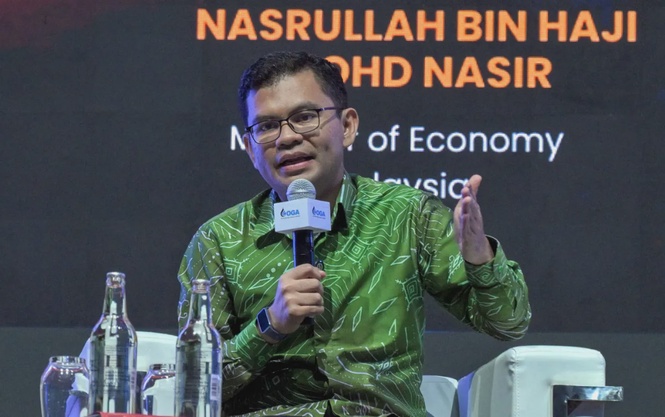
KUALA LUMPUR: Domestic oil and gas services and equipment (OGSE) companies must consolidate, strengthen balance sheets and reduce excessive dependence on Petroliam Nasional Bhd (Petronas) to compete for larger projects and expand into international markets.
Economy Minister Datuk Seri Akmal Nasrullah Mohd Nasir said the industry needed to build greater scale and resilience while moving beyond its traditional role as a technical and operational service provider.
“Can our players then move beyond that?” he said at the 8th Malaysia Oil & Gas Services Exhibition & Conference 2026 today, referring to the need for Malaysian OGSE companies to reduce their reliance on Petronas and expand beyond the domestic market.
Akmal Nasrullah said the government’s objective was not simply to bring more investment into the sector, but to ensure that more value was retained within Malaysia’s industrial ecosystem. “The values that we need to get out of this, it’s not just about how much investment we can bring in. But it’s really about how we can have the values in our ecosystem.”
He said Malaysian OGSE companies had already demonstrated their ability to operate, provide technical solutions and resolve issues on the ground, but the next challenge was to move further up the value chain.
“Our wish is actually for the industry to remain not just at the ability to operate, to provide technical solutions, or to really resolve the issues on the ground,” he said.
Instead, Akmal Nasrullah wants the industry to develop capabilities that can be taken beyond Malaysia, including through the development of technologies and inventions that can compete internationally. “I’m betting that what we do here is up to the international standard. The issue is how to scale us up then.”
This, he added, required Malaysian OGSE players to build greater financial strength and scale so they can take on larger and more complex projects, while consolidation could help create companies with stronger balance sheets and greater capacity.
Akmal Nasrullah said the push to scale up the industry was also closely linked to the opportunities emerging from the global energy transition. The transition should not be viewed merely as an energy-sector agenda, but as an opportunity to restructure the wider economy.
“We need to restructure our economy, and this is where the energy transition comes in. It is not just about the energy agenda, but also about the economic opportunity that comes with it,” he added.
Areas where Malaysia could leverage its existing capabilities include carbon capture, utilisation and storage (CCUS), digital solutions, and repurposing existing oil and gas infrastructure.
On carbon capture and storage (CCS), Akmal Nasrullah said Malaysia already had many of the necessary ingredients.
“We have the ingredients, we have the depleted reservoirs, we have the talent, we have the ecosystem, we have the infrastructure, but the challenge is how do we make it commercially viable?” he said.
However, he acknowledged that the technology remained costly and technically challenging, making it important for the industry to develop commercially viable solutions.
The government has been supporting the OGSE industry through targeted programmes, with RM21 million in OGSE development grants awarded to 97 projects. Of these, 25 projects commercialised between 2023 and 2025 generated RM77.5 million in sales and contract value.
Separately, about 600 companies have been supported to grow exports and develop technology through programmes involving Malaysia External Trade Development Corp (Matrade), generating more than RM2 billion in OGSE export sales.
Akmal Nasrullah said the longer-term ambition was for Malaysian companies to develop capabilities and solutions that could compete in regional and global markets.
He said the industry should move beyond simply being recognised for work carried out in Malaysia.
The ambition, he said, was to move from “Made in Malaysia” to “Made by Malaysia”, with Malaysian companies owning technologies and solutions they could export and deploy internationally.
This could position Malaysian OGSE players to tap opportuities across Asean and other regional markets as countries seek solutions to support their respective energy transitions.
Akmal said the ultimate objective was to ensure that Malaysia’s existing technical expertise, companies and talent could capture a greater share of the value created by the transition.
For OGSE companies, the shift means building sufficient scale, financial strength and technological capabilities to compete beyond Petronas and beyond Malaysia.
“I’m betting that what we do here is up to the international standard,” Akmal Nasrullah said. “The issue is how to scale us up then.”