“I’m moisturising all the time, but my skin is still itching. What am I doing wrong?”
It is a question that comes up regularly in community pharmacy. Someone may have tried three different creams, changed their soap and stopped using perfume, yet their skin is still red, uncomfortable and keeping them awake at night.
Eczema can be frustrating because it rarely follows a neat pattern. The skin may settle for weeks, only to flare up again without an obvious reason. Scratching provides temporary relief, but often leaves the skin more irritated than before.
The good news is that eczema can usually be managed more effectively with the right combination of everyday skincare and treatment during flare-ups. The challenge is understanding what each product does and using it properly.
Why does eczema keep coming back?
Atopic eczema is a common inflammatory skin condition. The skin’s natural protective barrier does not work as effectively as it should, allowing moisture to escape and making it easier for irritants to affect the skin.
The result can be dryness, redness, itching, cracking and inflammation. In some people, the skin becomes thickened after repeated scratching.
Eczema is not contagious. You cannot catch it by touching someone else’s skin, sharing a towel or sitting next to them.
It often begins in childhood, but adults can develop eczema too. Some people improve as they get older, while others continue to experience flare-ups throughout adulthood.
Heat, sweating, soaps, detergents, certain fabrics and stress may aggravate symptoms in some people, although triggers vary considerably. There is no single trigger that explains every case. NHS – Atopic eczema
The itch–scratch cycle
One of the most difficult parts of eczema is the cycle that develops between itching and scratching.
The skin becomes inflamed and itchy. Scratching brings a moment of relief, but it damages the skin further, increasing irritation and sometimes causing bleeding or cracks. That damaged skin then becomes even more uncomfortable.
At night, this can be particularly troublesome. People may scratch without realising it while asleep and wake up with sore, bleeding patches.
Breaking this cycle is an important part of treatment. Keeping the skin moisturised helps protect the skin barrier, while appropriate anti-inflammatory treatment can bring an active flare under control.
Simply telling someone to stop scratching is rarely enough. They need a practical plan to reduce the itch and treat the underlying inflammation.
The moisturiser matters more than you might think
In pharmacy, I often find that people think of moisturiser as something to apply when their skin feels dry. With eczema, it is better thought of as part of the daily treatment routine, even when the skin looks much better.
These products are known as emollients. They help soften the skin, reduce moisture loss and support the protective skin barrier.
There is no single best emollient for everyone. Some people prefer a light cream that absorbs quickly, while others find a thicker ointment more effective for very dry skin. Ointments generally contain more oil and less water, making them useful for dry, thickened areas, although they can feel greasy.
The most effective product is one you can use comfortably and regularly.
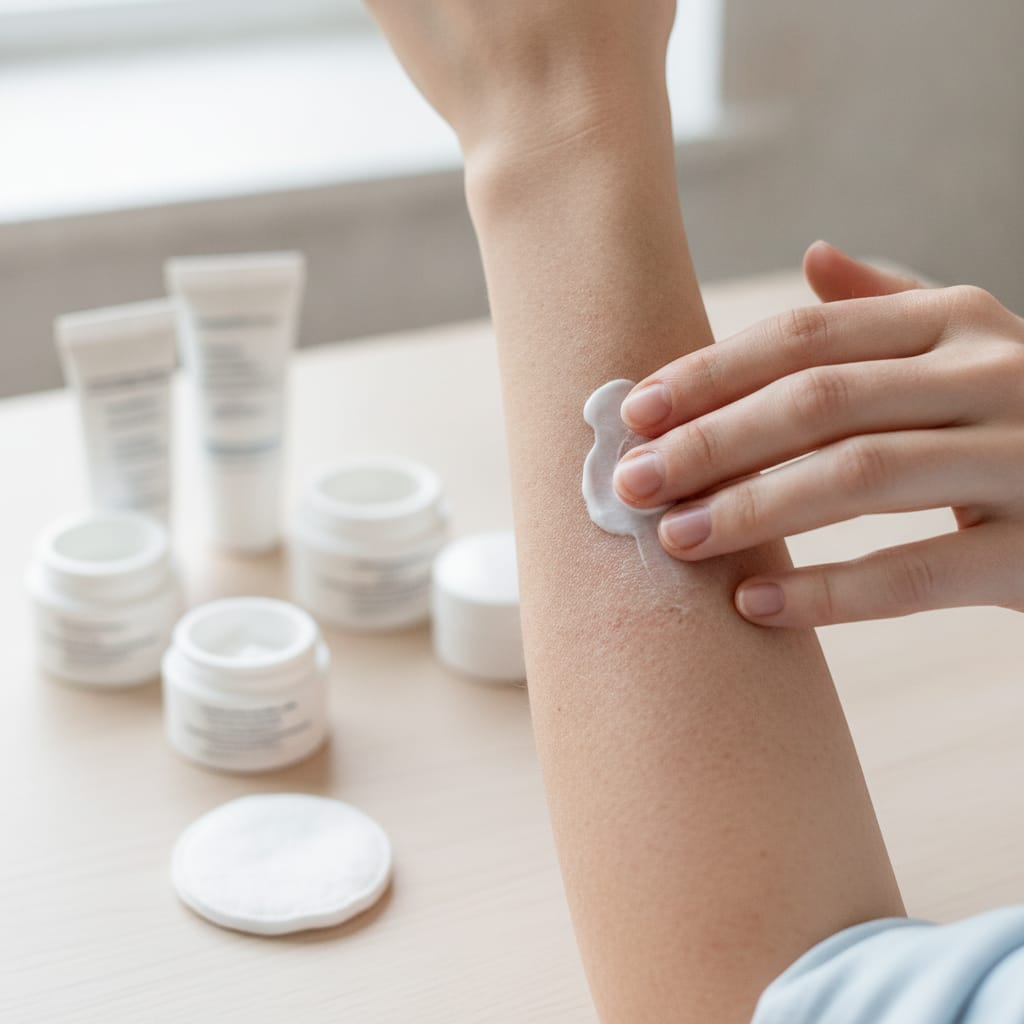
Choose an unperfumed product, apply it generously and reapply whenever the skin feels dry. Smooth it onto the skin rather than rubbing vigorously. If a product stings, irritates the skin or is unpleasant to use, ask your pharmacist about an alternative.
The NHS recommends regular emollient use, including when eczema has settled. NICE guidance also emphasises that emollients should be used alongside other treatments when needed. NHS – Emollients
One practical tip: ordinary soap, bubble bath and fragranced shower products can aggravate eczema. An appropriate emollient wash or soap substitute may be gentler.
Also remember that emollient residue can build up on clothing and bedding and increase the speed at which fabric burns. Keep away from naked flames and cigarettes, and wash fabrics regularly according to their care instructions. This warning applies even when the product has dried on the skin.
What about steroid creams? Should we be worried?
This is where unnecessary fear can sometimes prevent people from getting effective treatment.
Topical corticosteroids, often called steroid creams or ointments, reduce inflammation and are commonly used during eczema flare-ups. They are not the same as anabolic steroids used to build muscle.
When used appropriately, topical corticosteroids are an important and effective treatment. The strength required depends on the severity of the eczema and the area being treated.
However, not every steroid is suitable for every part of the body. The face, eyelids, groin and skin folds are particularly sensitive areas. Stronger preparations may cause harm if used incorrectly or for too long.
Follow the instructions from your prescriber or pharmacist, including how much to apply, how often to use it and how long treatment should continue. If an over-the-counter hydrocortisone product is being considered, check that it is suitable for your age, the affected area and the suspected condition.
A common mistake is to use moisturiser alone on an inflamed flare, hoping that the redness and itching will eventually disappear. Moisturisers help the skin barrier, but they do not replace anti-inflammatory treatment when this is needed.
Equally, do not use a steroid cream repeatedly on an undiagnosed rash. Fungal infections and other skin conditions can resemble eczema but need different treatment.
NICE advises tailoring topical corticosteroid potency to the severity of eczema and the body site, with clear instructions on safe use. NICE – Atopic eczema: treatment recommendations
Are food allergies responsible?
This is a question many parents ask, particularly when a child has persistent eczema.
Food allergy can coexist with eczema, especially in children, but that does not mean food is responsible for every flare. Cutting out dairy, eggs, wheat or several food groups without a clear reason can create nutritional problems, particularly for growing children.
If eczema occurs alongside symptoms suggestive of an immediate food allergy, such as hives, swelling, vomiting or breathing difficulties after eating a particular food, medical assessment is important.
For persistent eczema that is not responding to appropriate treatment, a clinician may consider whether allergy assessment is appropriate. Avoid relying on unregulated online allergy tests or starting restrictive diets without professional guidance.
NICE recommends considering the child’s symptoms and history rather than assuming that eczema automatically means food allergy. NICE – Atopic eczema in under 12s
When is eczema no longer just a flare-up?
Most flare-ups can be managed, but some symptoms need prompt attention.
Seek medical advice if eczema is not improving with appropriate treatment, is becoming increasingly painful, is spreading or is interfering significantly with sleep and everyday life.
Look out for signs of infection, including pus, increasing warmth, swelling, crusting, worsening pain or rapidly deteriorating skin.
There is one complication that deserves particular attention: eczema herpeticum, a potentially serious viral infection. It can cause rapidly worsening eczema with clusters of painful blisters or small, uniform sores, sometimes accompanied by fever or feeling unwell. This needs urgent same-day medical assessment.
Do not assume that every sudden deterioration is simply another eczema flare.
NICE recommends urgent assessment when eczema herpeticum is suspected, and prompt review when treatment is failing or infection is a concern. NICE – Atopic eczema: referral recommendations
A better routine, not another miracle cream
Living with eczema can mean trying to find a balance between preventing flare-ups and treating them quickly when they occur.
A useful routine is straightforward: moisturise regularly, avoid products that irritate your skin, use prescribed anti-inflammatory treatment as directed, and seek advice when the pattern changes or treatment stops working.
If you are repeatedly buying different creams without improvement, take the products you have been using to your community pharmacist. They can help you review your skincare routine, check whether a treatment is appropriate and decide whether you need to see your GP.
Eczema is not a sign that someone is unclean, nor is it something that can always be cured by finding the right moisturiser. But with a sensible treatment plan, many people can reduce flare-ups and regain a better night’s sleep.
The aim is not perfect skin every day. It is to keep the skin comfortable, recognise flare-ups early and know when additional help is needed.
Until next time, look after yourself.
This article is for general health information and is not intended to replace individual medical advice.
Health Matters (zaynp100@yahoo.com) is a content creator under the Newswav Creator programme, where you get to express yourself, be a citizen journalist, and at the same time monetize your content & reach millions of users on Newswav. Log in to creator.newswav.com and become a Newswav Creator now!
The User Content (as defined on Newswav Terms of Use) above including the views expressed and media (pictures, videos, citations etc) were submitted & posted by the author. Newswav is solely an aggregation platform that hosts the User Content. If you have any questions about the content, copyright or other issues of the work, please contact creator@newswav.com.