by Dr Victor Sl Tan
After decades of working with leaders across corporations, public institutions, and entrepreneurial ventures, one pattern has become unmistakably clear to me: sustainable leadership transformation never begins with strategy, systems, or KPIs. It begins inside the leader.
I have seen organisations invest millions in strategy rollouts, restructuring exercises, and digital transformation initiatives—only to see them stall. Not because the frameworks were weak, but because they started at the wrong level.
Leaders attempt to change results without changing actions.
They attempt to change actions without addressing emotions.
And they attempt to address emotions without examining the thinking and beliefs that drive them.
As the management thinker Peter Drucker once observed, “Culture eats strategy for breakfast.” What is less often acknowledged is that culture itself is shaped first by the inner world of leaders.
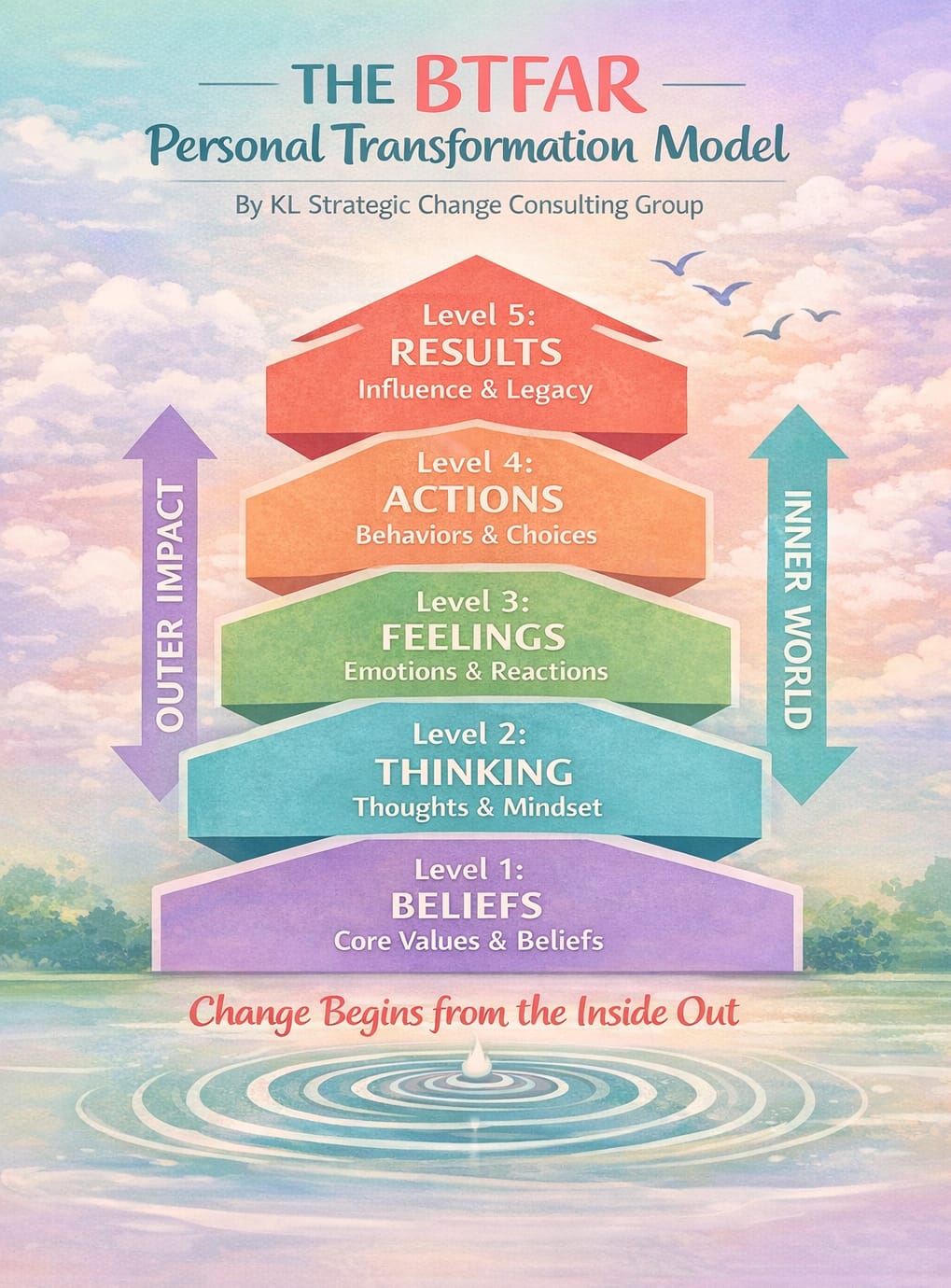
This is why our company developed the BTFAR Model — the 5 Levels of Personal and Leadership Transformation. It explains, in a practical and structured way, how leadership influence flows from the inside out:
Beliefs → Thinking → Feelings → Actions → Results
Leadership Is Not What You Say
Leadership is not what you say.
It is what consistently shows up through you.
I have worked with many leaders who communicate well, speak confidently, and articulate inspiring visions—yet struggle to build trust. Conversely, I have encountered leaders who speak sparingly, but whose presence creates calm, clarity, and confidence in others.
Why?
Because people do not experience leadership as a message.
They experience leadership as a pattern.
As Warren Buffett puts it, “The best leaders are those who lead by example.” Example, in this sense, is not performance—it is alignment.
Leadership Influence Is Always a Ripple Effect
Every leader carries influence—whether intentional or not. Influence does not begin with authority or position. It begins with the leader’s inner world and radiates outward.
When I ask leaders to reflect on someone who positively influenced them in their lives, their answers are rarely about eloquence or technical brilliance. Instead, they speak of consistency, calmness under pressure, integrity, courage, or empathy.
In other words, they describe who the person was, not just what the person did.
This reinforces a critical insight: leadership influence is not transmitted primarily through words. It is transmitted through inner alignment that becomes visible over time.
I observed this clearly while studying the leadership legacy of Tan Sri Teh Hong Piow. He was not known for flamboyant speeches or charismatic theatrics. Yet his discipline, prudence, and consistency shaped one of the strongest banking cultures in the region. His leadership influence endured precisely because it was lived, not declared.
Level 1: Beliefs — The Invisible Foundation of Leadership
At the deepest level of leadership lie beliefs. These are often unspoken, rarely examined, yet extraordinarily powerful.
What a leader believes about themselves determines how they show up under pressure.
What a leader believes about others determines how they delegate, trust, and empower.
What a leader believes about change determines whether they resist it—or lead it.
Beliefs operate silently, but they shape everything.
I once worked with a senior leadership team where control systems were excessive, approvals were slow, and innovation was stifled. The issue was not competence. It was belief. The underlying assumption was simple: “People cannot be trusted.” Until that belief was confronted, no amount of policy revision made a difference.
Conversely, leaders who believe in growth, learning, and human potential build environments where people dare to contribute. As Satya Nadella famously said when transforming Microsoft, “We needed to move from a know-it-all culture to a learn-it-all culture.” That shift began with belief—not structure.
Until beliefs are surfaced and examined, leadership change remains superficial.
Level 2: Thinking — The Daily Narratives Leaders Live By
Beliefs give rise to habitual thinking patterns. These patterns determine how leaders interpret events, especially under stress.
In high-pressure environments, leaders often default to automatic thinking—assumptions, worst-case scenarios, or defensive interpretations. Over time, these thought patterns become mental shortcuts that shape decisions.
I have seen leaders misinterpret silence as resistance, questions as defiance, and caution as incompetence—simply because their thinking went unexamined.
Strategic leadership requires more than analytical skill. It requires the discipline to notice one’s thinking—particularly when facing uncertainty, resistance, or failure. Leaders who do not examine their thinking often mistake their interpretations for facts.
In the AI era, where information is abundant and speed is rewarded, disciplined thinking becomes a competitive advantage. Leaders must slow down mentally even as organisations move faster operationally.
Level 3: Feelings — The Emotional Undercurrent of Leadership
Thoughts inevitably generate emotions. Yet many leadership cultures pretend emotions do not exist.
In reality, emotions are always present. They shape tone, body language, energy, and decision-making. Leaders may suppress emotions, but they cannot eliminate their influence.
Unaddressed frustration becomes impatience.
Unacknowledged fear becomes control.
Unresolved insecurity becomes defensiveness.
I have coached leaders who believed they were being “firm and professional,” unaware that their teams experienced them as tense and unpredictable. Over time, emotional misalignment erodes trust—not through dramatic conflict, but through quiet withdrawal.
Emotionally intelligent leadership is not about emotional display. It is about emotional awareness and regulation. Leaders who can recognise and manage their internal state lead with greater clarity, steadiness, and credibility.
As Daniel Goleman observed, “The leader’s mood is the single biggest driver of organisational climate.”
Level 4: Actions — Where Leadership Becomes Visible
Actions are where inner alignment—or misalignment—becomes observable.
Leadership actions are not limited to formal decisions. They include what leaders tolerate, what they ignore, how they respond under pressure, and how consistently they behave over time.
Teams watch actions far more closely than they listen to speeches. A leader’s credibility is built not through intention, but through repeated behaviour aligned with stated values.
Small actions matter. A delayed response. A dismissive comment. A failure to follow through. These signals accumulate and shape culture.
When actions are inconsistent with beliefs and values, trust erodes quietly—often long before performance indicators show decline.
Level 5: Results — Influence, Culture, and Legacy
Results are the natural outcome of the previous four levels. They include performance outcomes, engagement levels, culture, and long-term organisational health.
Leaders often focus here first—targets, metrics, outcomes—without recognising that results are lag indicators. They reflect what has already been happening internally.
Sustainable results emerge when leaders are aligned at the belief, thinking, feeling, and action levels. When alignment exists, influence becomes natural rather than forced.
This is where leadership becomes legacy—not just what the organisation achieves, but the kind of leaders it produces.
Why This Model Matters in the AI Era
As artificial intelligence automates tasks, analyses data, and accelerates decision-making, leadership differentiation shifts decisively to the human domain.
AI can process information.
It cannot examine beliefs.
AI can optimise systems.
It cannot build trust.
AI can recommend actions.
It cannot embody values.
The leaders who will thrive in the AI era are those who develop deep inner clarity and presence. They will be the ones who notice what data cannot capture: hesitation, disengagement, fear, motivation, and readiness for change.
BTFAR is not a soft model. It is a strategic leadership model for complex, fast-changing environments.
Leading from the Inside Out
Real leadership transformation does not begin by asking, “What should I do differently?”
It begins by asking, “What is driving how I show up right now?”
When leaders change at the belief level, thinking shifts naturally.
When thinking shifts, emotional responses stabilise.
When emotions stabilise, actions become more intentional.
And when actions align, results follow.
This is not theory. It is observable in every organisation that has sustained leadership excellence over time.
Leadership is not a position.
It is a pattern of inner alignment expressed outwardly.
And in an age of speed, automation, and constant distraction, leaders who understand this will not only lead more effectively—but sustain their level of performance.
Dr Victor S. L. Tan is the Chief Executive Officer of KL Strategic Change Consulting Group. He is the author of 21 books, including Changing Mindsets, Releasing Trapped Minds, Changing Your Corporate Culture, and Lessons of Tan Sri Teh Hong Piow. KL Strategic Change Consulting Group is the winner of The BrandLaureate Award for the company that makes the most positive and profitable impact on organisations through corporate training.
For a complimentary copy of the Leadership Effectiveness Survey form in the AI Era, email victorsltan@klscc.com or contact 012-390 3168.
Dr Victor SL Tan (victorsltan@klscc.com) is a content creator under the Newswav Creator programme, where you get to express yourself, be a citizen journalist, and at the same time monetize your content & reach millions of users on Newswav. Log in to creator.newswav.com and become a Newswav Creator now!
The User Content (as defined on Newswav Terms of Use) above including the views expressed and media (pictures, videos, citations etc) were submitted & posted by the author. Newswav is solely an aggregation platform that hosts the User Content. If you have any questions about the content, copyright or other issues of the work, please contact creator@newswav.com.