
In an era deeply fractured by global economic anxieties and fractured sociopolitical landscapes, nations often search for collective anchors to maintain internal solidarity. Recently, as global citizens navigated volatile market shifts and escalating geopolitical tensions, Malaysians found solace in an unexpected, fiercely domestic cultural triumph. It arrived not from the high-stakes halls of international diplomacy or macro-economic policy adjustments, but from a greasy, neon-lit griddle on the streets of Philadelphia.
When the iconic Malaysian Ramly burger was prominently featured in a special culinary anthology by The New York Times titled "The Burger is a Portrait of America," a collective wave of validation washed over the Malaysian digital landscape. For a nation that frequently engages in playful yet intense culinary border wars with its neighbors, the international acknowledgment felt less like a simple media mention and more like a profound cultural coronation.
The Anatomy of a Late-Night Heritage
To understand why a simple street-side staple caused such a stir when exported to the West, one must first dissect what the Ramly burger represents within its home ecosystem. For decades, the night air of Malaysian cities has been punctuated by the rhythmic, metallic clatter of spatulas hitting iron plates at neighborhood pasar malam (night market) stalls and roadside setups.
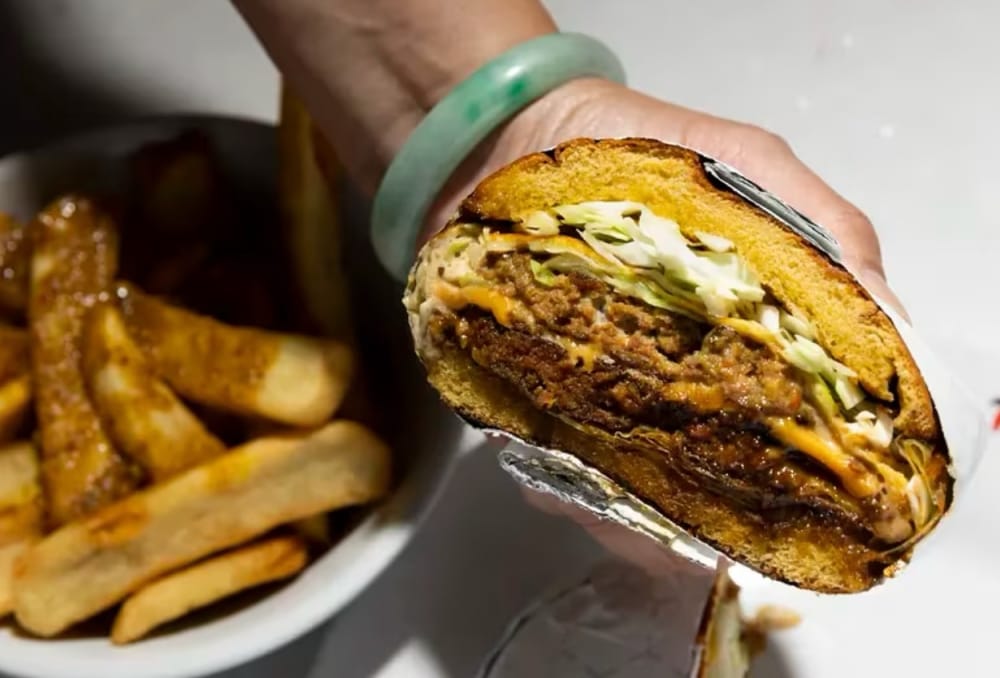
The classic preparation is a distinct sensory ritual: a frozen patty historically pioneered by Dato' Dr. Ramly bin Mokni in the late 1970s to offer affordable, strictly halal meat options to a rapidly urbanizing Muslim population is sliced down the middle, heavily seasoned with Worcestershire sauce, curry powder, and a signature blend of local spices. It is then meticulously wrapped inside a paper-thin omelette container, doused in a chaotic web of sweet chili sauce, mayonnaise, and processed cheese, and pressed inside margarine-toasted buns.
In its native habitat, the burger is exceptionally democratic. It costs only a few ringgits, bridges socio-economic divides, and serves as an equalizer where corporate executives in luxury sedans queue up right next to midnight shift workers.
When chef Angelina Branca introduced her meticulously reconstructed version of this street food icon at her highly acclaimed restaurant, Kampar, located in Philadelphia, Pennsylvania, she did more than just feed hungry Americans. She engineered a deliberate cross-cultural translation.
As reported extensively by Free Malaysia Today, Branca’s iteration adapts the format for an upscale American audience by using premium, house-made patties, custom spice blends, and artisanal sweet potato buns, while maintaining the non-negotiable architectural soul of the original egg wrap.
Decolonizing the Western Hamburger Architecture
From an analytical standpoint, the sudden American obsession with this specific format highlights a fascinating shift in global food migration and the deconstruction of Western culinary hegemony. The hamburger is arguably the ultimate symbol of American cultural imperialism, exported globally via massive multi-national fast-food conglomerates during the mid-to-late 20th century. However, when the concept was initially imported into Malaysia, local street vendors did not merely copy the Western design; they fundamentally subverted it.
The creation of the "Special" format encasing the entire protein matrix inside a thin layer of seasoned egg can be analyzed as a brilliant mechanical solution to retain moisture and hold highly fluid, unctuous sauces together. In doing so, Malaysian street culture effectively decolonized the fast-food staple, transforming a dry, rigid Western sandwich into a wet, heavily spiced, multi-textural experience optimized for the Southeast Asian palate.
When The New York Times selected Kampar’s Ramly interpretation as one of only eleven variations reflecting the modern, evolving landscape of contemporary American dining, it represented a beautiful, cyclical subversion. The modified food concept had traveled back across the ocean to conquer the very cultural fortress that originally birthed the generic model.
According to analytical commentary by the Malay Mail, when patrons questioned why a humble burger occupied a prominent spot on a menu dedicated to traditional Malaysian heritage cuisine alongside items like nasi lemak and rendang, Branca’s firm, unyielding response was simply: "This is Malaysian food." This structural assertion elevates the roadside burger from a mere westernized derivative to an irreplaceable pillar of authentic, living Malaysian heritage.
The Economics of Global Gastronomy
The transition from a roadside stall to a critically acclaimed establishment recognized by elite Western media also introduces a stark, fascinating economic paradox. In Malaysia, the Ramly burger is prized explicitly for its low cost and absolute accessibility. It is a working-class fuel designed to be cheap, fast, and delightfully messy.
Yet, across the Atlantic, the version served at Kampar commands a premium price tag of USD 19 (approximately RM 88), as documented by international lifestyle updates on Yahoo News.
This sharp price divergence exposes the complex institutional mechanics of global food systems. To survive and achieve mainstream validation in a competitive Western culinary market, diaspora restaurateurs must frequently navigate a fine line between maintaining absolute cultural authenticity and elevating their offerings to match the operational realities of Western dining institutions.
To achieve this balance, Branca intentionally partners with high-quality local suppliers, sourcing halal meats from Al-Baraka, specialized baked goods from Merzbacher’s Bakery, and fresh agricultural products from Smith Poultry, as highlighted by regional coverage on Vocket.
This localized supply chain validates an important analytical reality: the high price tag is not merely an arbitrary premium for exotic novelty. Instead, it reflects the true institutional cost of replicating a complex, beloved street food experience using premium, ethical, and locally harvested components within a foreign commercial ecosystem.
Cultural Diplomacy and the Diaspora Vanguard
Beyond the immediate sensory appeal of melted cheese and maggi seasoning, the success of the Ramly burger in international markets serves as an effective mechanism for grass-roots cultural diplomacy. Historically, institutional efforts by governments to promote national cuisines through formal, top-down marketing initiatives often struggle to capture the hearts of everyday global consumers. True, lasting cultural penetration is almost always driven from the bottom up by passionate diaspora communities operating as culinary vanguards.
Long before this recent mainstream recognition by legacy print outlets, independent student groups and young expatriates were already introducing these flavors to major Western urban centers. For instance, grassroots initiatives like The Malaysian Project spent years actively preparing street-style egg-wrapped burgers at highly competitive open-air night markets and public festivals across New York City.
Their consistent efforts eventually earned them prestigious nominations at the legendary Vendy Awards often affectionately dubbed the "Oscars of street food" as reported by The Star.
These community-led efforts prove that organic, unpolished street culture possesses a unique power to foster cross-cultural connections. An American diner standing on a street corner or sitting in an upscale Philadelphia eatery, completely mesmerized by the complex spectacle of an egg-wrapped patty, is experiencing a direct, unmediated piece of the Malaysian soul.
This specific form of cultural visibility is incredibly valuable for a country like Malaysia, which occasionally finds its distinct identity overshadowed on the global stage by larger regional neighbors. It asserts that our everyday urban culture is highly innovative, universally appealing, and fully capable of capturing the imagination of global food capitals.
What do you think? I’d love to hear your opinion in the comments section.
Ultimately, the global celebration of the Ramly burger invites us to re-examine how we value our own cultural artifacts. Too often, societies tend to look outward for validation, measuring the worth of their traditions only after they have been analyzed, repackaged, and approved by prestigious foreign institutions or elite international publications.
While seeing our beloved street food legacy praised in the pages of an iconic publication brings a deep sense of pride, the true value of the Ramly burger does not originate from New York or Philadelphia. It belongs to the tireless nighttime vendors who keep our streets vibrant, and the communities that gather around their glowing carts under the humid Malaysian sky.
Our food is a living, breathing archive of our collective resilience, our knack for creative adaptation, and our shared history. It reminds us that genius often thrives in the most unassuming places wrapped in a simple egg, tucked inside a paper bag, and served with a generous pour of extra sauce.

Share hidden facts about Malaysia and stand a chance to win prizes worth up to RM4,300! Find out how to join here. T&Cs apply.
AM World (tameer.work88@gmail.com) is a content creator under the Newswav Creator programme, where you get to express yourself, be a citizen journalist, and at the same time monetize your content & reach millions of users on Newswav. Log in to creator.newswav.com and become a Newswav Creator now!
The User Content (as defined on Newswav Terms of Use) above including the views expressed and media (pictures, videos, citations etc) were submitted & posted by the author. Newswav is solely an aggregation platform that hosts the User Content. If you have any questions about the content, copyright or other issues of the work, please contact creator@newswav.com.